Custom Night Guards for Teeth Grinding: Protect the Smile, Screen the Airway
I'm Dr. Nina Izhaky. A custom night guard is a fitted mouthpiece worn at night that absorbs the extra force of grinding (bruxism) so your teeth - and any veneers, crowns, or porcelain - don't have to take it. Here's the part most offices skip: when we see signs of grinding, we also screen your airway. Sometimes grinding is the body's way of keeping the airway open at night, and we want to know before we fit anything.
Why patients wear our night guards
Protection first - for your teeth, your dental work, and your sleep.
Built for grinding forces.
Heavy grinding puts extra force on teeth and porcelain. A custom guard fitted to your bite absorbs that force at night instead of your enamel - or your veneers and crowns - absorbing it.
Protects your cosmetic investment.
If you've invested in veneers or crowns, a nighttime guard protects that investment. We check your bite before recommending anything, because the right guard starts with the right diagnosis of your bite.
Stops wear in its tracks.
Grinding wears teeth down over time - flattening edges and shortening teeth. A fitted guard holds the line so the wear stops where we found it.
Custom-fitted, comfortable.
Off-the-shelf guards are bulky and often end up in a drawer. A custom guard is made to your bite, so it stays in, feels right, and you'll actually wear it every night.
Your night guard visit
Four steps from first exam to a guard you'll actually wear.
Bite and wear evaluation.
We examine your bite and look for the signs of grinding: worn edges, flattened teeth, stress on your porcelain. That tells us how much protection you need and what your guard should be made of.
Airway screen.
We ask about your sleep - snoring, waking tired, morning headaches. If grinding looks like it may be tied to a restricted airway, we'll recommend a proper sleep evaluation before or alongside your guard. Diagnosis first, always.
Custom fitting.
Your guard is made to your exact bite - not boiled-and-bent from a kit. We fit it in the office and adjust until it feels like it belongs in your mouth.
Follow-up checks.
We evaluate the fit of your guard at your visits, because your bite and your grinding can change. Bring it with you - it's part of your routine now.
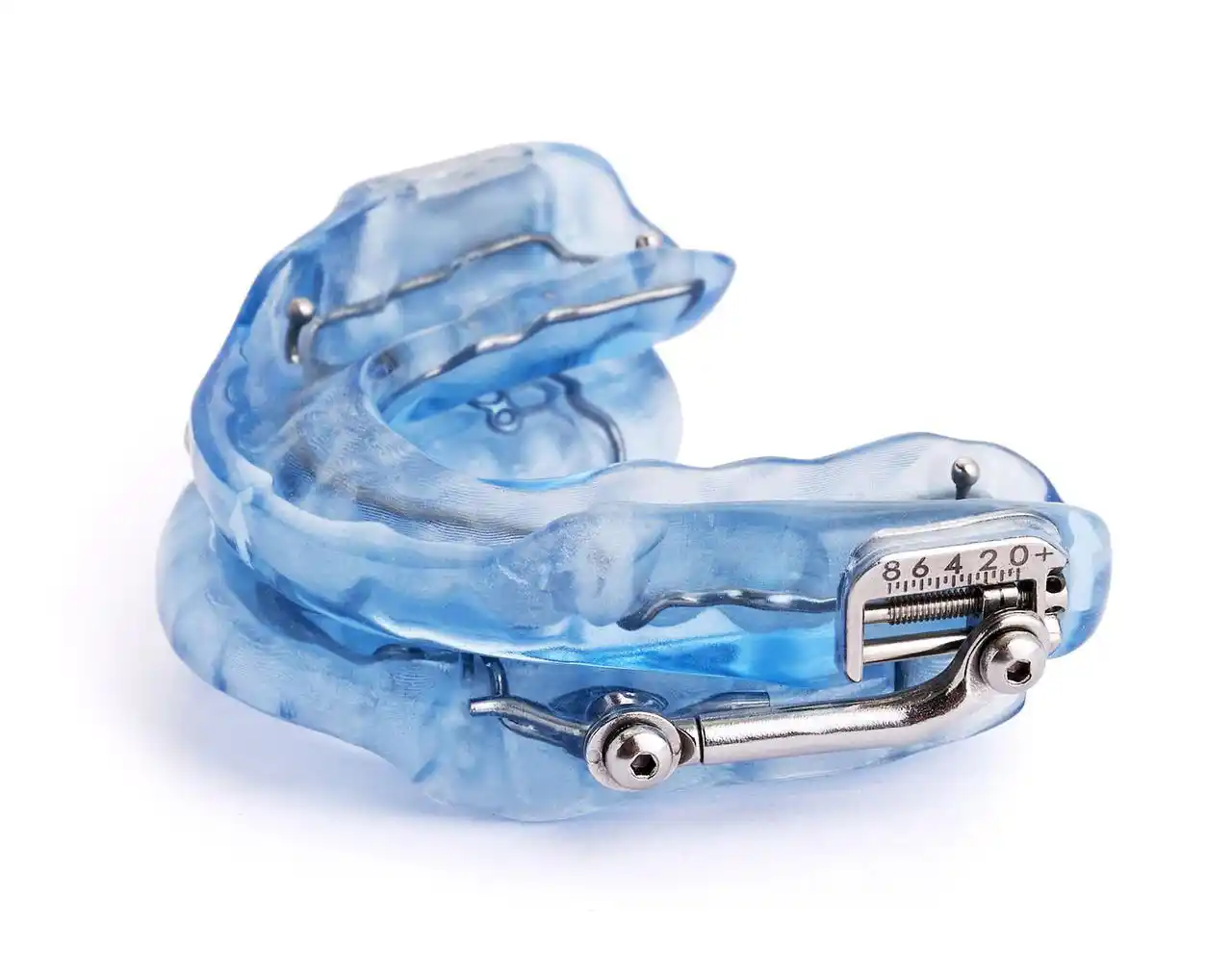
A night guard protects your teeth. An airway device protects your breathing.
These are two different tools, and we don't confuse them. A night guard is a protective guard - it absorbs grinding forces so your teeth and dental work don't take the damage. An oral appliance for sleep apnea is a treatment device - it gently shifts the lower jaw forward to keep the airway open during sleep. Our airway work starts the same way every time: a proper diagnosis to find out why you snore, whether you have sleep apnea, and what's causing it. Many causes of snoring and sleep apnea exist, but the effects are the same - decreased life expectancy and lower quality of life - which is why we take the screen seriously.
Hablamos español
We warmly welcome Spanish-speaking patients. Nuestro equipo le explica sus opciones de protectores nocturnos y evaluación de vías aéreas en su idioma - llámenos al (212) 561-5303. No facturamos directamente al seguro; le ayudamos con el financiamiento para que el plan se ajuste a su vida.
The Guard Is the Easy Part - the Screen Is the Important Part
Most people who grind their teeth don't know they do it. They find out when a dentist points at flattened edges, or when their partner complains about the sound at night. When I see that wear in my chair, I ask about sleep - because grinding is sometimes the body's way of keeping a restricted airway open while you sleep. That doesn't mean every grinder has sleep apnea. It means the question is worth asking.
Here's my rule: we never fit a guard and skip the screen. Snoring has many causes, and sleep apnea has serious effects - decreased life expectancy and lower quality of life. The only honest way to know what's going on is a proper diagnosis: a sleep study that tells us why you snore and whether apnea is present. Your first visit is about getting answers and a plan, not about selling you a piece of plastic.
And when a guard is what you need, we fit it to your exact bite - because the guard is only as good as its fit. A guard that doesn't fit ends up in the nightstand drawer, and your teeth keep taking the hit. We check your bite, protect your investment, and see you at your visits to keep it working. Simple, honest, done right.
Night guard questions, answered
01What is a custom night guard for teeth grinding?
A custom night guard is a fitted mouthpiece you wear at night that absorbs the extra force of grinding (bruxism), so your teeth - and any veneers, crowns, or porcelain - don't have to. It's made to your exact bite, which is what makes it comfortable enough to actually wear.
02How do I know if I grind my teeth at night?
Most people don't know they do it. We see the signs at your exam: worn or flattened edges, shortened teeth, stress on porcelain or fillings. If you're waking with a sore jaw or your partner hears grinding, tell us at your visit - we'll evaluate your bite.
03Why do you screen my airway if I just need a guard?
Because grinding is sometimes the body's way of keeping a restricted airway open during sleep. That's not always the case - but the question is worth asking. If we see red flags like snoring, waking tired, or morning headaches, we recommend a proper sleep evaluation before or alongside your guard. Diagnosis first.
04What's the difference between a night guard and a sleep apnea device?
A night guard is protective: it absorbs grinding forces so your teeth and dental work don't take the damage. An oral appliance for sleep apnea is a treatment device: it gently shifts the lower jaw forward to keep the airway open during sleep. They're different tools for different problems, and we don't confuse them.
05Will a night guard stop my snoring?
No - that's not what it's for. A night guard protects your teeth from grinding. Snoring needs a proper diagnosis: a sleep study that tells us why you snore and whether sleep apnea is present. If you snore, book the evaluation - we'll get you answers and a plan.
06I have veneers or crowns. Can I still wear a night guard?
Yes - and you should. Heavy grinding puts extra force on porcelain, so we check your bite and fit a nighttime guard to protect your investment. If grinding has already worn your teeth noticeably, veneers can even restore the lost length - and the guard keeps them safe.
07How long does a custom night guard last?
That depends on how heavily you grind and how well the guard fits over time. We evaluate the fit at your visits, so bring it with you - if it stops fitting right, we'll tell you before it becomes a problem.
08How do I care for my night guard?
Your care instructions come with your guard. The one rule that matters: bring it to your visits so we can evaluate the fit. A guard that stops fitting is a guard you stop wearing.
09How much does a custom night guard cost?
Exact cost is confirmed at your evaluation, because it depends on your bite and the material your case calls for. We don't bill insurance directly - we'll walk you through financing so the plan fits your life.
Night guards in the heart of Tribeca
Find us at 54 Warren Street, New York, NY 10007 - in the heart of Tribeca, serving patients across Tribeca, SoHo, Battery Park City, the Financial District, and Downtown Manhattan.
Protect your teeth - and check your sleep.
One evaluation: your bite, your grinding, and your airway. Call (212) 561-5303 or book online - 54 Warren St, Tribeca.
Your Visit from Tribeca
Getting here from Tribeca is a short walk, not a trip, and that is how most of our neighbors arrive. If you are coming by subway, the 1, 2, 3, A, C, and E trains stop at Chambers Street, about a five-minute walk up Warren to our door. The 4, 5, and 6 at Brooklyn Bridge–City Hall are ten minutes on foot through the civic center, and the J and Z also stop at Chambers Street for the east-side connection.
Citi Bike stations sit on Warren Street and Greenwich Street, and New Jersey commuters can take PATH to the World Trade Center Oculus.
When you arrive at 54 Warren Street, we keep the day simple and unhurried from the moment you check in. Our team works together under one roof, so your visit stays in one place instead of sending you across town for another appointment or another opinion. We talk through what brought you in, take any imaging we need here in the office, and explain what we are seeing in plain language before we discuss next steps together.
You will always know what we recommend, why we recommend it, and what can wait, so you leave with a clear plan rather than unanswered questions.
Life in Tribeca moves between the cast-iron lofts on Franklin Street, the towers along West Street, and afternoons with families at Washington Market Park, and we schedule with that rhythm in mind. We are open Monday through Friday from 8 AM to 6 PM, Saturday from 9 AM to 4 PM, and Sunday from 9 AM to 2 PM, and you can book online any time or call us at (212) 561-5303.
Street parking here is tight, with cobblestone blocks and film shoots, but attended garages on Warren Street and Greenwich Street sit within a block of our door. Follow-ups stay with our same team, so your care feels continuous.
Ongoing care is where being neighbors really pays off for our Tribeca patients. A six-month recall is just a short walk over, a quick check-in with the team who already knows your history, and a cleaning that fits between school drop-off and the rest of your day. When treatment takes more than one visit, we sequence it sensibly, review healing in person, and adjust the plan together rather than by phone tag.
Because we have cared for families here since 2007, we notice small changes early, keep your records continuous, and remind you when you are due — so staying on track never feels like starting over.
Preventive Dentistry in Depth: The System Behind the Checkup
Preventive dentistry is the discipline of the problems that never happen. Its premise is that nearly everything expensive and uncomfortable in dentistry — the root canal, the extraction, the implant — began as something small, detectable, and interruptible: a softening spot of enamel, a gum pocket quietly deepening, a grinding habit wearing a millimeter a year.
Prevention is the system that catches those beginnings: regular examination, professional cleaning, risk assessment, and the targeted interventions — fluoride, sealants, night guards, interval planning — matched to the risks your specific mouth actually carries.
Risk assessment is what separates prevention from routine. Two patients with identical-looking mouths can carry very different futures: one forms tartar quickly and fights gum inflammation; another has dry mouth from medication and a new cavity every year; a third grinds at night and is wearing through enamel at the chewing surfaces. Each needs a different plan — different recall intervals, different protective measures, different things watched.
At your visits we build that profile from your history and findings, and your preventive plan is written against it, not against a population average.
Fluoride and sealants are the targeted tools of the system. Fluoride helps enamel remineralize and resists acid attack, and it is dosed to risk — professional applications and prescription-strength home options for high-risk patients, standard toothpaste for low-risk ones. Sealants protect the deep grooves of molars where brushes cannot reach and decay most often begins, for children whose molars are newly erupted and for adults whose groove anatomy and history justify them.
Neither is applied by reflex; both are recommended where your anatomy and risk say they will change outcomes.
The mouth is not separate from the rest of health, and prevention planning respects that. Gum inflammation and diabetes influence each other in both directions. Dry mouth, one of the most common medication side effects, removes saliva's protection and accelerates decay dramatically. Tobacco reshapes the risk of gum disease and soft-tissue changes entirely.
Your plan accounts for these connections — and where a finding belongs to medicine rather than dentistry, we tell you plainly and help you route it, because pretending the boundary does not exist helps no one.
What prevention asks of you is a rhythm rather than an effort: keep the interval we set for your risk, brush twice daily with fluoride toothpaste, clean between the teeth daily, and report changes early — bleeding, sensitivity, a rough spot your tongue keeps finding. In return, the arithmetic is lopsided in your favor: prevention is the least expensive, least invasive, and least time-consuming dentistry that exists, and its entire product is the procedures you never need.
If you are restarting after years away, a preventive plan is also the right first step: assessment first, stabilization of anything active, then a maintenance rhythm built for your mouth.
Do adults really need fluoride treatments?
Fluoride strengthens enamel by helping it remineralize — replacing the minerals acids strip away — and it makes the enamel surface more resistant to the next acid attack. It is recommended based on your risk, not by routine: patients with recent cavities, dry mouth, receding gums that expose root surfaces, braces, or a diet high in acids and sugars benefit most. For a low-risk adult with no recent decay, the recommendation may be fluoride toothpaste alone.
At your visit we assess your actual risk pattern and recommend fluoride in the form and frequency your mouth calls for — and we will say so when the answer is that you do not need more than you already get.
Are sealants just for kids?
Dental sealants are thin protective coatings flowed into the deep grooves of back teeth, where toothbrush bristles cannot reach and cavities most often start. They are best known as a children's treatment, and they are highly effective there — but molars keep their grooves for life, and an adult with deep, stain-collecting fissures and a history of decay in those teeth can be a genuine candidate too.
The assessment is individual: groove anatomy, decay history, and how well the teeth can be kept dry during placement. We recommend sealants where the anatomy and the risk justify them, for children and adults alike, rather than by age bracket.
How do my other health conditions affect my dental prevention plan?
They are a risk factor, and we treat them as part of your dental picture rather than someone else's problem — but carefully, without pretending to be your physician. Dry mouth from medications is one of the fastest routes to new decay, because saliva is the mouth's own defense; diabetes and gum disease influence each other in both directions; and tobacco changes the risk profile of your gums and soft tissues entirely.
Prevention planning takes these into account — shorter intervals, fluoride strategy, saliva support — and where a finding belongs to medicine, we say so and coordinate rather than comment from the sidelines.
How Care Is Planned at Our Tribeca Studio
Every treatment plan at Tribeca Dental Studio begins with a diagnosis, not a recommendation made in the abstract. We examine the tooth or area in question, review imaging taken here in the office — including 3D CBCT scans when the case calls for them — and talk through what we see in plain language before any treatment is proposed. You will always know what we recommend, why we recommend it, and what could safely wait.
When several options would serve you well, we lay them side by side: what each involves, how many visits it takes, how long it is expected to last, and what it asks of the neighboring teeth and bone.
That conversation becomes a written plan. The sequence, the timing, and the reasoning are set down before treatment begins, so there are no surprises mid-course and no step is improvised. Staged treatment is grouped into planned steps when we can, and each stage is checked before the next one starts.
If a simpler option would serve you just as well, that is the option we will put in front of you — and if the honest answer is that a tooth or a treatment can be watched rather than treated today, we will say that instead.
Because every specialty sits under one roof at 54 Warren St, a plan that touches several disciplines is designed as a whole. Implant surgery, periodontics, endodontics, orthodontics, cosmetic work, airway care, and pediatric dentistry are handled by one team in one place, which means the implant plan accounts for the gum plan, the orthodontic plan accounts for the airway, and nothing is lost between offices across town.
Your records, your imaging, and your history stay with the same team from the first visit through every follow-up.
Technology We Use — and Why It Matters
Good planning depends on seeing clearly. Our studio works with 3D CBCT imaging, which shows bone volume, nerve positions, sinus anatomy, and root form in three dimensions rather than the flat shadow of a standard X-ray. Implant positions, grafting decisions, root canal anatomy, and expansion planning are all worked out on that imaging before treatment begins, so the day of the procedure holds as few unknowns as possible.
Digital planning carries the same approach into orthodontics and cosmetic work: tooth movement and smile design are mapped in advance, and you can see the intended direction before committing to it.
Laser technology is part of everyday care here, from gum therapy to the NightLase protocol we use for snoring. Lasers let us treat soft tissue with precision and, in many cases, with a quieter recovery than traditional surgery. For sleep concerns, we use at-home sleep testing rather than assumptions: your breathing is measured in your own bed, and the results — not a guess — decide whether an oral appliance, NightLase, or a referral is the right path.
Technology earns its place in the plan only when it changes a decision or improves an outcome; that is the standard each tool here is held to.
Costs, Insurance, and Written Estimates
Before treatment begins, you receive the plan in writing — including what each stage involves and what it costs — so you can decide with the full picture in front of you. There is no obligation attached to a consultation, and a second opinion is a reasonable thing to want; we would rather you choose with clear information than feel rushed into a chair.
If you have dental insurance, our team verifies your coverage and explains what it does and does not apply to before we start, and if you do not, the written plan still lets you stage treatment sensibly over time.
Dental treatment is often easier to approach in planned stages than all at once. A written plan lets you sequence what is urgent, what protects the teeth around it, and what is elective, so each visit moves the whole plan forward. If something changes along the way — a tooth responds better or worse than expected — the plan is revisited with you, in writing, before the next step. That discipline is what keeps a long course of treatment from becoming a series of surprises.
Comfort, Recovery, and Follow-Up
Most dental anxiety comes from the unknown, so we work to remove it: what will happen, how long it takes, what it will feel like, and what recovery looks like are all covered before we begin. During treatment we check in rather than push through, and after it we tell you plainly what is normal, what is not, and when to call.
Written aftercare instructions go home with you, and the precautions in them — protecting a healing site, eating soft foods for a few days, keeping the area clean — are the difference between an uneventful recovery and a complicated one.
Follow-up is part of the treatment, not an extra. We schedule reviews around your life, use return visits to check healing and the details we flagged together, and keep recall reminders running so maintenance does not drift. If something feels off between visits, we would rather see you quickly than have you wait and wonder.
Call us at (212) 561-5303 or book online at any time — the studio is open Monday to Friday from 8:00 AM to 6:00 PM, Saturday from 9:00 AM to 4:00 PM, and Sunday from 9:00 AM to 2:00 PM.
Before You Book
A final word on how to use pages like this one. Treatment pages describe what is possible; a consultation decides what is appropriate — for your anatomy, your history, your goals, and your budget, in that order of conversation. If anything here has raised a question we have not answered, bring it with you: patients who arrive with marked-up pages and specific questions get the most from their first visit, and the plan we write together is better for it.
Tribeca Dental Studio is at 54 Warren St in Tribeca, and new patients are welcome at any of the services described on this site. Book online at any time or call (212) 561-5303. The first step is an examination and an honest conversation; everything else in dentistry follows from those two things done properly.
The Next Step Is a Conversation
Wherever this page found you — a search at midnight, a partner's forwarded link, a dentist's suggestion — the next step is smaller than the worry usually makes it feel. A consultation at the studio is an examination and a conversation, not a commitment: findings first, options with their honest trade-offs, a written plan with costs, and time to decide at home.
Patients tell us the plan is what they actually came for, whether they proceed here, proceed elsewhere, or proceed nowhere for now. That is the offer, and it stands on every page of this site: 54 Warren St, bookable online at any hour, or at (212) 561-5303 — Monday to Friday 8:00 AM to 6:00 PM, Saturday 9:00 AM to 4:00 PM, Sunday 9:00 AM to 2:00 PM.
The Consultation Is Not a Funnel
A last word that applies to every page in this series, whichever treatment brought you here: the consultation is not a funnel. Patients arrive at these pages mid-worry — about a tooth, a jaw, a night's sleep, a smile in photographs — and the studio's answer has been the same since 2007. An examination. Imaging where imaging decides. A written plan with the options and their costs, including the option of doing less, or nothing yet.
Then time to think, at home, without a follow-up call designed to hurry you. If that is the experience you were hoping dentistry could be, the door is at 54 Warren St, and it opens online at any hour or at (212) 561-5303.
How We Plan Your Care at Tribeca Dental Studio
Every treatment at Tribeca Dental Studio starts with a diagnosis, not a sales pitch. Before we recommend anything, we examine the tooth or area in question, review imaging taken here in the office, and talk through what we see in plain language. You will always know what we recommend, why we recommend it, and what could safely wait.
That recommendation becomes a written plan, so the sequence, the timing, and the reasoning are clear before any treatment begins — and if a simpler option would serve you just as well, that is the option we will put in front of you.
Our studio brings every dental specialty under one roof at 54 Warren St in Tribeca, and it has since 2007. General dentistry, cosmetic care, implant surgery, periodontics, endodontics, orthodontics, airway care, and pediatric dentistry are handled by one team in one place, which means a treatment that touches several specialties is planned as a whole rather than handed off between offices across town.
Your records, your imaging, and your history stay with the same team from the first visit through every follow-up, so nothing is lost between providers and no step is planned in isolation.
We are open Monday to Friday from 8:00 AM to 6:00 PM, Saturday from 9:00 AM to 4:00 PM, and Sunday from 9:00 AM to 2:00 PM. You can book online at any time or call us at (212) 561-5303.
The studio sits between Greenwich Street and West Broadway, steps from the Chambers Street subway hub (1, 2, 3, A, C, E), with attended garages on Warren Street and Greenwich Street within a block of our door for patients who drive in.
Care does not end when the procedure does. We schedule reviews and follow-ups around your life, group staged treatment into planned steps when we can, and use each return visit to check healing and watch the details we flagged together. Between appointments we stay in touch with recall reminders and clear next steps, and if something feels off, we would rather see you quickly than have you wait and wonder.
The goal is a plan you understand, a team you recognize, and results that are checked over time rather than assumed.