Home Sleep Apnea Test: Find Out Why You Snore
I'm Dr. Nina Izhaky. Here's what I tell every patient who comes in about snoring: there are many different reasons people snore, and many different things that cause sleep apnea - but the effects are the same: decreased life expectancy and lower quality of life. You can't fix what you haven't measured. That's why every airway treatment at our office starts with a proper diagnosis - and for most patients, that diagnosis starts with a home sleep apnea test: an FDA-approved portable device that tracks your oxygen, breathing, and heart rate while you sleep in your own bed.
Signs you should get tested
If you or your bed partner notice any of these, a sleep test can be life-changing.
Loud, ongoing snoring.
Especially with choking or gasping episodes at night. Snoring means something is obstructing your airflow - the only way to know how much is a test.
Daytime exhaustion and brain fog.
Persistent fatigue, difficulty concentrating, low energy levels. If mornings feel like you never slept, your nights are telling a story.
Morning headaches and dry mouth.
Waking with headaches, a dry mouth, or frequent trips to the bathroom at night - all classic signals of sleep-disordered breathing.
High blood pressure or heart strain.
Co-existing high blood pressure, heart strain, or type 2 diabetes make testing even more important - untreated apnea puts real stress on the cardiovascular system.
How the home test works
Three steps from consultation to answers - most of it happens in your own bedroom.
Consultation & device setup.
It starts with an in-depth clinical assessment at our Tribeca office - your symptoms, your history, what your partner has noticed. Then you pick up the portable device with simple night-setup guidance.
Overnight data collection.
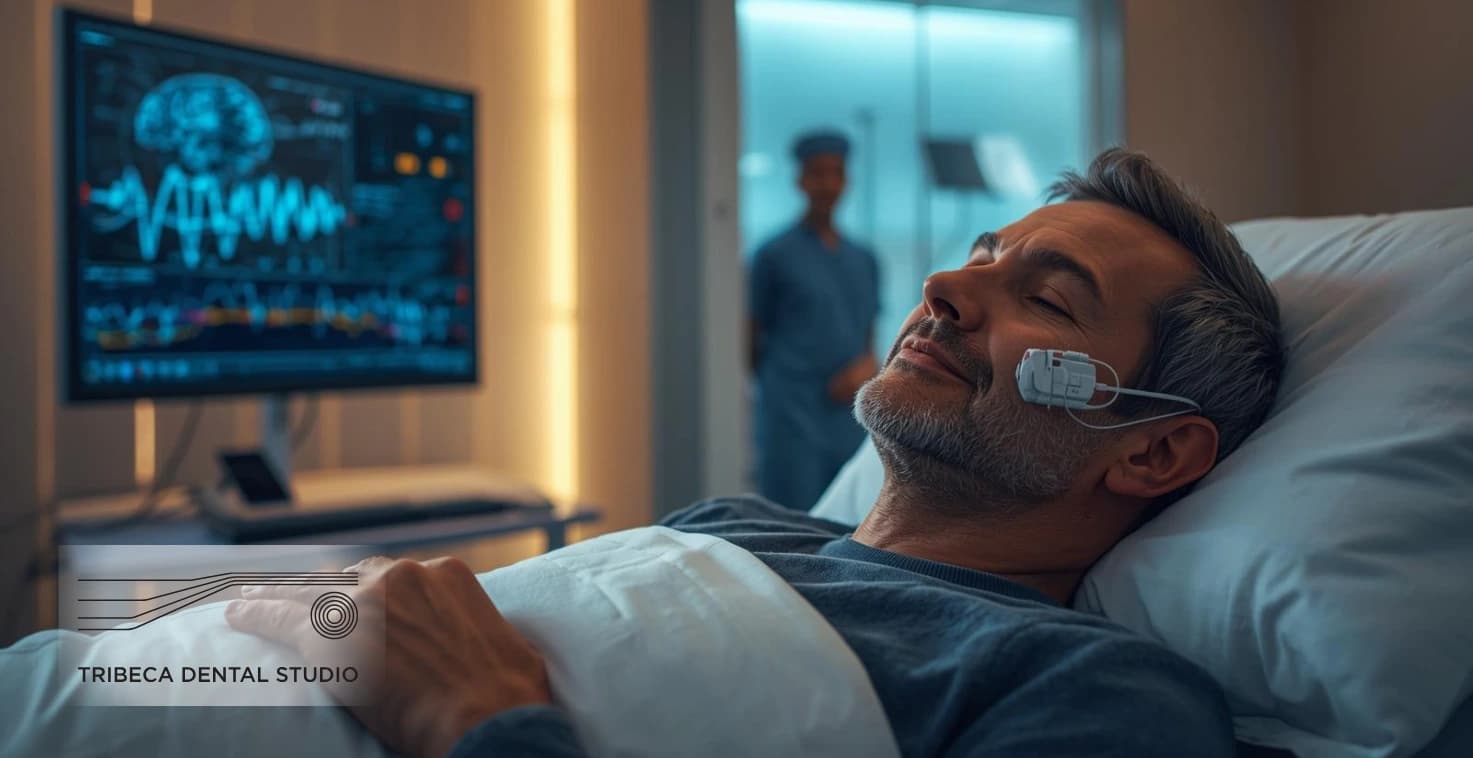
Sleep naturally while the device records your blood oxygen, breathing pauses, and snoring intensity. It's designed for minimal disruption: a small finger sensor, a chest band, and a soft nasal cannula. Silent, unobtrusive - most patients sleep normally.
Specialist analysis.
Sleep specialists review your data. Home studies are typically processed within a few days - then we contact you to schedule a consultation.
Your results, explained.
We explain every number in plain language - how many times per hour your breathing pauses, how far your oxygen drops - and what it means for your treatment. We never leave you deciphering a report alone.
Home test or in-lab - how we decide together
Most patients start with the home test, and for good reason: you sleep in your own bed, with your own pillow, following your normal routine. The data reflects how you actually sleep night after night. For suspected obstructive sleep apnea - the most common diagnosis we evaluate - it's usually all we need. The in-lab study comes into play when the case is more complex: if you already use CPAP and need precise titration, if we suspect other sleep disorders beyond apnea, or if a home test came back inconclusive. In a private, quiet clinical suite, we measure brain waves, eye movements, and muscle activity alongside breathing. The decision isn't yours alone or ours alone - we make it together at your initial consultation.
Hablamos español
We warmly welcome Spanish-speaking patients. Nuestro equipo le explica su estudio del sueño en su idioma - llámenos al (212) 561-5303. No facturamos directamente al seguro; le ayudamos con el financiamiento para que el plan se ajuste a su vida.
Snoring Is Never Just Noise
When a patient tells me they snore a little, I always ask the same follow-up: how do you feel in the morning? Because snoring rarely travels alone. Daytime fatigue, morning headaches, difficulty concentrating, blood pressure that won't come down - all can signal that the airway is partially or fully closing during the night. And there are many different causes of snoring and sleep apnea, but the effects are the same: decreased life expectancy and lower quality of life.
A sleep study is the first step toward real answers, and it doesn't require an uncomfortable night in a strange lab anymore. The FDA-approved home test monitors your breathing, oxygen levels, and heart rate while you sleep in your own bed. The data tells us not just whether you have apnea, but how severe it is and what's causing the airway collapse - essential information before recommending any treatment.
At Tribeca Dental Studio, the sleep study is just the start of the conversation. Once we know why you snore and whether you have sleep apnea, we determine whether and how we can improve or eliminate the problem - a custom oral appliance, NightLase laser therapy, or palatal expansion. The first visit is about diagnosis: finding the cause of your symptoms and creating a plan, not selling a treatment. And yes - children can have a sleep study too. Restless sleep, mouth breathing, or trouble focusing at school can signal sleep-disordered breathing in kids, and we adapt the testing approach to their age.
Sleep test questions, answered
01How accurate is a home sleep apnea test?
For the vast majority of patients with suspected obstructive sleep apnea, FDA-approved home sleep devices offer high diagnostic precision in the privacy of your own bed.
02What does the home test measure?
The portable device tracks oxygen saturation, respiratory effort, and heart rate overnight - recording breathing pauses, oxygen drops, and snoring intensity while you sleep naturally.
03Is the home test uncomfortable?
It's designed for minimal disruption: a small finger sensor, a chest band, and a soft nasal cannula. It's silent and unobtrusive - most patients sleep normally through the night.
04Will the home test disturb my partner's sleep?
No. The device makes no sounds and emits no light, so your partner will sleep just as peacefully as always.
05How long until I get my results?
Home studies are typically processed within a few days. Once we review your data, we contact you to schedule a consultation where we explain the findings and discuss your treatment options.
06What happens if I'm diagnosed with sleep apnea?
If diagnosed with mild-to-moderate sleep apnea, we offer custom oral appliances as a comfortable alternative to CPAP, often paired with NightLase therapy or palatal expansion - depending on your diagnosis.
07What if I snore but don't have apnea?
Primary snoring without apnea still deserves attention - it affects your rest and your partner's. Based on results, we may recommend an oral appliance, NightLase therapy, or an airway evaluation to find the cause.
08When would I need an in-lab sleep study instead?
If you already use CPAP and need precise titration, if we suspect sleep disorders beyond apnea, or if a home test came back inconclusive. We make the decision together at your initial consultation.
09Can children have a sleep study too?
Yes. Restless sleep, mouth breathing, snoring in children, or trouble focusing at school can signal sleep-disordered breathing. We evaluate children as part of our whole-airway health philosophy and adapt the testing approach to their age.
010How should I prepare for my sleep test?
Avoid caffeine and alcohol on the day of your test and stick to your regular sleep schedule. If you're doing an in-lab study, make sure your hair is clean and free of gels or oils.
Sleep testing in the heart of Tribeca
Find us at 54 Warren Street, New York, NY 10007 - in the heart of Tribeca, serving patients across Tribeca, SoHo, Battery Park City, the Financial District, and Downtown Manhattan.
Stop guessing. Get answers.
One sleep test, a real diagnosis, and a plan. Call (212) 561-5303 or book online - 54 Warren St, Tribeca.