Silent, Mask-Free & Unobtrusive
No motor noise, dry air, or awkward headstraps. Sleep naturally in any position.
Say goodbye to bulky, noisy CPAP masks. Our custom-molded oral appliance therapy offers a comfortable, quiet, and travel-friendly solution for snoring and mild-to-moderate Obstructive Sleep Apnea (OSA).
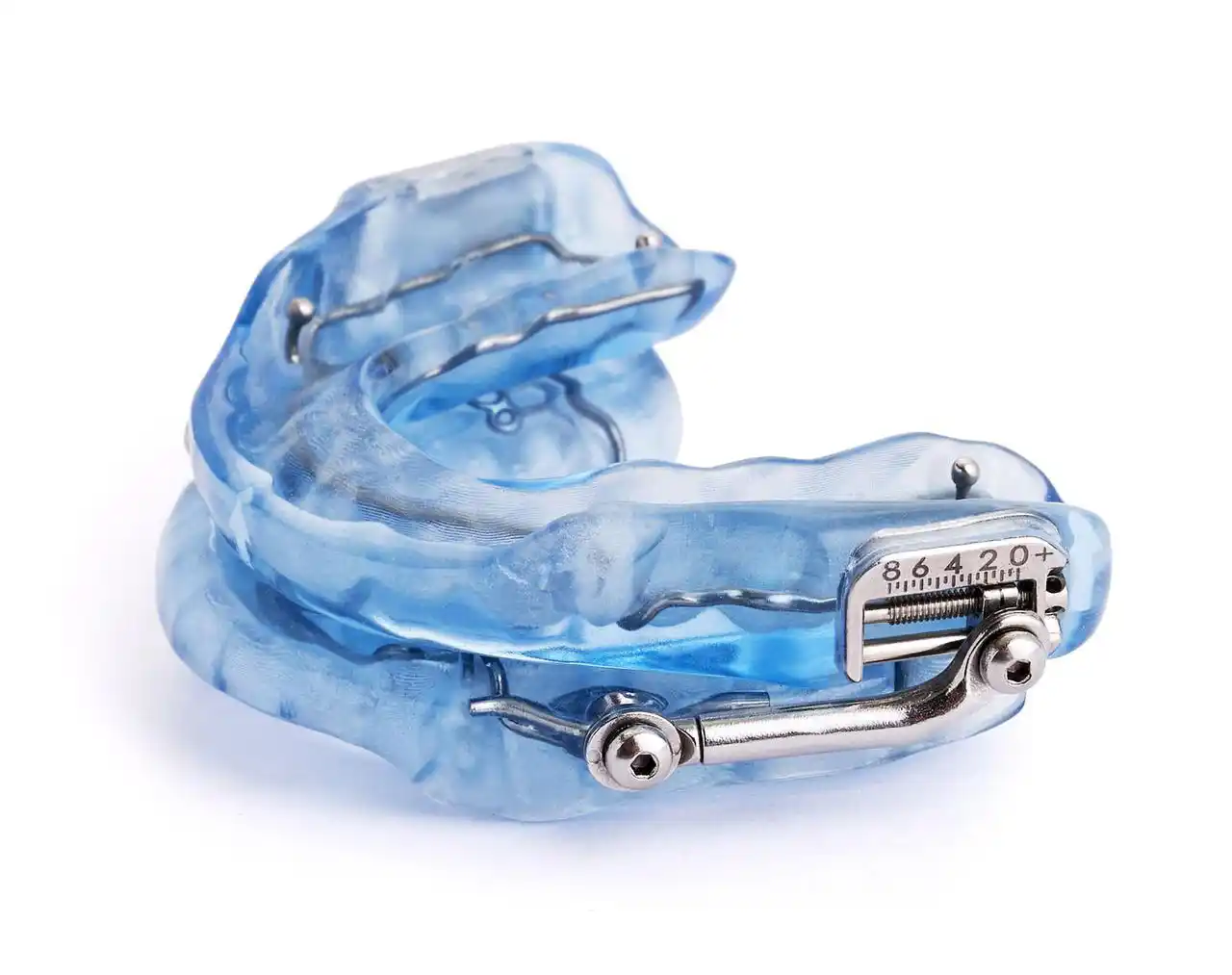
Oral Appliance Therapy (OAT)
Precision-molded to keep your airway open and silent all night long.
Can't tolerate CPAP? You're not out of options. A custom oral device is a mouthpiece worn at night that gently holds your lower jaw forward, keeping your airway open. No mask, no noise, no machine — it fits in a travel case. The American Academy of Sleep Medicine recognizes it as a first-line treatment for snoring and mild-to-moderate sleep apnea.
Snoring has many causes — but the effects are the same: decreased life expectancy and lower quality of life. A sleep apnea dentist doesn't start by treating; a sleep apnea dentist starts by diagnosing.
Your first visit is about answers, not appliances: why you snore, whether you have sleep apnea, what's causing it, and what your symptoms are. Only then do we build a plan — which might be an oral appliance, NightLase laser therapy, or a combination.
Diagnosis at Tribeca Dental Studio is at-home and straightforward: we don't do in-lab sleep studies. We use an at-home FDA-approved portable sleep test (HSAT) or a medical-grade at-home sleep test ordered through an accredited sleep lab, and a sleep specialist interprets the results.
Recognized by the American Academy of Sleep Medicine (AASM) as a highly effective first-line treatment for snoring and mild-to-moderate sleep apnea:
No motor noise, dry air, or awkward headstraps. Sleep naturally in any position.
Fits discreetly into a protective travel case. No outlets or distilled water needed.
Gently shifts the lower jaw forward to prevent airway collapse and soft tissue obstruction.
Patients wear it consistently night after night, leading to better real-world health outcomes.
We integrate radiation-free 3D digital impressions and advanced airway diagnostics for precise fitting:
Full digital impression using iTero® wands and CBCT airway volume mapping.
Crafted from durable medical-grade materials tailored to your unique bite.
Incremental advancement adjustments to achieve maximal airway opening with zero TMJ stress.
| Custom Oral Device | CPAP Machine | |
|---|---|---|
| Comfort | Silent, no mask — sleep in any position | Bulky mask, motor noise, headstraps |
| Travel | Fits in a small case; no outlets or water needed | Needs power outlets and distilled water |
| How it works | Gently shifts the lower jaw forward | Pressurized air delivered through a mask |
CPAP works — when it's used. But the statistics are stubborn: a large share of patients stop using their machine within the first year. The uncomfortable mask, the noise, the dryness, the claustrophobic feeling, the hassle of traveling with the equipment. At our Tribeca office, we hear these stories every week — from professionals who sleep in hotel rooms for work, from couples where one partner ends up on the couch.
A custom oral appliance addresses the same problem from a completely different angle. Instead of forcing pressurized air through the airway, it gently repositions the lower jaw forward during sleep, keeping the tongue and soft tissues away from the back of the throat. No mask, no hoses, no noise. It fits in a retainer-sized case and sails through airport security without a second thought.
It's important to be honest about the limits: oral appliances are best suited for mild to moderate obstructive sleep apnea and primary snoring. Severe cases usually need CPAP or a combined approach. That's why every treatment at Tribeca Dental Studio starts with a proper diagnosis — we want to know why you snore, whether you have sleep apnea, and what's causing it before recommending any device. The first visit is about getting answers and a plan, not selling a treatment.
Not all snoring needs a nighttime device — some of it needs the throat tissue to regain its firmness. NightLase® is a non-surgical laser therapy that gently warms the soft tissues at the back of the throat, stimulating collagen production so they tighten naturally. No cutting, no anesthesia, no downtime: you walk in and out of our Tribeca office and get on with your day.
It works best for primary snoring and mild cases, and it can be combined with an oral device when the diagnosis calls for it. That's why we never start with treatment — we start with diagnosis. A sleep study tells us why you snore and whether apnea is present, and with that information we decide whether NightLase, an oral device, or a combination is the right path for you.
Many of our patients arrive skeptical — they've tried nasal strips, sprays, and special pillows with no result. The difference with NightLase is that it addresses the cause: the slack tissue that vibrates and collapses during sleep. As collagen regenerates in the following weeks, snoring typically quiets noticeably, and your partner is usually the first to notice.
We can all benefit from it because as we age, the tissue slackens and becomes droopy. So even if you don't need it when you're young and have no symptoms, as you get older you'll need it to tighten up those back-of-the-throat muscles. And who needs it least? Opera singers — singers in general. They exercise those tissues and keep them tight even with age.
Dr. Nina Izhaky says:
Tribeca Dental Studio
Worn at night, the device holds the lower jaw slightly forward, preventing the tongue and soft tissues from blocking the airway. It's custom-fitted to your bite for maximum comfort and effectiveness.
Most patients adjust within one to two weeks. Because it's custom-made for your teeth, it feels similar to a retainer or sports mouthguard — far less intrusive than a CPAP mask.
Yes. A proper diagnosis is essential — we need to confirm whether you have obstructive sleep apnea and how severe it is before recommending an oral appliance. We can guide you through sleep study options.
For most patients with primary snoring or mild to moderate apnea, the device significantly reduces or eliminates snoring from the first nights of use.
With proper care and periodic check-ups at our office, a custom oral appliance typically lasts several years. We evaluate its fit at every visit to ensure it keeps working perfectly.
Absolutely — it's one of the biggest advantages over CPAP. It fits in a small case, needs no electricity, and requires no special handling at airport security.
NightLase® is a non-surgical laser therapy that gently tightens the tissues at the back of the throat to reduce snoring. Most patients describe only a mild warming sensation during the session — no anesthesia, no cutting, and no downtime.
It depends on your diagnosis. NightLase works best for primary snoring and mild cases, and it can be combined with an oral device. Moderate to severe apnea usually needs an oral device or CPAP. That's why every plan starts with a proper sleep study.
With proper fitting and follow-up, bite changes are minimal and monitored at every visit. We titrate the jaw advancement gradually to achieve maximum airway opening with the least possible joint strain.
Diagnosis first. We find out why you snore, whether you have sleep apnea, what's causing it, and what your symptoms are — then we build a plan. Oral appliance, NightLase laser therapy, or a combination: the diagnosis decides.
We don't do in-lab sleep studies. Diagnosis is at-home: an FDA-approved portable sleep test (HSAT) or a medical-grade at-home sleep test ordered through an accredited sleep lab, interpreted by a sleep specialist.
Schedule your comprehensive airway consultation to explore custom oral appliance therapy.
Book Online NowAn oral appliance for sleep apnea is a custom device, worn during sleep, that holds the lower jaw in a slightly forward position. That small mechanical change keeps the tongue from falling back and narrows the collapse of the airway that produces apneas — the repeated pauses in breathing that fragment sleep and strain the heart.
It is not a sports mouthguard and it is not one-size: it is fabricated from your dental records, fitted to your teeth and jaw, and adjusted in increments, because the right position is the one that opens your airway while remaining a position your jaw can live in nightly for years.
Diagnosis precedes the device, always. Sleep apnea is a medical condition, and its severity decides what treatment is appropriate — an appliance is an established therapy for mild to moderate obstructive sleep apnea and for patients who cannot tolerate CPAP, but severe cases may need CPAP or combination care, and no responsible practice fits a device on snoring alone.
Our process therefore starts with at-home sleep testing arranged through the studio, so your plan is built on your actual numbers. If those numbers say an appliance is not enough for you, you will hear that from us, plainly, before any device is made.
Here is what the at-home test actually involves. You sleep in your own bed — there is no lab and no overnight stay — wearing a small finger sensor, a chest band, and a soft nasal cannula that record your breathing pauses, oxygen drops, and snoring intensity across the night. Sleep specialists interpret the results, and the numbers turn a complaint about snoring into a diagnosis with a grade: whether you have apnea, how severe it is, and what is causing the airway to collapse.
That first study also becomes the yardstick for everything after it. If an appliance is fitted, your follow-up test is read against this baseline, number against number, so improvement is demonstrated rather than asserted. Diagnosis first is not a slogan here; it is a measurement taken where the problem actually happens, in your own bed.
Fitting is a titration, not a delivery. The appliance arrives set to a starting position derived from your evaluation, and over the following weeks its advancement is adjusted in small steps — far enough to treat the airway, no farther than your jaw comfort allows — with your symptoms and your bed partner's report guiding the pace. Follow-up sleep testing then verifies the result objectively.
That verification loop is the conscience of the treatment: an appliance that quiets snoring but leaves apnea untreated has failed at its real job, and only a re-test can tell the difference.
Living with the device is designed to be easy. It travels in a case the size of a soap dish — the reason many of our patients who fly for work succeed with an appliance where a CPAP stayed home — and it asks for a morning routine we teach you: exercises and a repositioning routine that return your bite to its normal meeting after a night of forward posture, plus simple cleaning to keep the device fresh.
Your teeth and bite are monitored at reviews, because a device that holds your jaw nightly earns the same surveillance as any other long-term appliance. If you snore, wake unrefreshed, or have a CPAP gathering dust, an evaluation built on a real sleep test will tell you whether this quieter route can genuinely treat your apnea.
They work by different mechanisms and suit different patients. A CPAP holds the airway open with pressurized air delivered through a mask — highly effective when it is used all night, every night, and a genuine struggle for patients who cannot tolerate the mask, travel constantly, or abandon it by 3 AM.
An oral appliance holds the lower jaw slightly forward during sleep, keeping the tongue and airway open mechanically; for mild to moderate apnea — and for many patients who have failed CPAP — it is the treatment that actually gets used, which is its own kind of effectiveness. Your sleep test results and diagnosis determine which are medically appropriate for you, and we will not steer you to an appliance your numbers say you should not rely on.
By measurement, not by impression. Snoring is a symptom, not the disease — an appliance can quiet snoring while apnea continues, which is why this studio does not treat sleep breathing on symptoms alone. Your plan begins with at-home sleep testing to establish your diagnosis and severity, and after the appliance is fitted and adjusted, follow-up testing verifies that your numbers have actually improved.
If they have not improved enough, the plan changes — adjustment, combination therapy, or referral — because the goal is treated apnea, verified, not quieter apnea, assumed.
Usually through the same team that treats it. Jaw soreness, bite changes, dry mouth, and excessive salivation are the common ones, and most are managed by adjusting the appliance's advancement, adjusting your morning routine, or refining the fit. What matters is reporting them rather than abandoning the appliance quietly — a side effect unreported is a treatment failed for a fixable reason.
Your follow-ups include the state of your teeth and bite as well as your sleep numbers, because an appliance lives in your mouth nightly and its dental effects deserve the same monitoring as its sleep effects.
Every treatment at Tribeca Dental Studio starts with a diagnosis, not a sales pitch. Before we recommend anything, we examine the tooth or area in question, review imaging taken here in the office, and talk through what we see in plain language. You will always know what we recommend, why we recommend it, and what could safely wait.
That recommendation becomes a written plan, so the sequence, the timing, and the reasoning are clear before any treatment begins — and if a simpler option would serve you just as well, that is the option we will put in front of you.
Our studio brings every dental specialty under one roof at 54 Warren St in Tribeca, and it has since 2007. General dentistry, cosmetic care, implant surgery, periodontics, endodontics, orthodontics, airway care, and pediatric dentistry are handled by one team in one place, which means a treatment that touches several specialties is planned as a whole rather than handed off between offices across town.
Your records, your imaging, and your history stay with the same team from the first visit through every follow-up, so nothing is lost between providers and no step is planned in isolation.
We are open Monday to Friday from 8:00 AM to 6:00 PM, Saturday from 9:00 AM to 4:00 PM, and Sunday from 9:00 AM to 2:00 PM. You can book online at any time or call us at (212) 561-5303.
The studio sits between Greenwich Street and West Broadway, steps from the Chambers Street subway hub (1, 2, 3, A, C, E), with attended garages on Warren Street and Greenwich Street within a block of our door for patients who drive in.
Care does not end when the procedure does. We schedule reviews and follow-ups around your life, group staged treatment into planned steps when we can, and use each return visit to check healing and watch the details we flagged together. Between appointments we stay in touch with recall reminders and clear next steps, and if something feels off, we would rather see you quickly than have you wait and wonder.
The goal is a plan you understand, a team you recognize, and results that are checked over time rather than assumed.