Best Pediatric Dentist in Tribeca, NYC
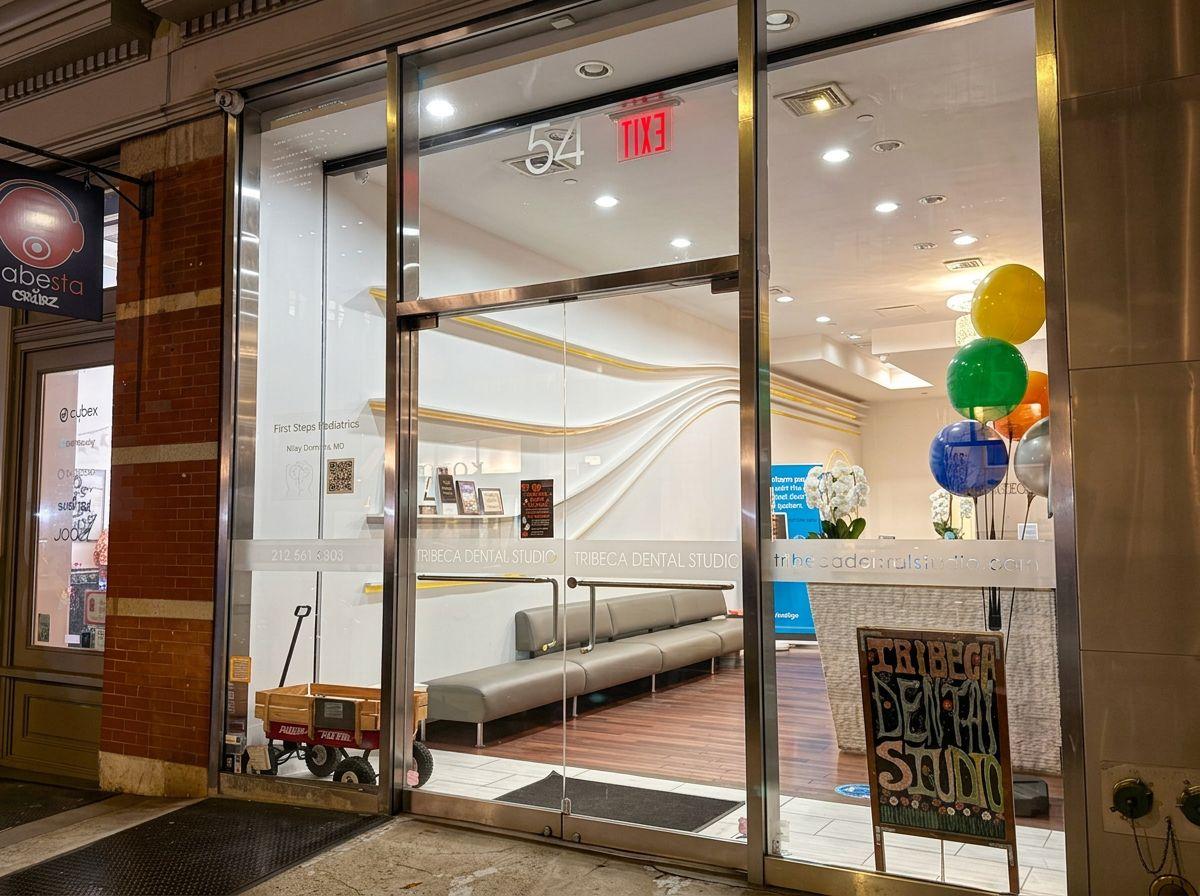
I'm Dr. Nina Izhaky. I opened Tribeca Dental Studio in 2007 because I believed a dental office could feel nothing like a dental office. TDS4KIDS — our pediatric practice — is that belief applied to children: a place at 54 Warren Street where kids are comfortable, parents are informed, and nobody is ever rushed. Parents across Tribeca, Battery Park City, and SoHo bring their children to us because we treat kids like kids — not small adults.
What makes a pediatric dentist the right one
Parents ask me how to choose a kids' dentist in NYC. Here's what actually matters — and how we built TDS4KIDS around it.
Kids are not small adults.
Children need shorter visits, gentler pacing, and words they understand before anything happens. Our pediatric team sees kids all day, every day — this is their specialty, not a side offering.
First visits by the first birthday.
We recommend your child's first visit by their first birthday, or when the first tooth appears. Early visits are short and friendly — a ride in the chair, a look around — and they teach your child the dentist is a safe place.
Airway screening at every exam.
Our signature difference: at every exam we screen how your child's jaw and airway are developing. Mouth breathing, snoring, restless sleep, crowded teeth — these often trace back to growth patterns we can guide early, right here.
One office for the whole family.
Parents can book their own checkup, cleaning, or Invisalign consult in the same visit. One trip to 54 Warren Street, one parking spot, done.
Your child's first visit
Short, friendly, and built around trust — nothing rushed, nothing forced.
The welcome.
Your child meets the team, picks a spot, and gets comfortable. No drills on day one — the first visit is about making friends with the chair.
The gentle exam.
A look, a count of teeth, maybe a polish — everything explained in kid-friendly words first, so nothing comes as a surprise.
Airway and growth screening.
We check how the jaw and airway are developing — breathing patterns, bite, and spacing — because early guidance can prevent years of problems.
Your plan.
We talk with you, not at you: what we saw, what to watch, and when to come back. Parents leave informed, kids leave smiling.
Early airway screening — our signature difference
Here's something most pediatric dentists don't do. At every TDS4KIDS exam, we screen how your child's jaw and airway are developing. Mouth breathing, snoring, restless sleep, crowded teeth — these often trace back to growth patterns we can guide early. Because our practice includes airway orthodontics for all ages, we can treat it right here at 54 Warren Street instead of sending you across town for a referral. If we spot a narrow palate or signs of sleep-disordered breathing, we'll show you exactly what we see and explain your options — including early palatal expansion for kids.
Hablamos español
We warmly welcome Spanish-speaking families. Nuestro equipo atiende a familias que hablan español — llámenos al (212) 561-5303 y con gusto le ayudamos.
For Teens, I Start With the Whole Picture
Teens get a different kind of visit here, because the teen years are when everything connects. When your teenager comes to TDS4KIDS, I see them first — myself. Not just their teeth, but the whole picture: their bite, how their jaws are growing, how they're breathing, whether their airway is developing the way it should. A teenager's mouth is still changing, and this is the window when early guidance can prevent years of problems later.
Here's what happens next. If orthodontics makes sense, I refer to an airway-focused orthodontist for an airway evaluation — and I mean that for every teen, whether or not they're already in orthodontic treatment. Why? Because most orthodontics straightens teeth without asking how the airway is doing. An airway evaluation tells you how the jaws developed, whether the airway is narrow, and what your options are for preventing sleep apnea as an adult. It's a conversation most families never get to have, and I want you to have it.
And because everything lives under this one roof, none of it becomes a project. Cleanings can be folded into the same visit. When the wisdom-teeth question comes up in the late teens, our oral surgeon is right here for the evaluation — same office, same team, same familiar faces. One trip to 54 Warren Street, and you walk out with a plan for your teen's smile, their breathing, and their sleep. That's what a dental home is supposed to feel like.
Questions Tribeca parents ask
01When should my child first see a dentist?
By their first birthday, or when the first tooth appears. Early visits are about comfort and prevention — a ride in the chair, a look around, maybe a polish. They teach your child the dentist is a safe place.
02My child is terrified of the dentist. Can you help?
This is one of the most common reasons parents find us. We go slowly, explain everything in kid-friendly words first, and never force treatment. Many of our most anxious first-timers become our most enthusiastic regulars.
03What ages do you see?
Infants through teenagers — from first tooth to adolescence.
04Do you really check my child's breathing and airway?
Yes, at every exam. If we spot a narrow palate, mouth breathing, or signs of sleep-disordered breathing, we'll show you exactly what we see and explain your options. Early guidance can prevent years of problems.
05Do you offer financing?
Every child deserves care. We'll walk you through financing options that work for your family — call (212) 561-5303 and we'll figure it out together.
06Where are you located?
54 Warren Street, New York, NY 10007 — in the heart of Tribeca. Families come to us from Tribeca, SoHo, Battery Park City, the Financial District, and across Downtown Manhattan.
07My teen is already in orthodontic treatment. Do we still need the airway evaluation?
Yes. Dr. Nina sees every teen herself first, and refers for an airway evaluation whether or not they're already in orthodontic treatment. Straightening teeth and evaluating the airway are two different conversations — your family deserves both.
08What does an airway-focused orthodontist look at?
How the jaws developed, whether the airway is narrow, breathing patterns, and growth direction — and what your options are for preventing sleep apnea as an adult. It's about the whole system, not just straight teeth.
09Can you evaluate my teen's wisdom teeth at the same visit?
Absolutely. Our oral surgeon is right here at 54 Warren Street, so a wisdom-teeth evaluation can be part of the same plan — no referral slip to a stranger's office.
TDS4KIDS in the heart of Tribeca
Find us at 54 Warren Street, New York, NY 10007 — in the heart of Tribeca, serving families across Tribeca, SoHo, Battery Park City, the Financial District, and Downtown Manhattan. Follow @tds4kids on Instagram for a look inside.
Give your child a dental home in Tribeca
A first visit that's short, friendly, and built around trust. Call (212) 561-5303 or book online — we'd love to meet your family.
Your Visit from Tribeca
Getting here from Tribeca is a short walk, not a trip, and that is how most of our neighbors arrive. If you are coming by subway, the 1, 2, 3, A, C, and E trains stop at Chambers Street, about a five-minute walk up Warren to our door. The 4, 5, and 6 at Brooklyn Bridge–City Hall are ten minutes on foot through the civic center, and the J and Z also stop at Chambers Street for the east-side connection.
Citi Bike stations sit on Warren Street and Greenwich Street, and New Jersey commuters can take PATH to the World Trade Center Oculus.
When you arrive at 54 Warren Street, we keep the day simple and unhurried from the moment you check in. Our team works together under one roof, so your visit stays in one place instead of sending you across town for another appointment or another opinion. We talk through what brought you in, take any imaging we need here in the office, and explain what we are seeing in plain language before we discuss next steps together.
You will always know what we recommend, why we recommend it, and what can wait, so you leave with a clear plan rather than unanswered questions.
Life in Tribeca moves between the cast-iron lofts on Franklin Street, the towers along West Street, and afternoons with families at Washington Market Park, and we schedule with that rhythm in mind. We are open Monday through Friday from 8 AM to 6 PM, Saturday from 9 AM to 4 PM, and Sunday from 9 AM to 2 PM, and you can book online any time or call us at (212) 561-5303.
Street parking here is tight, with cobblestone blocks and film shoots, but attended garages on Warren Street and Greenwich Street sit within a block of our door. Follow-ups stay with our same team, so your care feels continuous.
Ongoing care is where being neighbors really pays off for our Tribeca patients. A six-month recall is just a short walk over, a quick check-in with the team who already knows your history, and a cleaning that fits between school drop-off and the rest of your day. When treatment takes more than one visit, we sequence it sensibly, review healing in person, and adjust the plan together rather than by phone tag.
Because we have cared for families here since 2007, we notice small changes early, keep your records continuous, and remind you when you are due — so staying on track never feels like starting over.
Preventive Dentistry in Depth: The System Behind the Checkup
Preventive dentistry is the discipline of the problems that never happen. Its premise is that nearly everything expensive and uncomfortable in dentistry — the root canal, the extraction, the implant — began as something small, detectable, and interruptible: a softening spot of enamel, a gum pocket quietly deepening, a grinding habit wearing a millimeter a year.
Prevention is the system that catches those beginnings: regular examination, professional cleaning, risk assessment, and the targeted interventions — fluoride, sealants, night guards, interval planning — matched to the risks your specific mouth actually carries.
Risk assessment is what separates prevention from routine. Two patients with identical-looking mouths can carry very different futures: one forms tartar quickly and fights gum inflammation; another has dry mouth from medication and a new cavity every year; a third grinds at night and is wearing through enamel at the chewing surfaces. Each needs a different plan — different recall intervals, different protective measures, different things watched.
At your visits we build that profile from your history and findings, and your preventive plan is written against it, not against a population average.
Fluoride and sealants are the targeted tools of the system. Fluoride helps enamel remineralize and resists acid attack, and it is dosed to risk — professional applications and prescription-strength home options for high-risk patients, standard toothpaste for low-risk ones. Sealants protect the deep grooves of molars where brushes cannot reach and decay most often begins, for children whose molars are newly erupted and for adults whose groove anatomy and history justify them.
Neither is applied by reflex; both are recommended where your anatomy and risk say they will change outcomes.
The mouth is not separate from the rest of health, and prevention planning respects that. Gum inflammation and diabetes influence each other in both directions. Dry mouth, one of the most common medication side effects, removes saliva's protection and accelerates decay dramatically. Tobacco reshapes the risk of gum disease and soft-tissue changes entirely.
Your plan accounts for these connections — and where a finding belongs to medicine rather than dentistry, we tell you plainly and help you route it, because pretending the boundary does not exist helps no one.
What prevention asks of you is a rhythm rather than an effort: keep the interval we set for your risk, brush twice daily with fluoride toothpaste, clean between the teeth daily, and report changes early — bleeding, sensitivity, a rough spot your tongue keeps finding. In return, the arithmetic is lopsided in your favor: prevention is the least expensive, least invasive, and least time-consuming dentistry that exists, and its entire product is the procedures you never need.
If you are restarting after years away, a preventive plan is also the right first step: assessment first, stabilization of anything active, then a maintenance rhythm built for your mouth.
Do adults really need fluoride treatments?
Fluoride strengthens enamel by helping it remineralize — replacing the minerals acids strip away — and it makes the enamel surface more resistant to the next acid attack. It is recommended based on your risk, not by routine: patients with recent cavities, dry mouth, receding gums that expose root surfaces, braces, or a diet high in acids and sugars benefit most. For a low-risk adult with no recent decay, the recommendation may be fluoride toothpaste alone.
At your visit we assess your actual risk pattern and recommend fluoride in the form and frequency your mouth calls for — and we will say so when the answer is that you do not need more than you already get.
Are sealants just for kids?
Dental sealants are thin protective coatings flowed into the deep grooves of back teeth, where toothbrush bristles cannot reach and cavities most often start. They are best known as a children's treatment, and they are highly effective there — but molars keep their grooves for life, and an adult with deep, stain-collecting fissures and a history of decay in those teeth can be a genuine candidate too.
The assessment is individual: groove anatomy, decay history, and how well the teeth can be kept dry during placement. We recommend sealants where the anatomy and the risk justify them, for children and adults alike, rather than by age bracket.
How do my other health conditions affect my dental prevention plan?
They are a risk factor, and we treat them as part of your dental picture rather than someone else's problem — but carefully, without pretending to be your physician. Dry mouth from medications is one of the fastest routes to new decay, because saliva is the mouth's own defense; diabetes and gum disease influence each other in both directions; and tobacco changes the risk profile of your gums and soft tissues entirely.
Prevention planning takes these into account — shorter intervals, fluoride strategy, saliva support — and where a finding belongs to medicine, we say so and coordinate rather than comment from the sidelines.
How Care Is Planned at Our Tribeca Studio
Every treatment plan at Tribeca Dental Studio begins with a diagnosis, not a recommendation made in the abstract. We examine the tooth or area in question, review imaging taken here in the office — including 3D CBCT scans when the case calls for them — and talk through what we see in plain language before any treatment is proposed. You will always know what we recommend, why we recommend it, and what could safely wait.
When several options would serve you well, we lay them side by side: what each involves, how many visits it takes, how long it is expected to last, and what it asks of the neighboring teeth and bone.
That conversation becomes a written plan. The sequence, the timing, and the reasoning are set down before treatment begins, so there are no surprises mid-course and no step is improvised. Staged treatment is grouped into planned steps when we can, and each stage is checked before the next one starts.
If a simpler option would serve you just as well, that is the option we will put in front of you — and if the honest answer is that a tooth or a treatment can be watched rather than treated today, we will say that instead.
Because every specialty sits under one roof at 54 Warren St, a plan that touches several disciplines is designed as a whole. Implant surgery, periodontics, endodontics, orthodontics, cosmetic work, airway care, and pediatric dentistry are handled by one team in one place, which means the implant plan accounts for the gum plan, the orthodontic plan accounts for the airway, and nothing is lost between offices across town.
Your records, your imaging, and your history stay with the same team from the first visit through every follow-up.
Technology We Use — and Why It Matters
Good planning depends on seeing clearly. Our studio works with 3D CBCT imaging, which shows bone volume, nerve positions, sinus anatomy, and root form in three dimensions rather than the flat shadow of a standard X-ray. Implant positions, grafting decisions, root canal anatomy, and expansion planning are all worked out on that imaging before treatment begins, so the day of the procedure holds as few unknowns as possible.
Digital planning carries the same approach into orthodontics and cosmetic work: tooth movement and smile design are mapped in advance, and you can see the intended direction before committing to it.
Laser technology is part of everyday care here, from gum therapy to the NightLase protocol we use for snoring. Lasers let us treat soft tissue with precision and, in many cases, with a quieter recovery than traditional surgery. For sleep concerns, we use at-home sleep testing rather than assumptions: your breathing is measured in your own bed, and the results — not a guess — decide whether an oral appliance, NightLase, or a referral is the right path.
Technology earns its place in the plan only when it changes a decision or improves an outcome; that is the standard each tool here is held to.
Costs, Insurance, and Written Estimates
Before treatment begins, you receive the plan in writing — including what each stage involves and what it costs — so you can decide with the full picture in front of you. There is no obligation attached to a consultation, and a second opinion is a reasonable thing to want; we would rather you choose with clear information than feel rushed into a chair.
If you have dental insurance, our team verifies your coverage and explains what it does and does not apply to before we start, and if you do not, the written plan still lets you stage treatment sensibly over time.
Dental treatment is often easier to approach in planned stages than all at once. A written plan lets you sequence what is urgent, what protects the teeth around it, and what is elective, so each visit moves the whole plan forward. If something changes along the way — a tooth responds better or worse than expected — the plan is revisited with you, in writing, before the next step. That discipline is what keeps a long course of treatment from becoming a series of surprises.
Comfort, Recovery, and Follow-Up
Most dental anxiety comes from the unknown, so we work to remove it: what will happen, how long it takes, what it will feel like, and what recovery looks like are all covered before we begin. During treatment we check in rather than push through, and after it we tell you plainly what is normal, what is not, and when to call.
Written aftercare instructions go home with you, and the precautions in them — protecting a healing site, eating soft foods for a few days, keeping the area clean — are the difference between an uneventful recovery and a complicated one.
Follow-up is part of the treatment, not an extra. We schedule reviews around your life, use return visits to check healing and the details we flagged together, and keep recall reminders running so maintenance does not drift. If something feels off between visits, we would rather see you quickly than have you wait and wonder.
Call us at (212) 561-5303 or book online at any time — the studio is open Monday to Friday from 8:00 AM to 6:00 PM, Saturday from 9:00 AM to 4:00 PM, and Sunday from 9:00 AM to 2:00 PM.
Before You Book
A final word on how to use pages like this one. Treatment pages describe what is possible; a consultation decides what is appropriate — for your anatomy, your history, your goals, and your budget, in that order of conversation. If anything here has raised a question we have not answered, bring it with you: patients who arrive with marked-up pages and specific questions get the most from their first visit, and the plan we write together is better for it.
Tribeca Dental Studio is at 54 Warren St in Tribeca, and new patients are welcome at any of the services described on this site. Book online at any time or call (212) 561-5303. The first step is an examination and an honest conversation; everything else in dentistry follows from those two things done properly.
The Next Step Is a Conversation
Wherever this page found you — a search at midnight, a partner's forwarded link, a dentist's suggestion — the next step is smaller than the worry usually makes it feel. A consultation at the studio is an examination and a conversation, not a commitment: findings first, options with their honest trade-offs, a written plan with costs, and time to decide at home.
Patients tell us the plan is what they actually came for, whether they proceed here, proceed elsewhere, or proceed nowhere for now. That is the offer, and it stands on every page of this site: 54 Warren St, bookable online at any hour, or at (212) 561-5303 — Monday to Friday 8:00 AM to 6:00 PM, Saturday 9:00 AM to 4:00 PM, Sunday 9:00 AM to 2:00 PM.
The Consultation Is Not a Funnel
A last word that applies to every page in this series, whichever treatment brought you here: the consultation is not a funnel. Patients arrive at these pages mid-worry — about a tooth, a jaw, a night's sleep, a smile in photographs — and the studio's answer has been the same since 2007. An examination. Imaging where imaging decides. A written plan with the options and their costs, including the option of doing less, or nothing yet.
Then time to think, at home, without a follow-up call designed to hurry you. If that is the experience you were hoping dentistry could be, the door is at 54 Warren St, and it opens online at any hour or at (212) 561-5303.
How We Plan Your Care at Tribeca Dental Studio
Every treatment at Tribeca Dental Studio starts with a diagnosis, not a sales pitch. Before we recommend anything, we examine the tooth or area in question, review imaging taken here in the office, and talk through what we see in plain language. You will always know what we recommend, why we recommend it, and what could safely wait.
That recommendation becomes a written plan, so the sequence, the timing, and the reasoning are clear before any treatment begins — and if a simpler option would serve you just as well, that is the option we will put in front of you.
Our studio brings every dental specialty under one roof at 54 Warren St in Tribeca, and it has since 2007. General dentistry, cosmetic care, implant surgery, periodontics, endodontics, orthodontics, airway care, and pediatric dentistry are handled by one team in one place, which means a treatment that touches several specialties is planned as a whole rather than handed off between offices across town.
Your records, your imaging, and your history stay with the same team from the first visit through every follow-up, so nothing is lost between providers and no step is planned in isolation.
We are open Monday to Friday from 8:00 AM to 6:00 PM, Saturday from 9:00 AM to 4:00 PM, and Sunday from 9:00 AM to 2:00 PM. You can book online at any time or call us at (212) 561-5303.
The studio sits between Greenwich Street and West Broadway, steps from the Chambers Street subway hub (1, 2, 3, A, C, E), with attended garages on Warren Street and Greenwich Street within a block of our door for patients who drive in.
Care does not end when the procedure does. We schedule reviews and follow-ups around your life, group staged treatment into planned steps when we can, and use each return visit to check healing and watch the details we flagged together. Between appointments we stay in touch with recall reminders and clear next steps, and if something feels off, we would rather see you quickly than have you wait and wonder.
The goal is a plan you understand, a team you recognize, and results that are checked over time rather than assumed.