Dental Bone Graft in Tribeca, NYC
A dental bone graft rebuilds the foundation an implant stands on. I'm Dr. Nina Izhaky. When you lose a tooth — or lose bone to gum disease — your jawbone starts to shrink in that spot. It's just what bone does when it has no tooth root to support. A bone graft rebuilds that lost bone, creating a solid foundation so an implant, or your natural teeth, has something strong to hold onto.
When is bone grafting needed?
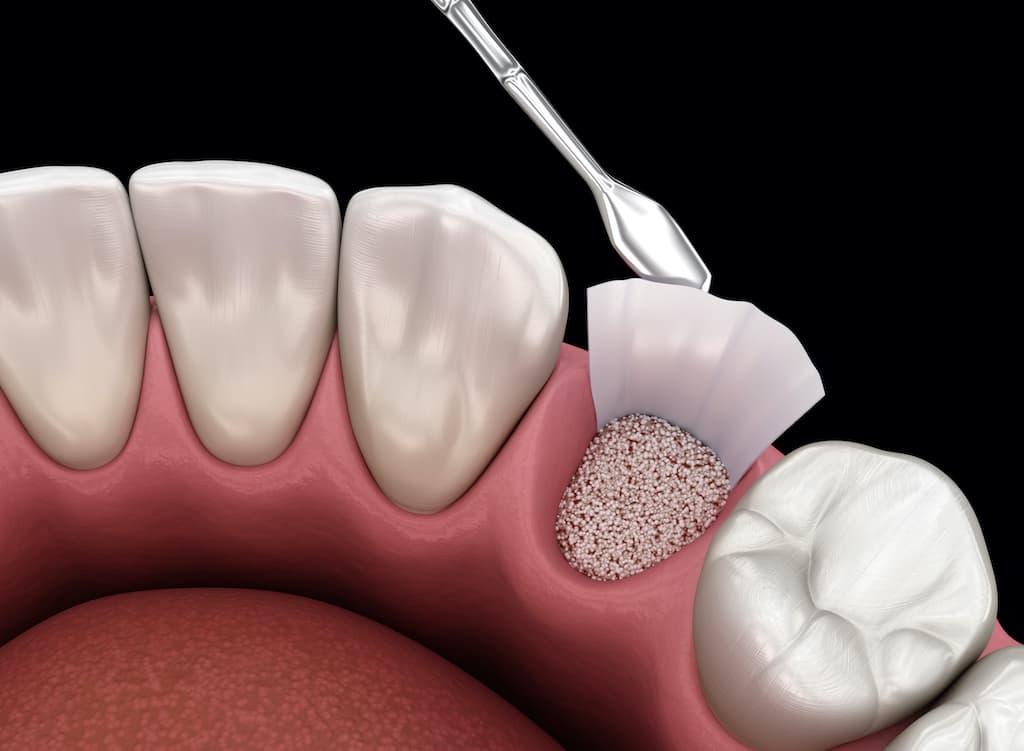
The short version: we place natural, biocompatible grafting material where your bone has thinned. Over the next few months, your body converts it into your own living bone. Then we place your implant into bone that's truly yours.
Before a dental implant.
When the bone has shrunk after years without a tooth, the implant needs its foundation rebuilt first. Placed in thin bone, even a perfect implant has nothing solid to hold.
At the extraction itself.
Grafting the socket the day a tooth comes out preserves the ridge so the bone doesn't collapse — one healing period instead of two, and far more bone to work with later.
After gum disease.
Advanced gum disease eats away the bone supporting your teeth. Where the case allows, grafting rebuilds what infection took and gives those teeth, or their replacements, support again.
After trauma or a failed implant.
Bone lost to injury or a failed fixture can often be rebuilt. Our 3D imaging shows exactly how much bone you have and where — no guessing, and we'll show you the images.
What the procedure is like
A routine, well-established procedure — most patients are surprised by how manageable it is, start to finish.
The 3D evaluation.
We image your jaw in 3D and measure the bone you actually have. You see the same images we do, and the plan is built on measurements, not estimates.
The graft is placed.
You're fully numb. We place safe, biocompatible grafting material — most commonly processed donor bone or a synthetic graft — exactly where your bone has thinned.
Recovery is manageable.
Most patients take it easy for a few days, with soft foods and prescribed medication for soreness. For most people it's easier than the tooth problem that brought them in.
Your body makes it yours.
Over the next several months your body converts the graft into your own living bone. We confirm with imaging that it's ready before any implant goes in — not before.
One rung of the ladder, climbed in-house
Bone grafting is one rung of the complex-implant ladder we climb under one roof: grafts, sinus lifts, zygomatic implants, and horizontal bone growth — the hardest rung of all — planned by our oral surgeon, periodontist, and prosthodontist together from the first 3D scan. I don't know another practice in this city that does all of it.
My honest rule about grafts
“The graft isn't an upsell — it's what makes the implant last decades instead of years.” — Dr. Nina Izhaky
An implant placed in insufficient bone can fail. That's not a scare tactic; it's mechanics. Bone work is not fast, because it treats the foundation, not the surface — the graft needs several months to fully convert, typically three to six depending on its size, and we'll time your implant for when your bone is ready.
And because we do the graft and the implant, there's no handoff between offices, no conflicting plans, no repeated imaging. The specialist who grafts your bone is planning for the implant that's coming — one continuous plan, one team, from the first scan to the final tooth.
Bone grafting questions, answered
01Is bone grafting painful?
You're fully numb during the procedure. Afterward, most patients manage with prescribed medication for a few days, and it proves easier than they expected.
02Where does the graft material come from?
We use safe, biocompatible materials — most commonly processed donor bone or synthetic graft material designed for your body to convert into its own bone. We'll explain your specific options at the evaluation.
03How long before I can get my implant?
Typically three to six months, depending on the size of the graft. Imaging confirms the graft has converted into your own bone before we move forward.
04What happens if I skip the graft and just get the implant?
An implant placed in insufficient bone can fail. The graft isn't an upsell — it's what makes the implant last decades instead of years.
05Can bone lost years ago be rebuilt?
Usually, yes — that's the most common case we see. Bone lost to years without a tooth, to infection, or to gum disease can often be rebuilt. The 3D scan shows how much you have and what a graft can recover.
06How much does bone grafting cost?
It depends on the size and location of the graft. We'll give you an exact number at your evaluation and walk you through financing. We are a private fee-for-service practice and don't bill insurance directly; ask about financing and our membership plan.
07Where is bone grafting done in Tribeca, NYC?
Right here — Tribeca Dental Studio, 54 Warren Street, New York, NY 10007, in the heart of Tribeca. Call (212) 561-5303 for a 3D evaluation.
Find us in Tribeca
Tribeca Dental Studio is at 54 Warren Street, New York, NY 10007, in the heart of Tribeca — serving Tribeca, SoHo, Battery Park City, the Financial District, and Lower Manhattan.
Find out what your bone needs
Call (212) 561-5303 for a 3D evaluation — we'll show you your bone and give you a straight answer.
Read all our reviews on Google
Your Visit from Tribeca
Getting here from Tribeca is a short walk, not a trip, and that is how most of our neighbors arrive. If you are coming by subway, the 1, 2, 3, A, C, and E trains stop at Chambers Street, about a five-minute walk up Warren to our door. The 4, 5, and 6 at Brooklyn Bridge–City Hall are ten minutes on foot through the civic center, and the J and Z also stop at Chambers Street for the east-side connection.
Citi Bike stations sit on Warren Street and Greenwich Street, and New Jersey commuters can take PATH to the World Trade Center Oculus.
When you arrive at 54 Warren Street, we keep the day simple and unhurried from the moment you check in. Our team works together under one roof, so your visit stays in one place instead of sending you across town for another appointment or another opinion. We talk through what brought you in, take any imaging we need here in the office, and explain what we are seeing in plain language before we discuss next steps together.
You will always know what we recommend, why we recommend it, and what can wait, so you leave with a clear plan rather than unanswered questions.
Life in Tribeca moves between the cast-iron lofts on Franklin Street, the towers along West Street, and afternoons with families at Washington Market Park, and we schedule with that rhythm in mind. We are open Monday through Friday from 8 AM to 6 PM, Saturday from 9 AM to 4 PM, and Sunday from 9 AM to 2 PM, and you can book online any time or call us at (212) 561-5303.
Street parking here is tight, with cobblestone blocks and film shoots, but attended garages on Warren Street and Greenwich Street sit within a block of our door. Follow-ups stay with our same team, so your care feels continuous.
Ongoing care is where being neighbors really pays off for our Tribeca patients. A six-month recall is just a short walk over, a quick check-in with the team who already knows your history, and a cleaning that fits between school drop-off and the rest of your day. When treatment takes more than one visit, we sequence it sensibly, review healing in person, and adjust the plan together rather than by phone tag.
Because we have cared for families here since 2007, we notice small changes early, keep your records continuous, and remind you when you are due — so staying on track never feels like starting over.
Bone Grafting in Depth: Rebuilding the Foundation
When a tooth is lost, the bone that held it begins to shrink. Without a root to stimulate it, the jawbone in that spot gradually resorbs — narrowing and lowering over months and years — until there may not be enough bone left to anchor a dental implant securely. Bone grafting rebuilds that foundation.
Graft material is placed where bone has been lost, and over the following months your body replaces it with your own living bone, restoring the volume an implant needs and the contour your face and gums depend on.
Timing matters, and it is one of the first things we assess. A graft placed at the time of extraction — often called socket preservation — can hold the ridge's shape while the site heals, making later implant placement simpler and more predictable. A graft can also be placed months or years after a tooth was lost, rebuilding a ridge that has already narrowed.
Which approach fits you depends on when the tooth was lost, how much bone remains on your 3D imaging, and what the final restoration needs to achieve.
Healing is measured in months, not days, and we would rather be straightforward about that than rush a foundation. The grafted site needs time to consolidate before it can carry an implant, and placing an implant into bone that is not ready is how otherwise good plans fail. During healing we review the site, confirm progress on imaging, and only then schedule placement.
The wait buys stability that lasts: an implant anchored in solid, rebuilt bone is positioned where the final tooth needs it, not merely where the remaining bone happened to allow.
Recovery from grafting is usually straightforward. Most patients manage with standard post-operative guidance — protecting the site while the tissue closes, following the soft-food and hygiene instructions we give you in writing, and keeping review appointments so we can confirm the graft is integrating as expected.
If you are planning implant treatment, ask us at your evaluation how grafting fits your sequence, whether it can be combined with extraction or implant placement in your case, and what your realistic timeline looks like from first visit to final tooth.
Do I always need a bone graft before an implant?
No. Many implant sites have enough healthy bone to proceed without grafting, and we only recommend a graft when your 3D imaging shows the bone volume is genuinely insufficient for stable placement or for positioning the implant where the final tooth needs it. When a graft is needed, it is because the foundation determines the result: an implant placed in adequate bone, at the right angle and depth, supports a restoration that looks natural and carries bite forces properly.
Your evaluation shows you exactly what your bone looks like and why we are — or are not — recommending grafting.
How long after a graft can an implant be placed?
It depends on the size and location of the graft. Smaller grafts, such as socket preservation at extraction, may be ready for implant placement in a few months, while larger ridge rebuilds take longer to consolidate fully. We confirm readiness with imaging rather than the calendar alone, because placing an implant into bone that has not finished integrating risks the stability the graft was meant to create.
Your written plan lays out the expected sequence and timing for your case, and we update it at each review as healing is confirmed.
How Care Is Planned at Our Tribeca Studio
Every treatment plan at Tribeca Dental Studio begins with a diagnosis, not a recommendation made in the abstract. We examine the tooth or area in question, review imaging taken here in the office — including 3D CBCT scans when the case calls for them — and talk through what we see in plain language before any treatment is proposed. You will always know what we recommend, why we recommend it, and what could safely wait.
When several options would serve you well, we lay them side by side: what each involves, how many visits it takes, how long it is expected to last, and what it asks of the neighboring teeth and bone.
That conversation becomes a written plan. The sequence, the timing, and the reasoning are set down before treatment begins, so there are no surprises mid-course and no step is improvised. Staged treatment is grouped into planned steps when we can, and each stage is checked before the next one starts.
If a simpler option would serve you just as well, that is the option we will put in front of you — and if the honest answer is that a tooth or a treatment can be watched rather than treated today, we will say that instead.
Because every specialty sits under one roof at 54 Warren St, a plan that touches several disciplines is designed as a whole. Implant surgery, periodontics, endodontics, orthodontics, cosmetic work, airway care, and pediatric dentistry are handled by one team in one place, which means the implant plan accounts for the gum plan, the orthodontic plan accounts for the airway, and nothing is lost between offices across town.
Your records, your imaging, and your history stay with the same team from the first visit through every follow-up.
Technology We Use — and Why It Matters
Good planning depends on seeing clearly. Our studio works with 3D CBCT imaging, which shows bone volume, nerve positions, sinus anatomy, and root form in three dimensions rather than the flat shadow of a standard X-ray. Implant positions, grafting decisions, root canal anatomy, and expansion planning are all worked out on that imaging before treatment begins, so the day of the procedure holds as few unknowns as possible.
Digital planning carries the same approach into orthodontics and cosmetic work: tooth movement and smile design are mapped in advance, and you can see the intended direction before committing to it.
Laser technology is part of everyday care here, from gum therapy to the NightLase protocol we use for snoring. Lasers let us treat soft tissue with precision and, in many cases, with a quieter recovery than traditional surgery. For sleep concerns, we use at-home sleep testing rather than assumptions: your breathing is measured in your own bed, and the results — not a guess — decide whether an oral appliance, NightLase, or a referral is the right path.
Technology earns its place in the plan only when it changes a decision or improves an outcome; that is the standard each tool here is held to.
Costs, Insurance, and Written Estimates
Before treatment begins, you receive the plan in writing — including what each stage involves and what it costs — so you can decide with the full picture in front of you. There is no obligation attached to a consultation, and a second opinion is a reasonable thing to want; we would rather you choose with clear information than feel rushed into a chair.
If you have dental insurance, our team verifies your coverage and explains what it does and does not apply to before we start, and if you do not, the written plan still lets you stage treatment sensibly over time.
Dental treatment is often easier to approach in planned stages than all at once. A written plan lets you sequence what is urgent, what protects the teeth around it, and what is elective, so each visit moves the whole plan forward. If something changes along the way — a tooth responds better or worse than expected — the plan is revisited with you, in writing, before the next step. That discipline is what keeps a long course of treatment from becoming a series of surprises.
Comfort, Recovery, and Follow-Up
Most dental anxiety comes from the unknown, so we work to remove it: what will happen, how long it takes, what it will feel like, and what recovery looks like are all covered before we begin. During treatment we check in rather than push through, and after it we tell you plainly what is normal, what is not, and when to call.
Written aftercare instructions go home with you, and the precautions in them — protecting a healing site, eating soft foods for a few days, keeping the area clean — are the difference between an uneventful recovery and a complicated one.
Follow-up is part of the treatment, not an extra. We schedule reviews around your life, use return visits to check healing and the details we flagged together, and keep recall reminders running so maintenance does not drift. If something feels off between visits, we would rather see you quickly than have you wait and wonder.
Call us at (212) 561-5303 or book online at any time — the studio is open Monday to Friday from 8:00 AM to 6:00 PM, Saturday from 9:00 AM to 4:00 PM, and Sunday from 9:00 AM to 2:00 PM.
Before You Book
A final word on how to use pages like this one. Treatment pages describe what is possible; a consultation decides what is appropriate — for your anatomy, your history, your goals, and your budget, in that order of conversation. If anything here has raised a question we have not answered, bring it with you: patients who arrive with marked-up pages and specific questions get the most from their first visit, and the plan we write together is better for it.
Tribeca Dental Studio is at 54 Warren St in Tribeca, and new patients are welcome at any of the services described on this site. Book online at any time or call (212) 561-5303. The first step is an examination and an honest conversation; everything else in dentistry follows from those two things done properly.
The Next Step Is a Conversation
Wherever this page found you — a search at midnight, a partner's forwarded link, a dentist's suggestion — the next step is smaller than the worry usually makes it feel. A consultation at the studio is an examination and a conversation, not a commitment: findings first, options with their honest trade-offs, a written plan with costs, and time to decide at home.
Patients tell us the plan is what they actually came for, whether they proceed here, proceed elsewhere, or proceed nowhere for now. That is the offer, and it stands on every page of this site: 54 Warren St, bookable online at any hour, or at (212) 561-5303 — Monday to Friday 8:00 AM to 6:00 PM, Saturday 9:00 AM to 4:00 PM, Sunday 9:00 AM to 2:00 PM.
The Consultation Is Not a Funnel
A last word that applies to every page in this series, whichever treatment brought you here: the consultation is not a funnel. Patients arrive at these pages mid-worry — about a tooth, a jaw, a night's sleep, a smile in photographs — and the studio's answer has been the same since 2007. An examination. Imaging where imaging decides. A written plan with the options and their costs, including the option of doing less, or nothing yet.
Then time to think, at home, without a follow-up call designed to hurry you. If that is the experience you were hoping dentistry could be, the door is at 54 Warren St, and it opens online at any hour or at (212) 561-5303.
How We Plan Your Care at Tribeca Dental Studio
Every treatment at Tribeca Dental Studio starts with a diagnosis, not a sales pitch. Before we recommend anything, we examine the tooth or area in question, review imaging taken here in the office, and talk through what we see in plain language. You will always know what we recommend, why we recommend it, and what could safely wait.
That recommendation becomes a written plan, so the sequence, the timing, and the reasoning are clear before any treatment begins — and if a simpler option would serve you just as well, that is the option we will put in front of you.
Our studio brings every dental specialty under one roof at 54 Warren St in Tribeca, and it has since 2007. General dentistry, cosmetic care, implant surgery, periodontics, endodontics, orthodontics, airway care, and pediatric dentistry are handled by one team in one place, which means a treatment that touches several specialties is planned as a whole rather than handed off between offices across town.
Your records, your imaging, and your history stay with the same team from the first visit through every follow-up, so nothing is lost between providers and no step is planned in isolation.
We are open Monday to Friday from 8:00 AM to 6:00 PM, Saturday from 9:00 AM to 4:00 PM, and Sunday from 9:00 AM to 2:00 PM. You can book online at any time or call us at (212) 561-5303.
The studio sits between Greenwich Street and West Broadway, steps from the Chambers Street subway hub (1, 2, 3, A, C, E), with attended garages on Warren Street and Greenwich Street within a block of our door for patients who drive in.
Care does not end when the procedure does. We schedule reviews and follow-ups around your life, group staged treatment into planned steps when we can, and use each return visit to check healing and watch the details we flagged together. Between appointments we stay in touch with recall reminders and clear next steps, and if something feels off, we would rather see you quickly than have you wait and wonder.
The goal is a plan you understand, a team you recognize, and results that are checked over time rather than assumed.