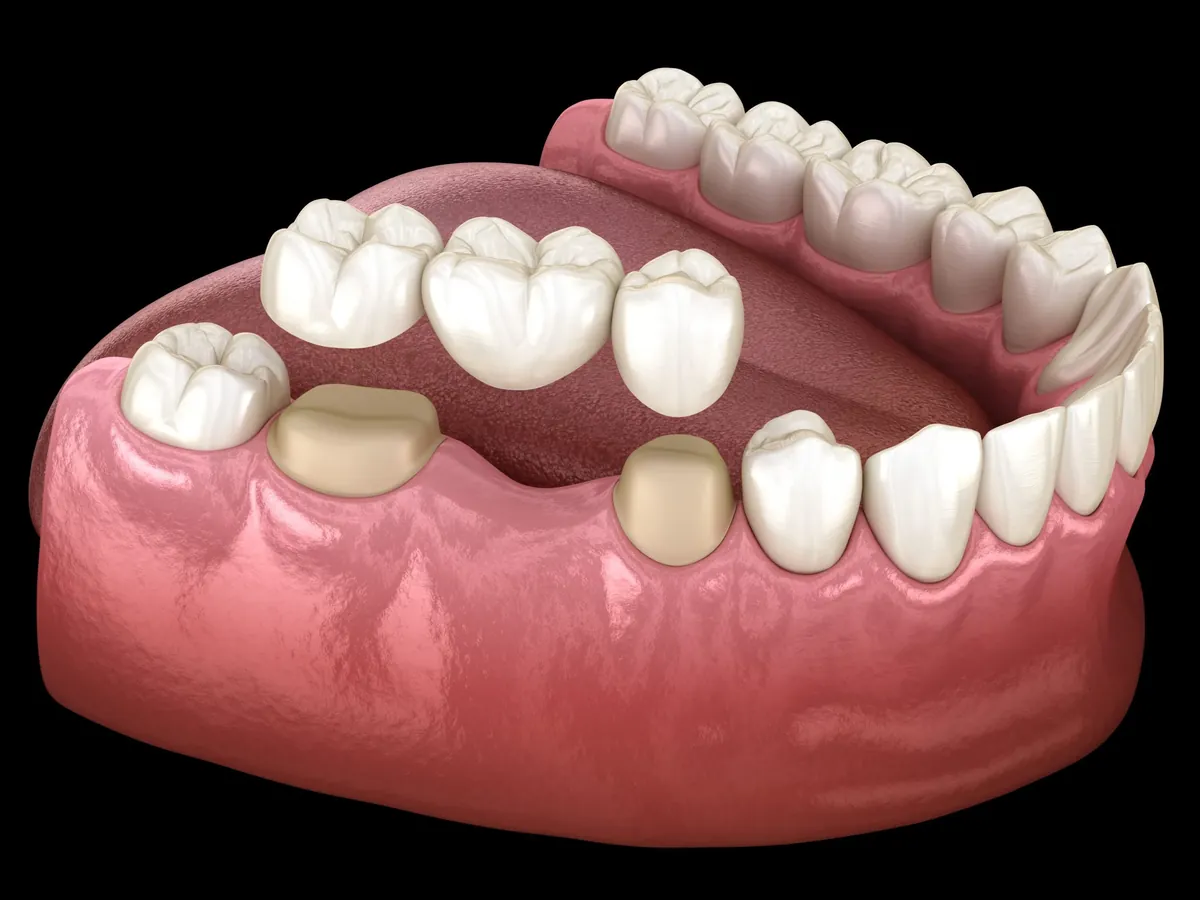
The decision between a crown and a bridge starts with what remains. A crown protects a tooth that is still present but weakened — by a large filling, a crack, significant decay, or root canal treatment — by covering its visible portion and absorbing bite forces that the remaining structure can no longer handle alone. A bridge answers a different problem: a tooth that is already gone.
It spans the gap with an artificial tooth, supported either by crowned natural teeth on each side or by dental implants. Choosing well means looking honestly at how much healthy structure remains, because a restoration built on a doubtful foundation fails early no matter how well it is made.
Material choice shapes both appearance and lifespan. Modern crowns and bridges are fabricated to match the shade, translucency, and contour of your natural teeth, and the right material depends on where the restoration sits and what forces it will carry. A back molar endures grinding loads that a front tooth never sees, while a front tooth demands the most lifelike light handling.
We plan shade, contours, and contact points before fabrication begins, and we check the bite carefully at delivery, because a restoration that is even slightly high concentrates force exactly where the tooth is least able to absorb it.
Preparation is deliberately conservative. For a crown, only the damaged or weakened portions are reshaped so the restoration can seat fully and protect what remains; the goal is always to preserve healthy structure, never to remove more than the restoration requires. For a traditional bridge, the supporting teeth are prepared for crowns, which is why a bridge is recommended only when those teeth can genuinely carry the load — or when they already need crowns of their own.
Where an implant can support the replacement instead, we will explain why sparing the neighboring teeth may be the better long-term call.
The visits follow a measured sequence. At the first appointment we evaluate the tooth, surrounding gums, bite, and neighboring teeth, using digital radiographs and, when clinically indicated, 3D imaging to assess roots and supporting bone. Digital impressions capture the shape and bite relationship of your teeth without traditional impression material in many cases.
While the laboratory fabricates your restoration, a well-made temporary protects the prepared tooth and holds your bite, so you are never left with an exposed, sensitive tooth between visits.
At the delivery visit, the restoration is tried in before it is bonded. We check the fit at the margins, the contact with neighboring teeth, the shade against your natural teeth in real light, and the bite with thin marking film, adjusting until your teeth come together evenly. Only then is the crown or bridge cemented or bonded in place.
Small adjustments in the first days are normal as your bite settles, and we would rather see you for a five-minute refinement than have you adapt to a bite that is not quite right.
Daily care is simple but specific. Brush and floss as you would natural teeth, and learn to clean under a bridge pontic with floss threaders or interdental brushes, because the space beneath a bridge collects plaque where a regular brush cannot reach. A crown has one vulnerability worth respecting: the margin where restoration meets natural tooth, which is where new decay most often starts.
Keeping that margin clean, and keeping your regular cleaning appointments, is what turns a well-made restoration into a long-lived one.
Longevity expectations should be realistic. A well-planned crown or bridge, cared for properly, serves for many years, but no restoration is permanent. The habits that shorten its life are the same ones that damage natural teeth: grinding at night, chewing ice, using teeth as tools, and skipping the reviews that catch small problems early.
If you grind, we may recommend a night guard — it protects the restoration and your natural teeth at the same time, and it is far cheaper than replacing either.
Warning signs deserve a prompt call. A crown that feels loose, a new sensitivity to hot or cold that lingers, pain when biting, a chip you can feel with your tongue, or a bridge that seems to trap food differently than it used to — each is easier and less expensive to address when it is caught early. At your regular visits we check margins, contacts, and bite as a matter of routine, because the difference between a repair and a replacement is usually timing.
If something changes between visits, do not wait for the next scheduled cleaning to mention it.