Zygomatic Implants in Tribeca, NYC
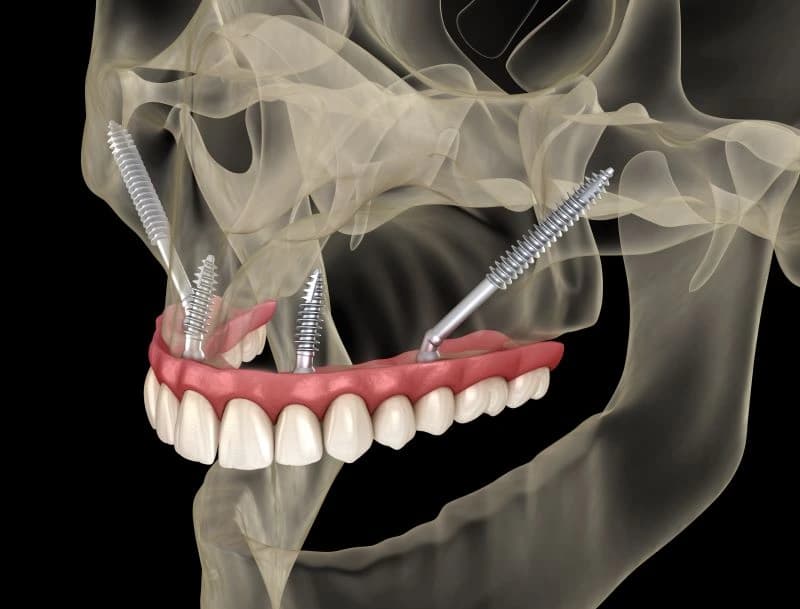
For patients with severe bone loss in the upper jaw, traditional dental implants may not be possible without extensive bone grafting. Zygomatic implants anchor directly into the cheekbone, providing a strong, stable foundation often without grafting.
The short answer
If you've been told you don't have enough bone for implants, zygomatic implants may be your second chance. Long specialized fixtures (30–55 mm) anchor into the dense cheekbone — which doesn't resorb the way the jawbone does — eliminating extensive bone grafting in most cases. Many patients leave the same day with a fixed temporary bridge.
How do zygomatic implants compare to traditional implants?
Understanding how zygomatic anchors bypass bone deterioration for a faster, more predictable smile restoration.
Traditional Dental Implants
Require sufficient upper jawbone density. When bone loss is present, treatment is frequently delayed by months of preparatory bone grafting or sinus lifts.
- • Dependent on native jawbone volume
- • Multi-stage surgical timeline
- • High risk of rejection if bone is soft
Zygomatic Dental Implants
Ideal when the jawbone is too thin or soft. Placed into the dense cheekbone (zygoma) which does not resorb the way the jawbone does, offering immediate high-stability anchoring.
- • Bypasses jawbone deterioration entirely
- • Eliminates extensive grafting in most cases
- • Faster path to a fixed functional smile
How does the zygomatic implant procedure work?
Executed with meticulous 3D planning and state-of-the-art surgical comfort.
Consultation & 3D Planning
Comprehensive evaluation including 3D CBCT scans to precisely map your facial anatomy and plan optimal fixture placement.
The Surgical Procedure
Performed under sedation in our surgical suite. Long specialized fixtures (30–55 mm) anchor securely into the dense zygoma.
Same-Day Teeth
A custom temporary fixed bridge is attached immediately post-surgery, allowing you to walk out with a functional smile.
| Feature | How it works |
|---|---|
| Anchorage | Long specialized fixtures (30–55 mm) anchored in the dense cheekbone, which does not resorb like jawbone. |
| Bone grafting | Eliminates extensive grafting requirements in most complex cases. |
| Same-day teeth | A temporary fixed bridge is attached immediately post-surgery in many cases. |
Candidate Criteria
- Patients told traditional implants are impossible due to severe upper jaw bone loss.
- Individuals wishing to avoid invasive, multi-month bone grafting or sinus lift procedures.
- Denture wearers seeking a permanent, non-removable fixed restoration alternative.
- Good overall health with the ability to undergo minor oral surgery.
Key Benefits
- Eliminates bone grafting requirements in the vast majority of complex cases.
- Shortens overall timeline from years of staged surgeries to immediate solutions.
- Restores facial volume and prevents further structural facial collapse.
- Backed by decades of high success rates for permanent full-arch stability.
Learn More About Zygomatic Implant Treatment
Zygomatic Implant Success & Complications
Review factors involved in planning, healing, maintenance, and potential complications with complex zygomatic implant treatment.
Step-by-Step Guide to Zygomatic Surgery
Explore the evaluation, planning, surgical, restorative, and follow-up stages involved in zygomatic implant treatment.
Zygomatic Implants in Tribeca
Zygomatic implant care at our Tribeca studio for patients with severe upper-jaw bone loss.
When You've Been Told Implants Aren't Possible
Many of our patients arrive at our Tribeca office after hearing the same sentence somewhere else: “you don't have enough bone for implants.” For someone who has lived for years with loose dentures or missing teeth, those words feel like a door closing. Zygomatic implants exist to open that door again.
Severe bone loss in the upper jaw is usually the result of years without teeth, advanced gum disease, or long-term denture wear. Over time, the bone resorbs and the sinus cavities expand downward, leaving very little for a conventional implant to hold onto. Rather than rebuilding bone through months of grafting, zygomatic implants take advantage of a structure that never deteriorates: the dense cheekbone.
At Tribeca Dental Studio, every zygomatic case begins with detailed three-dimensional planning. We use cone-beam imaging to map the cheekbone, sinuses, and neighboring structures precisely before any surgical decision is made. That planning is what makes it possible to place the implants confidently and, in many cases, attach a temporary fixed prosthesis the very same day.
If you live or work in downtown Manhattan — Tribeca, SoHo, Battery Park, the Financial District — and you've been told implants aren't an option for you, a second opinion is worth your time. A consultation at our Warren Street office includes a complete evaluation of your anatomy and an honest conversation about whether zygomatic implants are right for your situation.
Frequently Asked Questions
What are zygomatic dental implants?
Zygomatic implants are a specialized type of dental implant designed for patients with significant bone loss in the upper jaw, anchored into the dense cheekbone rather than the deteriorating jawbone.
Do zygomatic implants eliminate bone grafting?
In most cases, yes. By utilizing the natural strength of the cheekbone, they bypass the need for lengthy bone grafting or sinus lift procedures.
Can I receive teeth on the same day?
In many cases, yes. A custom-fabricated temporary fixed bridge is attached immediately after surgery, allowing you to walk out with a functional smile.
How long do zygomatic implants last?
With proper care, maintenance, and routine check-ups, zygomatic implants are designed as a permanent solution that can last a lifetime.
Am I a candidate for zygomatic implants?
Typical candidates are patients with severe upper-jaw bone loss who have been told conventional implants aren't possible without extensive grafting. An evaluation with 3D imaging at our office confirms whether your anatomy is suitable.
What is recovery like after zygomatic implant surgery?
Most patients experience moderate swelling for the first few days, managed with prescribed medication and rest. Because many receive temporary teeth the same day, you return to normal activities with a functional smile while healing continues underneath.
How do zygomatic implants compare to traditional dentures?
Unlike removable dentures that can shift when speaking or eating, zygomatic implants support a fixed prosthesis that feels stable and secure. No adhesives, no slipping, and nothing to remove at night.
Why choose Tribeca Dental Studio for zygomatic implants?
Our office at 54 Warren Street combines advanced 3D treatment planning, a genuine focus on patient comfort, and over 15 years serving downtown Manhattan. Every treatment plan is customized to your anatomy and your goals.
Schedule Your Zygomatic Implant Consultation
If you've been told implants aren't possible due to severe bone loss, zygomatic implants may give you the second chance you've been waiting for.
Book Zygomatic Consultation NowZygomatic Implants in Depth: A Second Chance for Fixed Teeth
Zygomatic implants exist for the patients who have been told that implants are not possible for them. In the upper jaw, severe bone loss — from years without teeth, from dentures, or from earlier failed treatment — can leave too little bone for conventional implants, even with grafting.
A zygomatic implant takes a different route: it is a longer implant that anchors not in the thin upper jawbone but in the zygomatic bone, the dense cheekbone, which retains its volume even when the jaw has resorbed. That anchorage is what makes fixed upper teeth possible again for carefully selected patients.
Candidacy is genuinely selective, and an honest evaluation matters more here than anywhere. We assess your anatomy on cone-beam 3D imaging: the condition of your sinuses, the shape and density of the zygomatic bone, the health of your remaining teeth and gums, and your overall medical picture.
Some patients are better served by grafting and conventional implants; others by a combination, where zygomatic implants at the back support a restoration alongside standard implants at the front. If zygomatic implants are not the right answer for your anatomy, we will tell you plainly and explain what is.
Planning is digital and restoration-led. The final teeth are designed first — their position, your bite, and how they will look and function — and the implant angles are worked backward from that design. Because zygomatic implants approach the cheekbone at an angle, the surgical plan maps the exact path in advance on your scan, including the relationship to the sinus.
This is specialist surgery, planned in detail before the day, and coordinated here so that imaging, surgery, and the restorative work stay with one team rather than being split between offices.
The surgical visit itself is longer than a standard implant appointment, and comfort planning is part of the preparation: we discuss anesthesia and sedation options in advance and choose what fits your case and your comfort.
Many patients can be fitted with provisional fixed teeth during the healing phase, so you are not left without teeth while the implants integrate — whether that is realistic for you depends on the stability achieved at placement, and we will be clear about it before surgery rather than promise it in advance.
Healing and integration take months, as with any implant, and the provisional phase is a working phase: the temporary teeth let you eat, speak, and be seen while the bone bonds to the implants, and they also serve as a test of the design. We review your healing, check the bite, and refine before the definitive restoration is made.
The final bridge is built to the design that has already proven itself in your mouth, which is why the finished result feels settled rather than experimental.
Long-term care mirrors the care any fixed full-arch restoration needs: daily cleaning around the implants with the brushes and tools we show you, and regular review appointments so we can check the implants, the restoration, and the tissues around them. Zygomatic implants carry the same truth as every implant — their lifespan is built in the planning and protected in the maintenance.
If you have worn a denture for years and believed fixed teeth were closed to you, an evaluation costs you one visit and gives you a definite answer based on your own anatomy.
How are zygomatic implants different from regular implants?
A conventional implant anchors in the jawbone where the tooth root used to be, and it needs enough of that bone in the right place. A zygomatic implant is longer and anchors in the cheekbone (the zygoma), which stays dense and strong even when the upper jaw has lost most of its bone.
That difference in anchorage is the whole point: it allows fixed upper teeth for patients whose jawbone cannot support conventional implants, in many cases without the large grafting procedures that severe bone loss would otherwise require. Your 3D evaluation shows which anchorage your anatomy supports.
I was told I don't have enough bone for implants. Should I still come in?
Yes — that is exactly the situation zygomatic implants were developed for, and a general 'not enough bone' assessment does not rule them out, because they do not rely on the bone you are missing. It also does not guarantee them: candidacy depends on your cheekbone anatomy, sinus health, and overall picture, which only a dedicated 3D evaluation can establish. What we can promise is a definite answer.
We will show you your own scan, explain what is and is not possible in your case, and if another route serves you better — grafting, conventional implants, or a combination — we will lay that out instead.
Will I have teeth while the implants heal?
In many cases, yes: provisional fixed teeth can be fitted during the healing phase so you are not without teeth while integration happens. Whether that is appropriate depends on the stability of the implants at placement and your bite forces, which can only be confirmed on the day — so we discuss it as a possibility with conditions, never a guarantee.
The provisional teeth are later replaced by your definitive restoration once healing is complete and the design has been tested in your mouth.
How We Plan Your Care at Tribeca Dental Studio
Every treatment at Tribeca Dental Studio starts with a diagnosis, not a sales pitch. Before we recommend anything, we examine the tooth or area in question, review imaging taken here in the office, and talk through what we see in plain language. You will always know what we recommend, why we recommend it, and what could safely wait.
That recommendation becomes a written plan, so the sequence, the timing, and the reasoning are clear before any treatment begins — and if a simpler option would serve you just as well, that is the option we will put in front of you.
Our studio brings every dental specialty under one roof at 54 Warren St in Tribeca, and it has since 2007. General dentistry, cosmetic care, implant surgery, periodontics, endodontics, orthodontics, airway care, and pediatric dentistry are handled by one team in one place, which means a treatment that touches several specialties is planned as a whole rather than handed off between offices across town.
Your records, your imaging, and your history stay with the same team from the first visit through every follow-up, so nothing is lost between providers and no step is planned in isolation.
We are open Monday to Friday from 8:00 AM to 6:00 PM, Saturday from 9:00 AM to 4:00 PM, and Sunday from 9:00 AM to 2:00 PM. You can book online at any time or call us at (212) 561-5303.
The studio sits between Greenwich Street and West Broadway, steps from the Chambers Street subway hub (1, 2, 3, A, C, E), with attended garages on Warren Street and Greenwich Street within a block of our door for patients who drive in.
Care does not end when the procedure does. We schedule reviews and follow-ups around your life, group staged treatment into planned steps when we can, and use each return visit to check healing and watch the details we flagged together. Between appointments we stay in touch with recall reminders and clear next steps, and if something feels off, we would rather see you quickly than have you wait and wonder.
The goal is a plan you understand, a team you recognize, and results that are checked over time rather than assumed.
Severe Bone Loss: The Pathways, Honestly Mapped
Severe upper-jaw bone loss closes some doors, but it does not leave a patient with only one remaining option, and a proper consultation maps all the pathways before recommending any of them. Conventional implants with bone grafting rebuild the missing volume first — a proven route that adds healing stages and months, and remains the right answer for many patients whose loss is moderate or localised.
Zygomatic implants take the different route described on this page: anchoring in the dense cheekbone to bypass the deficient upper jaw entirely, which can avoid grafting and shorten the overall path to fixed teeth.
Planning Imaging and Realistic Timelines
Zygomatic implant timelines reward honesty, because they are measured in stages rather than weeks.
The sequence runs: consultation and 3D imaging; digital planning of the final teeth and the implant angles that serve them; the surgical visit, with provisional fixed teeth fitted during healing in many cases; a monitored integration period of months while bone bonds to the implants, during which the provisional teeth are worn, tested and adjusted; and finally the definitive restoration, built from everything the provisional phase taught us about your bite,
speech and appearance.