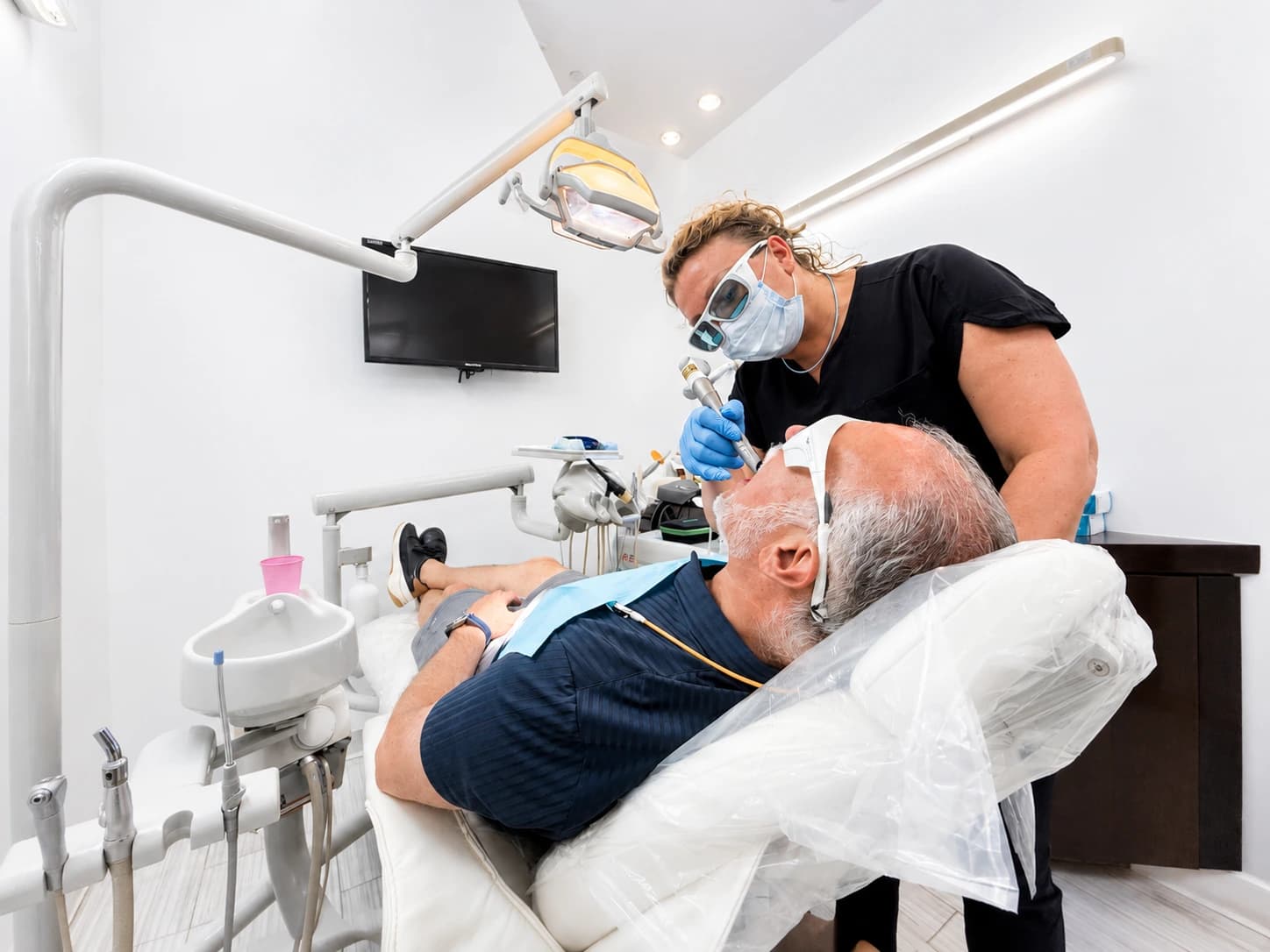
Dentures & All-on-4®
From permanent All-on-4 fixed teeth to flexible partials and zygomatic implants. Restore natural chewing power, facial symmetry, and total confidence in Lower Manhattan.
The short answer
From permanent All-on-4 fixed teeth to flexible partials, we rebuild full smiles for people missing many or all teeth. All-on-4 uses four implants to anchor a complete arch — often with teeth the same day. It's the closest thing to getting your natural teeth back.
Not your grandparents' dentures. Advanced smile architecture.
Tooth loss significantly impacts facial collapse, speech clarity, and nutritional intake. At Tribeca Dental Studio, our multi-specialist team crafts custom prosthetics using biocompatible resins, digital impressions, and precision dental implants for permanent stability.

Comprehensive Denture Configurations
All-on-4 / All-on-X Implants
Four to six standard titanium implants support a fixed, non-removable prosthesis. Provides jawbone stimulation to prevent bone loss, maintains natural facial structure, and never slips or clicks.
All-on-4® Implants vs. Conventional Dentures
All-on-4® / Implant Fixed
- ✓Jawbone Preservation: Implants stimulate bone tissue, preventing facial collapse and sunken appearance.
- ✓Permanent Solution: One-and-done restoration without needing relining every few years.
- ✓Absolute Stability: Zero clicking, slipping, or adhesives. Cleaned just like natural teeth.
Conventional Dentures
- •No Bone Requirement: Can be placed regardless of existing jawbone density or surgical restrictions.
- •Periodic Remaking: Must be relined or remade every 7–10 years as jawbone structure resorbs naturally.
- •Nightly Removal: Requires daily adhesive gels, cleaning solutions, and night soaking.
A Full Arch Without the Denture Compromises
There's a moment we see again and again at our Tribeca office: a patient removes their upper denture to show us the sore spots on their gums, or tells us they avoid certain restaurants because they can't chew with confidence. Conventional dentures were an advance in their time, but they demand daily compromises — adhesives, nightly soaking, the constant fear of slipping mid-laugh. All-on-4 eliminates those compromises at the root.
The concept is elegant in its simplicity: four to six titanium implants, placed strategically — the rear ones angled to maximize contact with available bone — support a complete fixed prosthesis that never comes out. Unlike a denture, which rests on the gums and accelerates bone loss, All-on-4 implants stimulate the jawbone with every bite, preserving the facial structure that dentures allow to collapse over the years.
For our downtown Manhattan patients, the practical appeal is undeniable. No adhesives to apply before a meeting in the Financial District. No nightly soaking in a Battery Park bathroom. Just fixed teeth that brush like natural ones and a smile that never requires a second thought. Planning with 3D imaging at our Warren Street office lets us determine in a single consultation whether All-on-4 is right for your case — even if you've worn dentures for years.
Surgery Day: What Actually Happens
Here's what the day looks like. You arrive in the morning; by the time you leave, the implants are in and a fixed temporary prosthesis is attached — meaning you walk out with teeth the same day. The surgery itself is done under anesthesia with sedation available, so you're comfortable throughout. Most patients tell us the anticipation was worse than the appointment.
Then comes the healing phase, and honesty matters here: your implants need several months to fuse with the jawbone, a process called osseointegration. During that time you wear the temporary prosthesis and eat a softer diet while the bone does its quiet work. We see you for check-ins along the way to make sure everything is integrating exactly as it should.
When the foundation is solid, we take new digital impressions and craft your final prosthesis — shaped, shaded, and fitted to your face and bite. The result is teeth that don't come out at night, don't need adhesive, and let you bite into an apple without thinking about it. For people who've spent years managing dentures, that first confident bite is the moment everything was for.
Who All-on-4 Helps Most
All-on-4 was designed for people facing full-arch tooth loss: patients whose remaining teeth are failing, long-time denture wearers tired of the daily routine, and anyone told they don't have enough bone for traditional implants. The angled rear implants change that math for many patients — and for severe upper-arch bone loss, zygomatic implants anchored in the cheekbone can complete the picture.
It's not for everyone, and we'll tell you if it isn't. Untreated gum disease needs to be addressed first, and habits like smoking affect healing — we'll have an honest conversation about every factor that matters. That's what the 3D scan and consultation are for: a straight answer about whether All-on-4 is your best path, or whether a different option serves you better.
“If the tooth is no longer there and the bone is good, the replacement process is actually very uneventful — very little recovery at all. What we hear from our patients is how unremarkable the procedure was. They’re surprised, and we’re thankful for their appreciation.”
— Dr. Nina Izhaky, Tribeca Dental Studio
Frequently Asked Questions
What is the difference between All-on-4 and traditional dentures?
+Am I a candidate for All-on-4?
+How long does the All-on-4 process take?
+Is the All-on-4 procedure painful?
+How do I care for All-on-4 implants?
+What if I've been wearing dentures for years?
+Explore Related Services
TRIBECA • NEW YORK
Restore Your Natural Smile & Chewing Power
Schedule your consultation for All-on-4® or custom dentures with our prosthodontic team in Lower Manhattan.
SCHEDULE CONSULTATIONYour Visit from Tribeca
Getting here from Tribeca is a short walk, not a trip, and that is how most of our neighbors arrive. If you are coming by subway, the 1, 2, 3, A, C, and E trains stop at Chambers Street, about a five-minute walk up Warren to our door. The 4, 5, and 6 at Brooklyn Bridge–City Hall are ten minutes on foot through the civic center, and the J and Z also stop at Chambers Street for the east-side connection.
Citi Bike stations sit on Warren Street and Greenwich Street, and New Jersey commuters can take PATH to the World Trade Center Oculus.
When you arrive at 54 Warren Street, we keep the day simple and unhurried from the moment you check in. Our team works together under one roof, so your visit stays in one place instead of sending you across town for another appointment or another opinion. We talk through what brought you in, take any imaging we need here in the office, and explain what we are seeing in plain language before we discuss next steps together.
You will always know what we recommend, why we recommend it, and what can wait, so you leave with a clear plan rather than unanswered questions.
Life in Tribeca moves between the cast-iron lofts on Franklin Street, the towers along West Street, and afternoons with families at Washington Market Park, and we schedule with that rhythm in mind. We are open Monday through Friday from 8 AM to 6 PM, Saturday from 9 AM to 4 PM, and Sunday from 9 AM to 2 PM, and you can book online any time or call us at (212) 561-5303.
Street parking here is tight, with cobblestone blocks and film shoots, but attended garages on Warren Street and Greenwich Street sit within a block of our door. Follow-ups stay with our same team, so your care feels continuous.
Ongoing care is where being neighbors really pays off for our Tribeca patients. A six-month recall is just a short walk over, a quick check-in with the team who already knows your history, and a cleaning that fits between school drop-off and the rest of your day. When treatment takes more than one visit, we sequence it sensibly, review healing in person, and adjust the plan together rather than by phone tag.
Because we have cared for families here since 2007, we notice small changes early, keep your records continuous, and remind you when you are due — so staying on track never feels like starting over.
All-on-4 Implants in Tribeca: The Complete Picture
All-on-4 may be considered for people in Tribeca who are missing most or all of their teeth in an arch, people with severely compromised teeth, or denture wearers seeking a fixed option. Four strategically placed implants support a full arch of teeth that stays in, with no adhesives, no slipping, and no taking your teeth out at night. You brush and floss them like natural teeth.
Candidacy is never assumed, though: it depends on your oral health, bone anatomy, medical history, hygiene, and restorative goals. Some patients qualify and some do not, and the only honest way to know is a full evaluation with 3D imaging before any plan is promised.
The concept uses two anterior implants and two posterior implants, with the back two angled to make the most of your available bone. Using four implants rather than six or eight often means no bone grafting and a shorter, simpler surgery than traditional full-arch approaches. We begin with cone-beam 3D imaging, which maps your bone anatomy precisely, and we evaluate whether four implants can support your arch and whether your bone is sufficient.
Implant positions and angles are then planned digitally on your scan before surgery day. The angled posterior implants are positioned to use your existing bone and reduce the cantilever on the final bridge. Every position is decided in advance, not improvised during surgery on the day itself.
On surgery day, the four implants are placed in a single surgical visit. When adequate stability and clinical criteria are met, a fixed provisional restoration, a full set of temporary teeth, may be attached the same day. That outcome depends on implant stability, bone conditions, bite forces, and the surgical plan, so it cannot be promised before evaluation. The provisional is functional and natural-looking, but it is designed for the healing phase.
After healing, your definitive bridge is fitted, refined in material, fit, bite design, and hygiene access compared with the provisional. That final bridge is the set built to last, designed around your face rather than taken from stock.
Living with the result is different from living with a removable denture, and that difference is the point for many patients from Tribeca. Fixed teeth do not slip, do not need adhesives, and do not come out at night, and they let you bite with far more force than a removable denture. You brush and floss them like natural teeth. Your final bridge is planned digitally around your facial proportions, lip support, and bite, not made from a stock set of denture teeth.
The result should look like teeth that belong in your face, because they are designed for it, and feel like a stable part of everyday life. That stability is why fixed teeth are chosen over a removable alternative by many.
What sets our approach apart is one coordinated treatment pathway at Tribeca Dental Studio, 54 Warren Street, where we have served downtown since 2007. For patients travelling from Tribeca, 3D imaging, surgical planning, implant placement, and provisional teeth are coordinated in one practice, with every dental specialty under one roof and a written plan before treatment. There is no bouncing between a surgeon's office across town and a restorative dentist somewhere else.
We are open Monday to Friday 8 AM to 6 PM, Saturday 9 AM to 4 PM, and Sunday 9 AM to 2 PM. Call (212) 561-5303 to begin with the evaluation that determines candidacy honestly. That first evaluation sets out the plan, the phases, and the expectations in writing.
Before you commit, ask the questions that determine whether All-on-4 genuinely fits you, because candidacy is never assumed. At our evaluation for patients from Tribeca, we use cone-beam 3D imaging to assess your oral health, bone anatomy, medical history, hygiene, and restorative goals, and we give you a written plan before treatment.
Ask whether your bone can support four implants, whether the angled posterior implants help you avoid bone grafting, and whether same-day provisional teeth are realistic for your stability and bite forces, since that cannot be promised in advance. Ask how your final bridge will be designed around your face, how the provisional differs from the definitive bridge, and how healing and hygiene access are planned.
Ask also who coordinates imaging, surgery, and restoration, and whether that pathway stays in one practice rather than being handed off between offices across town before you decide.
Can I get fixed teeth the same day in Tribeca?
In qualifying cases, a fixed provisional restoration may be delivered on the day of implant placement, so you leave with a full set of fixed temporary teeth. Immediate loading depends on implant stability, bone conditions, bite forces, and the surgical plan, so it cannot be promised before evaluation. Your 3D imaging and candidacy assessment tell us whether same-day provisional teeth are appropriate for you.
Why does All-on-4 use only four implants?
The concept uses two anterior implants and two posterior implants, with the back two typically angled to make better use of available bone. That angulation often avoids the need for bone grafting and supports a full fixed arch without placing six or eight implants. Implant positions and angles are planned digitally on your 3D scan before surgery, using your existing bone as effectively as possible.
What is the difference between the provisional and final bridge?
The provisional bridge is a fixed set of temporary teeth placed on surgery day in qualifying cases. It is functional and natural-looking, but designed for the healing phase. The definitive bridge comes after healing and is refined in material, fit, bite design, and hygiene access compared with the provisional. It is the long-term restoration, planned digitally around your facial proportions, lip support, and bite.
Will I need bone grafting with All-on-4 in Tribeca?
Often, the angled posterior implants help avoid bone grafting by making the most of your available bone, but that is not guaranteed for every patient. Your cone-beam 3D imaging maps your bone anatomy precisely, and we evaluate whether your bone is sufficient and whether four implants can support your arch. Implant positions and angles are planned digitally before surgery, and we explain honestly at your evaluation whether grafting is needed in your specific case.
All-on-4 Dentures in Depth: Stability, Still Removable
All-on-4 dentures and the fixed All-on-4 bridge share a foundation — four implants, the back pair angled to make the most of your available bone — and differ in what sits on top of it. The denture version is an implant-supported overdenture: it clips or snaps onto the implants for stability that a conventional denture cannot approach, yet still comes out for cleaning and at night. The fixed version is a bridge that only the dental team removes.
Same surgical foundation, two different daily lives, and the right choice is the one that matches how you want to live with your teeth.
The case for the supported denture is practical strength. Implants end the defining miseries of a conventional lower denture — the floating, the adhesive, the sore spots from a base that moves under load — because the denture is anchored rather than balanced. Eating returns toward normal, speech stabilizes, and the denture's base can often be made smaller and less covering than a conventional one.
It is also, in most cases, the more economical route to implant stability, and it can serve as a stage: a foundation placed today can, in many plans, carry a fixed bridge later if you decide the removable chapter should close.
The evaluation that decides between them looks beyond the implants. We assess your bone on 3D imaging for the shared foundation, then examine the factors that shape daily life with each design: your bite forces, your manual dexterity for the cleaning each design requires, your feelings about removing teeth at night — which range from indifference to absolute refusal — and your budget across the full course of treatment, not just the surgical day.
You will see both designs, handle the comparison in plain terms, and receive the recommendation with its reasoning in writing. A choice this daily deserves that completeness before it is made.
Should I choose implant-supported dentures or a fixed All-on-4 bridge?
Ask which problem you most need solved. If your current denture moves, limits your diet, and embarrasses you socially, but you are comfortable removing teeth at night and your budget points to the more economical fix, implant support transforms that denture's stability without changing its removable nature.
If you want to leave the removable chapter behind entirely — teeth that stay in, feel like a fixed part of you, and are cleaned like natural teeth — the fixed bridge is the destination, and in many cases the same implant foundation can serve either design over time. Your evaluation lays out both against your bone, your bite, and your priorities, in writing, before you choose.
How We Plan Your Care at Tribeca Dental Studio
Every treatment at Tribeca Dental Studio starts with a diagnosis, not a sales pitch. Before we recommend anything, we examine the tooth or area in question, review imaging taken here in the office, and talk through what we see in plain language. You will always know what we recommend, why we recommend it, and what could safely wait.
That recommendation becomes a written plan, so the sequence, the timing, and the reasoning are clear before any treatment begins — and if a simpler option would serve you just as well, that is the option we will put in front of you.
Our studio brings every dental specialty under one roof at 54 Warren St in Tribeca, and it has since 2007. General dentistry, cosmetic care, implant surgery, periodontics, endodontics, orthodontics, airway care, and pediatric dentistry are handled by one team in one place, which means a treatment that touches several specialties is planned as a whole rather than handed off between offices across town.
Your records, your imaging, and your history stay with the same team from the first visit through every follow-up, so nothing is lost between providers and no step is planned in isolation.
We are open Monday to Friday from 8:00 AM to 6:00 PM, Saturday from 9:00 AM to 4:00 PM, and Sunday from 9:00 AM to 2:00 PM. You can book online at any time or call us at (212) 561-5303.
The studio sits between Greenwich Street and West Broadway, steps from the Chambers Street subway hub (1, 2, 3, A, C, E), with attended garages on Warren Street and Greenwich Street within a block of our door for patients who drive in.
Care does not end when the procedure does. We schedule reviews and follow-ups around your life, group staged treatment into planned steps when we can, and use each return visit to check healing and watch the details we flagged together. Between appointments we stay in touch with recall reminders and clear next steps, and if something feels off, we would rather see you quickly than have you wait and wonder.
The goal is a plan you understand, a team you recognize, and results that are checked over time rather than assumed.
Related Services at Tribeca Dental Studio
All-on-4 by Neighborhood
If you're missing most or all of your teeth — or facing that reality soon — you have two kinds of options: removable, or fixed. All-on-4 is the fixed one that doesn't require rebuilding your entire jaw first.
Patients come to us from across Lower Manhattan and Brooklyn. Choose your neighborhood below for visit notes, directions, and what to expect, written for patients traveling from that area.