Bone Grafting in Tribeca
Rebuild jawbone volume and create a permanent foundation for lifelong dental implants. Advanced 3D-guided bone augmentation in Lower Manhattan.
The short answer
After tooth loss, the jawbone starts resorbing — up to 25% in the first year. A bone graft gives your body the framework to regrow solid, living bone — the strong foundation implants need. Most grafts integrate over 3 to 9 months, and the procedure is outpatient — most patients return to routine in a day or two.
Rebuild the solid foundation your smile needs.
Just like natural tooth roots, dental implants require a strong, dense jawbone to anchor securely. Following tooth loss, severe periodontitis, or trauma, the surrounding bone quickly deteriorates. Dental bone grafting acts as a scaffold that encourages your body to regenerate fresh bone tissue, ensuring your implants remain firm and permanent.
Why do I need a bone graft before implants?
Immediate Socket Preservation
Placing bone material immediately following tooth extraction to prevent rapid bone resorption.
Ridge Augmentation
Restores natural height and width to depleted jawbone ridges for secure implant anchoring.
Sinus Lift Augmentation
Adds bone volume to upper posterior regions where sinus cavities sit close to missing molar roots.
Advanced 3D CBCT Surgical Planning
High-resolution 3D CT scanning maps bone density and vital structures to ensure predictable graft integration.
Which bone graft technique is right for me?
Socket Preservation
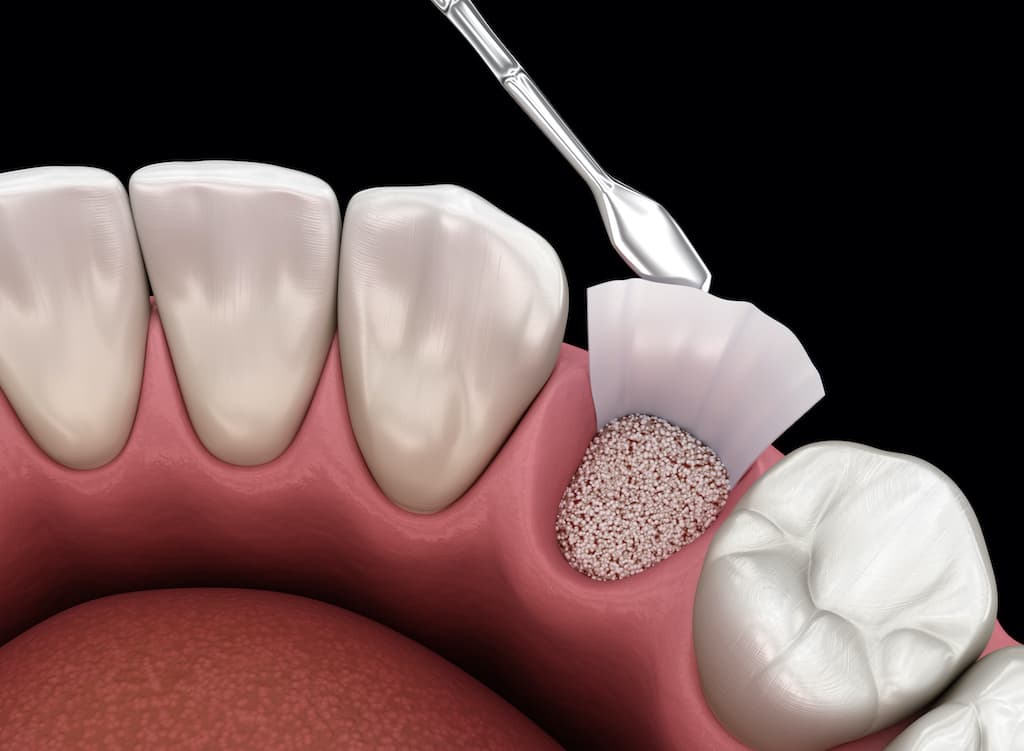
Placed into the empty tooth socket immediately following an extraction. This prevents the surrounding bone walls from collapsing and maintains the natural contours needed for future implant placement.
How does bone grafting work?
3D CBCT Assessment & Planning
We capture high-definition 3D imaging to evaluate bone quality, sinus boundaries, and precise grafting areas.
Anesthesia & Comfortable Preparation
Targeted local anesthesia combined with optional sedation ensures a completely relaxed, pain-free experience.
Biocompatible Material Placement
High-grade biocompatible graft material is placed precisely into deficient areas to act as a scaffold.
Healing & Osseous Integration
Over several months, your natural jawbone fuses with the graft scaffold, creating a rigid base for implants.
| Graft size | When implants can be placed |
|---|---|
| Minor graft (e.g. at tooth extraction) | As little as 3 to 4 months. |
| Larger reconstruction | 6 to 9 months, depending on the extent of bone loss. |
| Daily recovery | Most return to their normal routine within a day or two. |
Your dental bone graft, planned by the specialist who places your implant
A dental bone graft is not a standalone procedure — it's the first stage of your implant treatment. At Tribeca Dental Studio, the same specialist who grafts your bone is planning for the implant that's coming: the graft is sized, shaped, and positioned for the exact implant it will one day hold. That is the difference a bone graft specialist makes — one continuous plan, one team, no handoff between offices, no conflicting plans, no repeated imaging.
It's also why we so often graft at the moment of extraction. Placing graft material into the socket the same day — socket preservation — means one healing period instead of two, and it holds the bone volume your future implant needs. Our in-house implant specialist, Dr. Sam Morhaim, plans graft and implant together from the first 3D scan, and follow-up imaging — not a calendar — decides when your bone is ready.
Lost Bone Doesn't Have to Stay Lost
When a tooth is lost and not replaced, the jawbone begins a quiet process of resorption. Without the daily stimulation of a tooth root, the body literally reabsorbs the bone — sometimes up to 25% in the first year alone. Over time, this doesn't just complicate implant placement — it changes the shape of your face, making cheeks look sunken and the jawline less defined. Bone grafting interrupts that process and reverses it.
At Tribeca Dental Studio, bone grafting is never a one-size-fits-all procedure. Every case starts with cone-beam 3D imaging that shows us exactly where bone is missing, how much is missing, and which grafting technique will deliver the best outcome. For small defects, a minor graft placed at the time of extraction can preserve existing bone. For extensive loss, we rebuild entire sections of the ridge. The graft material — whether from your own body, processed donor bone, or synthetic biocompatible material — acts as a scaffold that your body colonizes with new, living bone.
Our downtown Manhattan patients are often surprised to learn that bone grafting is an outpatient procedure performed under local anesthesia with optional sedation, and that most return to their normal routine within a day or two. Over the following months, the graft integrates quietly. When we place the final implant, it anchors into bone that is genuinely yours — strong, living, and capable of supporting a restoration for decades.
Why We Plan Every Graft with 3D Imaging
A bone graft is not a guessing procedure. The exact amount of missing bone, its density, and its relationship to neighboring structures — sinuses, nerves, adjacent tooth roots — determine which technique will work and how much regeneration is possible. A traditional two-dimensional X-ray simply doesn't show all of that. That's why every graft case at Tribeca Dental Studio starts with a cone-beam 3D scan: we see your jaw in three dimensions, measure the defect down to the millimeter, and choose the grafting technique that will give you the best result.
This planning also makes the procedure more conservative. When we know exactly where healthy bone ends and the defect begins, we can use the minimum amount of graft material needed and keep the incision small. Less disturbed tissue means less swelling afterward, less discomfort, and faster healing. It's the difference between operating with a complete map and operating blind — and we'd never choose the latter for our patients.
The scan also tells us when your bone is ready for the implant. Instead of estimating integration time from a generic calendar, we verify the actual density of the new bone on follow-up imaging. Some minor grafts mature in three to four months; extensive reconstructions need more time. In both cases, the decision is based on what we see in your scan — not a guess. That's how we deliver predictable results, case after case.
Your graft, month by month: how it becomes your own bone
The day of the procedure is the short part. The graft itself is outpatient — local anesthesia with optional sedation — and most patients return to their normal routine within a day or two. For the first two weeks you will eat soft foods: yogurt, eggs, mashed potatoes, smoothies, soft fish, well-cooked pasta. Avoid chewing on the graft side, skip crunchy or seedy foods that could disturb the site, and let hot foods cool down first. We give you the full list at your appointment, and any mild soreness in those first days is easily managed with the medication we recommend.
What happens next is quiet, and it is the real treatment. The graft material — your own bone, processed donor bone, animal-source material processed for complete safety, or a synthetic biocompatible material — is not the final bone. It is a scaffold. Over the following months your body colonizes it: the material is gradually replaced by your own natural, living bone, until the rebuilt area is genuinely yours. Rejection is extremely rare precisely because every material is biocompatible and designed to be substituted by your tissue. If you smoke, we will tell you plainly: nicotine constricts blood vessels and reduces the blood supply the graft needs to integrate, which is why we ask patients to stop at least two weeks before and after the procedure — and we will be honest about how it affects your outcome if you don't.
In the meantime, you are not simply left waiting. At follow-up visits we examine the site, confirm that the surface healing looks as expected, and answer any questions about diet or soreness. If anything is not progressing as it should, we catch it at a check while it is still a minor adjustment — not when the implant is already scheduled. That oversight is part of the specialist's continuous plan: the same team that placed the graft is the team that verifies its conversion and the team that will place the implant on top of it.
How long does that conversion take? It depends on the size of the graft. Minor grafts — like socket preservation on the day of an extraction — can be ready for the implant in as little as 3 to 4 months. Larger ridge reconstructions need 6 to 9 months. And we don't decide by calendar: we decide by imaging. A follow-up 3D scan shows the actual density and maturity of the new bone, and only once the graft has fully converted into solid, living bone do we schedule the implant. That verified patience is what lets the implant anchor into a foundation that can support a restoration for decades.
“If the tooth is no longer there and the bone is good, the replacement process is actually very uneventful — very little recovery at all. What we hear from our patients is how unremarkable the procedure was. They're surprised, and we're thankful for their appreciation.”
— Dr. Nina Izhaky, Tribeca Dental Studio
Frequently Asked Questions
Is dental bone grafting painful?
+How long does a bone graft take to heal?
+Where does the bone material come from?
+What happens if I skip bone grafting before getting implants?
+Does bone grafting hurt?
+How long do I wait between grafting and implant placement?
+Will my body reject the graft material?
+Can bone grafting be done at the time of tooth extraction?
+Does smoking affect how a bone graft heals?
+What can I eat after a bone graft?
+How do I know when the graft is ready for an implant?
+Why does it matter that a specialist plans my bone graft and implant together?
+Which bone grafts are complex or specialty cases?
+Explore Related Services
TRIBECA • NEW YORK
Rebuild Your Foundation for Lifetime Implants
Schedule your consultation for bone grafting surgery with our oral surgery team in Lower Manhattan today.
SCHEDULE CONSULTATIONBone Grafting in Depth: Rebuilding the Foundation
When a tooth is lost, the bone that held it begins to shrink. Without a root to stimulate it, the jawbone in that spot gradually resorbs — narrowing and lowering over months and years — until there may not be enough bone left to anchor a dental implant securely. Bone grafting rebuilds that foundation.
Graft material is placed where bone has been lost, and over the following months your body replaces it with your own living bone, restoring the volume an implant needs and the contour your face and gums depend on.
Timing matters, and it is one of the first things we assess. A graft placed at the time of extraction — often called socket preservation — can hold the ridge's shape while the site heals, making later implant placement simpler and more predictable. A graft can also be placed months or years after a tooth was lost, rebuilding a ridge that has already narrowed.
Which approach fits you depends on when the tooth was lost, how much bone remains on your 3D imaging, and what the final restoration needs to achieve.
Healing is measured in months, not days, and we would rather be straightforward about that than rush a foundation. The grafted site needs time to consolidate before it can carry an implant, and placing an implant into bone that is not ready is how otherwise good plans fail. During healing we review the site, confirm progress on imaging, and only then schedule placement.
The wait buys stability that lasts: an implant anchored in solid, rebuilt bone is positioned where the final tooth needs it, not merely where the remaining bone happened to allow.
Recovery from grafting is usually straightforward. Most patients manage with standard post-operative guidance — protecting the site while the tissue closes, following the soft-food and hygiene instructions we give you in writing, and keeping review appointments so we can confirm the graft is integrating as expected.
If you are planning implant treatment, ask us at your evaluation how grafting fits your sequence, whether it can be combined with extraction or implant placement in your case, and what your realistic timeline looks like from first visit to final tooth.
Do I always need a bone graft before an implant?
No. Many implant sites have enough healthy bone to proceed without grafting, and we only recommend a graft when your 3D imaging shows the bone volume is genuinely insufficient for stable placement or for positioning the implant where the final tooth needs it. When a graft is needed, it is because the foundation determines the result: an implant placed in adequate bone, at the right angle and depth, supports a restoration that looks natural and carries bite forces properly.
Your evaluation shows you exactly what your bone looks like and why we are — or are not — recommending grafting.
How long after a graft can an implant be placed?
It depends on the size and location of the graft. Smaller grafts, such as socket preservation at extraction, may be ready for implant placement in a few months, while larger ridge rebuilds take longer to consolidate fully. We confirm readiness with imaging rather than the calendar alone, because placing an implant into bone that has not finished integrating risks the stability the graft was meant to create.
Your written plan lays out the expected sequence and timing for your case, and we update it at each review as healing is confirmed.
How We Plan Your Care at Tribeca Dental Studio
Every treatment at Tribeca Dental Studio starts with a diagnosis, not a sales pitch. Before we recommend anything, we examine the tooth or area in question, review imaging taken here in the office, and talk through what we see in plain language. You will always know what we recommend, why we recommend it, and what could safely wait.
That recommendation becomes a written plan, so the sequence, the timing, and the reasoning are clear before any treatment begins — and if a simpler option would serve you just as well, that is the option we will put in front of you.
Our studio brings every dental specialty under one roof at 54 Warren St in Tribeca, and it has since 2007. General dentistry, cosmetic care, implant surgery, periodontics, endodontics, orthodontics, airway care, and pediatric dentistry are handled by one team in one place, which means a treatment that touches several specialties is planned as a whole rather than handed off between offices across town.
Your records, your imaging, and your history stay with the same team from the first visit through every follow-up, so nothing is lost between providers and no step is planned in isolation.
We are open Monday to Friday from 8:00 AM to 6:00 PM, Saturday from 9:00 AM to 4:00 PM, and Sunday from 9:00 AM to 2:00 PM. You can book online at any time or call us at (212) 561-5303.
The studio sits between Greenwich Street and West Broadway, steps from the Chambers Street subway hub (1, 2, 3, A, C, E), with attended garages on Warren Street and Greenwich Street within a block of our door for patients who drive in.
Care does not end when the procedure does. We schedule reviews and follow-ups around your life, group staged treatment into planned steps when we can, and use each return visit to check healing and watch the details we flagged together. Between appointments we stay in touch with recall reminders and clear next steps, and if something feels off, we would rather see you quickly than have you wait and wonder.
The goal is a plan you understand, a team you recognize, and results that are checked over time rather than assumed.