The Step-by-Step Guide to Zygomatic Surgery
July 24, 2026
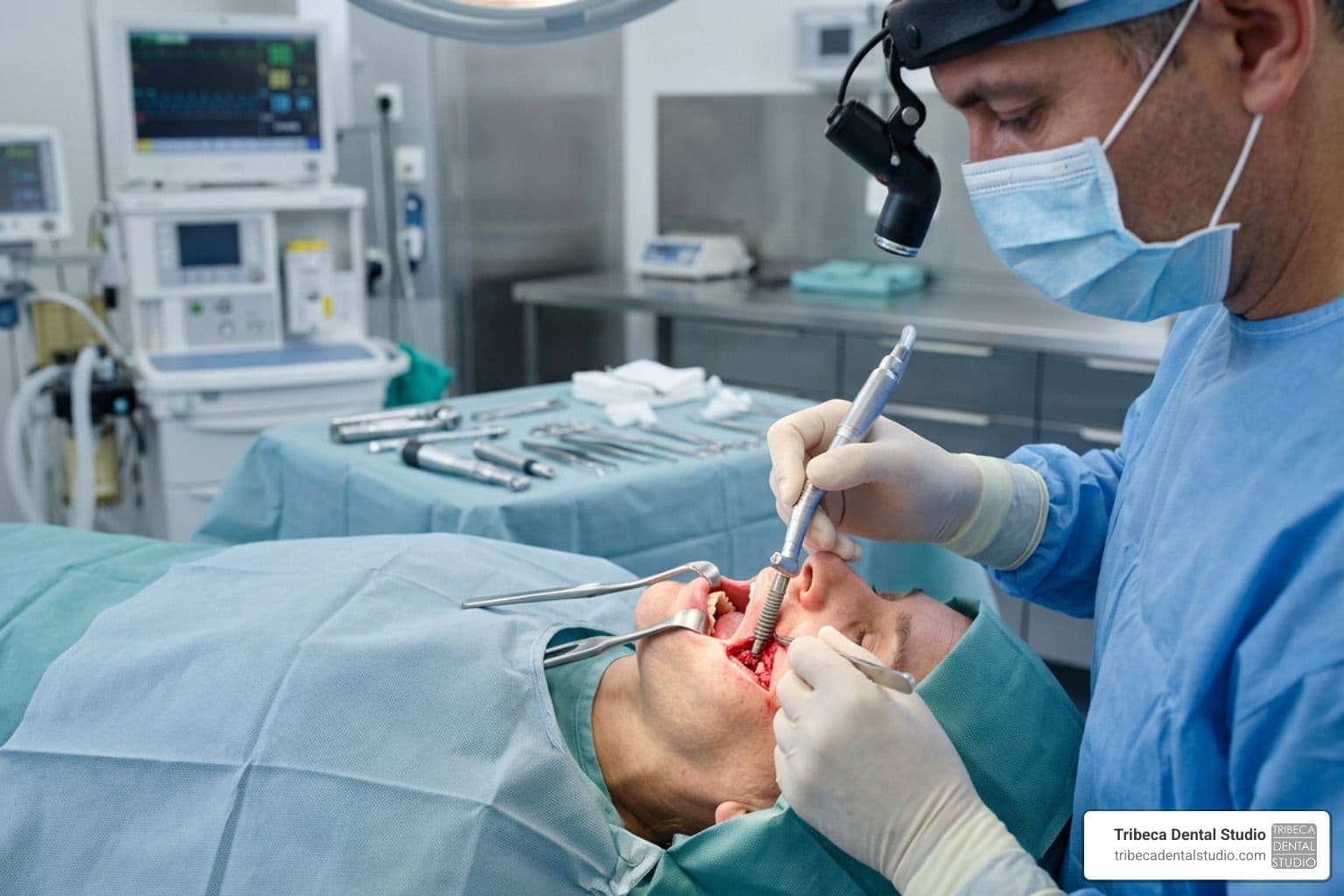
Zygomatic Implant Surgery: Procedure, Candidacy, Risks, and Recovery
What Is Zygomatic Implant Surgery — and Is It Right for You?
Zygomatic implant surgery is an advanced dental implant approach. It uses special implants made to get support from the zygomatic bone, or cheekbone. They do not rely only on the bone of the upper jaw.
This approach may be an option for some patients with severe bone loss in the upper jaw. For them, standard implants cannot be placed predictably without extensive bone grafting.
This treatment differs a lot from routine implant placement. These implants are longer. They follow a different anatomical pathway. The upper jaw, the maxillary sinuses, the cheekbones, and the structures around them must all be checked with care.
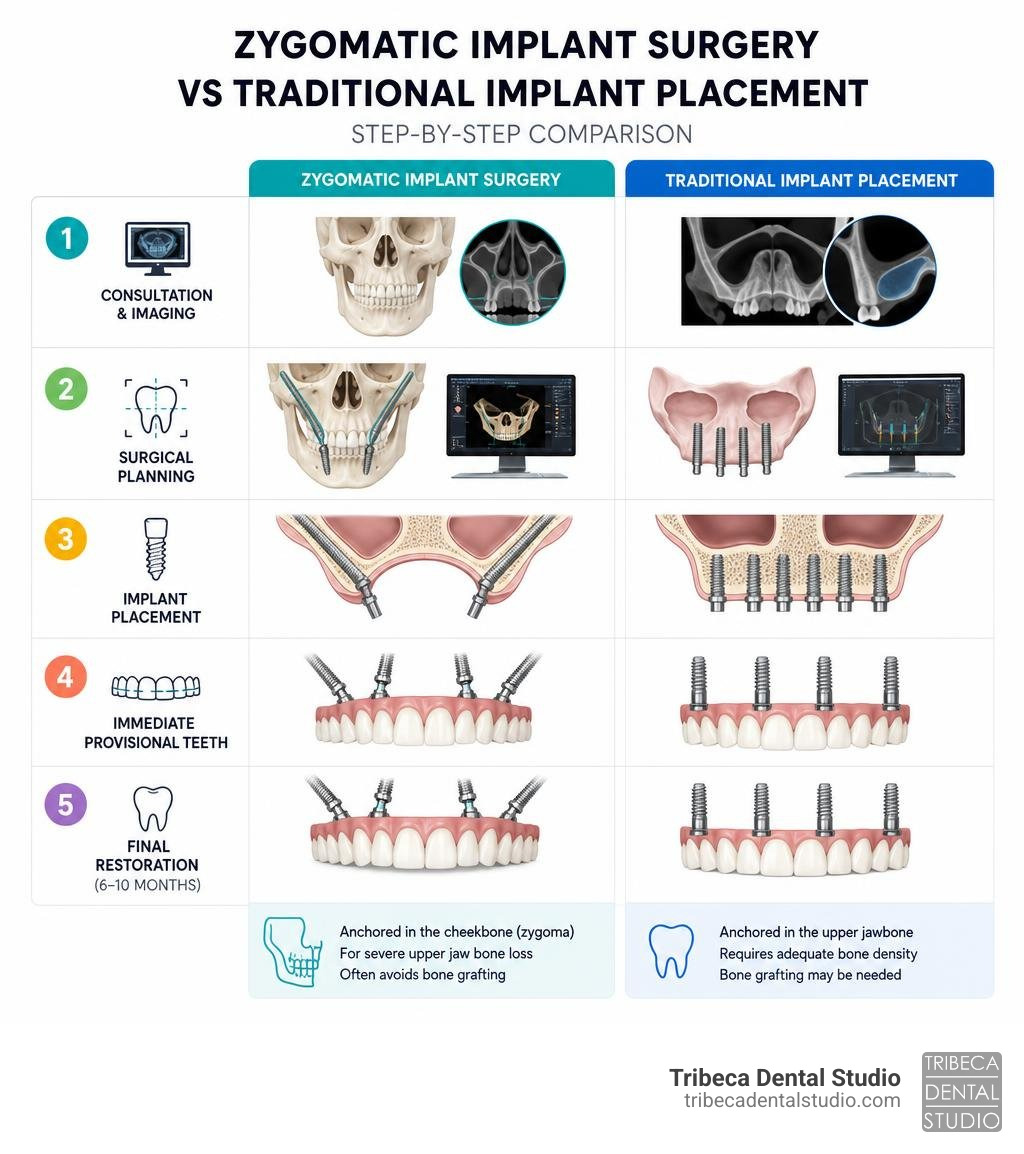
Here is a general overview of the treatment process:
- Consultation and imaging — Clinical examination and three-dimensional imaging are used to evaluate the upper jaw, zygomatic bone, maxillary sinuses, and surrounding anatomy.
- Treatment planning — Implant position, trajectory, restorative requirements, and alternative treatment options are evaluated.
- Implant placement — Specially designed implants are positioned to obtain support from the zygomatic bone.
- Provisional restoration — In selected cases with appropriate implant stability and restorative conditions, a temporary fixed restoration may be possible soon after surgery.
- Definitive restoration — After healing and clinical evaluation, the final prosthesis is designed according to the patient's restorative plan.
Zygomatic implants are most often discussed for advanced bone loss in the upper jaw. They may help patients who have been told that standard implants would require substantial bone grafting. But candidacy must always be decided for each patient.
This is a technically demanding form of implant treatment. Careful diagnosis is a key part of the process. So are surgical planning, planning for the final teeth, and long term maintenance.
This guide explains the anatomy and who may be a candidate. It covers treatment approaches, potential benefits, risks, and recovery. It also covers other factors patients may want to discuss during an implant consultation.
Discover more about advanced implant treatment:
Understanding Zygomatic Implant Surgery: Indications and Candidacy
The part of the jaw that supports teeth can change after tooth loss. Over time, some patients lose a lot of bone in the upper jaw. This happens most when teeth have been missing for many years. Other oral or health factors can affect the supporting structures too.
When the bone left in the upper jaw is not enough for standard implants, the team may consider many strategies. These can include bone grafting, sinus augmentation, alternative implant positions, pterygoid implants, zygomatic implants, or a mix of these approaches.
Zygomatic implants obtain their primary anchorage from the zygomatic bone. They use another path through the anatomy. This may let some patients with advanced upper jaw bone loss get fixed implant supported teeth. They do not have to rely fully on rebuilding the posterior upper jaw first.
The right treatment depends on the person's anatomy and medical history. It depends on sinus health, the needs of the final teeth, the teeth that are still there, past implant treatment, and other clinical factors.
Comparing Treatment Options for Severe Upper-Jaw Bone Loss
| Feature | Conventional Dental Implants | Bone Augmentation + Implants | Zygomatic Implant Treatment |
|---|---|---|---|
| Primary Anchorage | Available upper-jaw bone | Native bone plus augmented areas | Zygomatic bone with treatment-specific implant positioning |
| Bone Grafting | May or may not be required | Usually part of the treatment strategy | May reduce the need for extensive maxillary grafting in selected cases |
| Treatment Staging | Depends on implant stability and case complexity | Often involves additional healing stages | Varies according to anatomy, implant stability, and restorative plan |
| Surgical Complexity | Routine to advanced depending on case | Can involve multiple surgical procedures | Advanced and highly anatomy-dependent |
| Typical Use | Adequate or augmentable jawbone | Insufficient bone that can be reconstructed | Advanced maxillary bone loss in appropriately selected patients |
Clinicians may use classification systems to describe the degree and pattern of maxillary resorption, or loss of upper jaw bone. But the class alone does not decide whether these implants are right.
Before the team can recommend a treatment, they need 3D imaging and an exam. They need planning for the final teeth, and a review of the alternative approaches.
For more about alternatives to extensive bone grafting, see our guide: Can You Get Dental Implants Without a Bone Graft?
Who May Be Considered for Zygomatic Implants?
Zygomatic implants are designed for specific clinical cases. They are not a routine way to replace teeth.
Situations in which they may be evaluated include:
- Severe loss of bone in the upper jaw.
- Previous unsuccessful or unsuitable bone-grafting procedures.
- Complex full-arch reconstruction where conventional posterior implants cannot be positioned appropriately.
- Certain reconstructive cases involving major anatomical defects.
- Cases in which alternative anchorage is being considered because conventional implant placement is limited.
Zygomatic implants are not right for every patient.
Many factors may affect whether implant treatment is right, or how it should be planned. These include medical conditions, medications, smoking status, sinus health, and active oral disease. They also include past radiation treatment, how well a person can maintain oral hygiene, and other factors.
For more background on indications and the factors weighed in treatment, see the ITI consensus report on zygomatic implants .
Preparing for Zygomatic Implant Surgery: Preoperative Evaluation
Checks before surgery matter a lot here. Zygomatic implants are placed close to several complex structures in the body.
Cone Beam Computed Tomography, or CBCT, can give 3D details of the upper jaw and surrounding anatomy.
Depending on the case, the scan may help the team evaluate:
- The shape and dimensions of the zygomatic bone.
- The maxillary sinus and surrounding structures.
- The remaining upper-jaw bone.
- The relationship between the proposed implant pathway and nearby anatomical landmarks.
- Potential implant positions in relation to the planned prosthesis.
Planning for the final teeth matters too. Implant placement and the final prosthesis should be planned together. Where the implant sits affects where the prosthetic parts emerge. It affects hygiene access, speech, comfort, and long term maintenance.
For more, see our Zygomatic Dental Implants Guide .
Surgical Approaches: Intrasinus, Extrasinus, and Anatomy-Guided Planning
Zygomatic implant techniques have changed a lot since the treatment was first introduced.
Modern planning focuses more and more on fitting the surgical path to each patient's anatomy. It does not use exactly the same path for every patient.
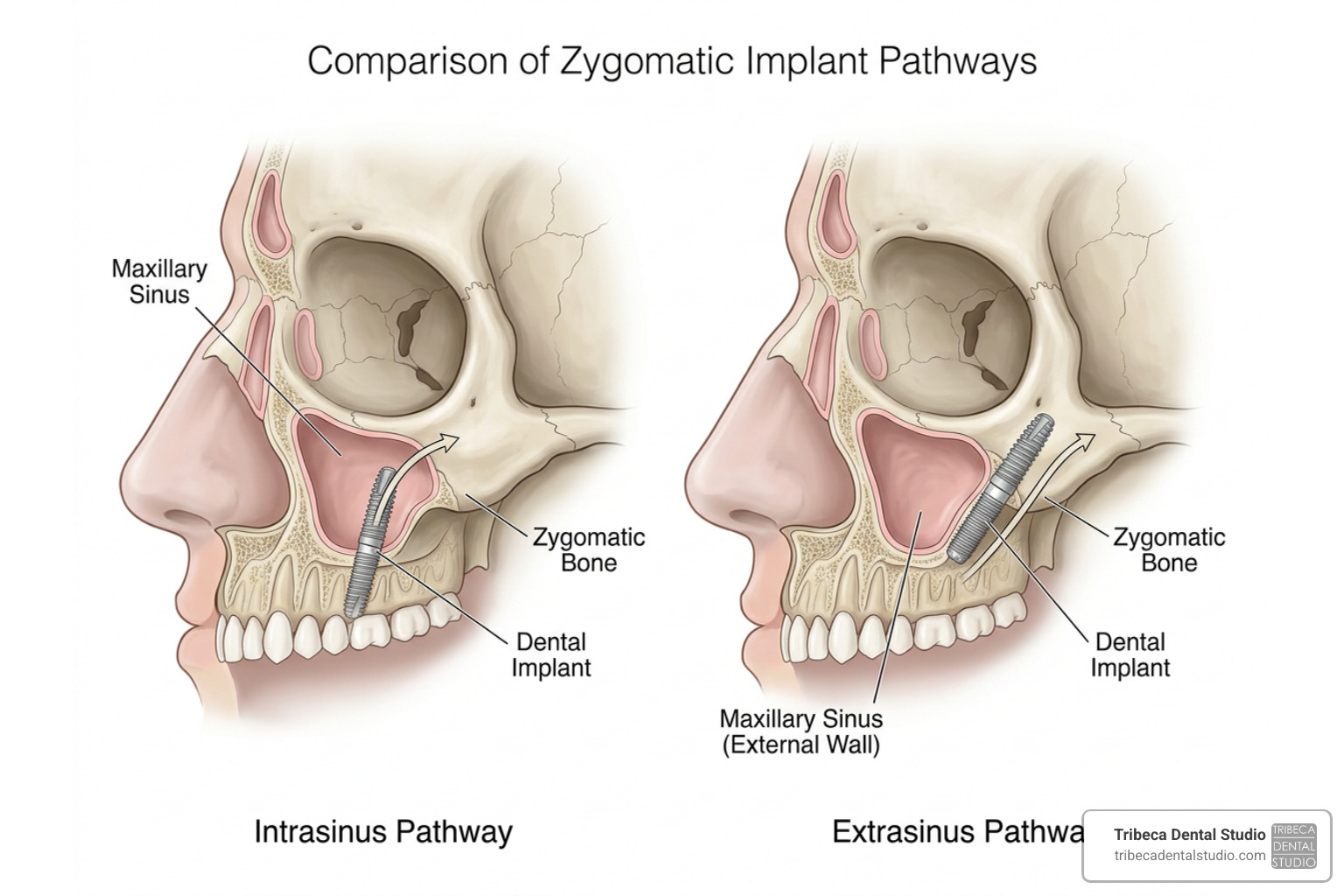
In broad terms, the implant pathway may travel partly through the maxillary sinus region. Or it may follow a more external path along the maxillary wall.
Anatomy-guided concepts, such as the Zygomatic Anatomy Guided Approach (ZAGA), were developed to help doctors adapt treatment. They fit the treatment to differences in the upper jaw and the cheekbone.
For a detailed discussion, see: The Zygoma Anatomy-Guided Approach for Rehabilitation of the Atrophic Maxilla .
Intrasinus Approach
The traditional intrasinus approach places part of the implant pathway by the maxillary sinus. The implant then obtains anchorage in the cheekbone.
The implant pathway runs close to the sinus region. So the anatomy of the sinus, and sinus health, are key points to weigh during treatment planning.
Possible findings or complications related to the sinus have been reported in clinical studies. That is why the right imaging and follow up matter for these cases.
Extrasinus and Anatomy-Guided Approaches
In some patients, the anatomy may allow the implant path to follow more of the outer surface of the wall of the upper jaw. It does not travel as much through the sinus cavity.
This can influence where the prosthetic parts emerge in the mouth. It may affect prosthetic design, hygiene access, and soft tissue management.
The patient's anatomy decides the right path. An extrasinus approach is not always better. It is not always less invasive for each patient.
Other techniques, including minimally invasive approaches, continue to be described in studies. Whether a technique suits a patient depends on the patient's anatomy, the clinician's training, how complex the case is, and the goals of the treatment.
How Zygomatic Implant Treatment Is Generally Performed
Zygomatic implant treatment requires specialized planning. The implants are longer than standard implants. They travel through a more complex region of the body.
Exact implant length, path, drilling sequence, surgical access, anesthesia, and restorative parts vary a lot. They vary between patients and between implant systems.
For that reason, what follows is a general overview for patients, not a surgical protocol.
General Treatment Sequence
Step 1: Anesthesia and Patient Comfort
The anesthesia or sedation approach is selected based on the patient's medical history. How complex the procedure is, the clinical setting, and the treatment plan play a role too.
Options may include local anesthesia, with or without sedation. Other anesthesia approaches may be used when appropriate for the case.
Step 2: Surgical Access
The surgical team creates access to the relevant anatomy of the upper jaw and cheekbone. They protect nearby soft tissues and structures as they work.
The exact approach depends on the planned implant path and the patient's anatomy.
Step 3: Preparing the Implant Site
The implant pathway is prepared with special instruments designed for this treatment.
3D planning, body landmarks, surgical technique, and implant-system protocols help guide the intended direction and depth of the implant.
Step 4: Verifying Position and Path
Before the final placement, the clinician confirms that the prepared pathway matches the treatment plan. It must provide the right position for both anchorage and prosthetic restoration.
Step 5: Implant Placement
The implant is positioned along the planned path. It obtains anchorage in the cheekbone.
Primary stability is checked. This is part of the decision on whether an immediate provisional restoration is right.
Step 6: Prosthetic Components and Closure
Restorative parts may be used to compensate for implant angulation. They create a proper prosthetic platform.
The surgical site is then managed based on the case. The restorative phase proceeds based on implant stability and the planned protocol.
You can learn more about implant treatment at Tribeca Dental Studio by visiting: Dental Implant Specialist Dr. Sam .
Provisional Teeth, Healing, and Long-Term Restoration
Zygomatic implants may be considered in full arch rehabilitation for one reason: a fixed provisional restoration may be provided fairly early in treatment. This is possible when the implants are stable enough and other conditions are appropriate.
This approach is often called immediate loading or immediate provisionalization.
Immediate loading does not happen by itself. The decision depends on implant stability, how the implants are spread, and bone conditions. Bite forces, prosthetic design, health factors, and the clinician's judgment matter as well.
During healing, this restoration may be adjusted as needed. At the same time, the implants integrate with the supporting bone.
After healing, the treatment team checks the implants and the tissues around them. Then they proceed with the definitive restoration.
Final prostheses may use different materials and designs. This depends on clinical needs and on the needs for the final teeth.
To explore implant treatment options, visit: Dental Implant Services .
Potential Complications and Long-Term Maintenance
Studies have reported good long term outcomes for these implants. The patients in these studies were selected and treated in the right way.
But survival percentages vary between studies. Studies differ in patient selection, surgical techniques, and implant designs. They differ in follow up periods, definitions of success, and other factors too.
No published survival percentage can predict the outcome for any one patient.
Possible complications reported in studies include:
- Sinus-related complications: Inflammation or other sinus findings can occur and may require additional evaluation or treatment.
- Soft-tissue complications: Irritation, recession, or exposure around implant or prosthetic components may occur.
- Sensory changes: Temporary or, less commonly, persistent altered sensation can occur when nearby nerves or tissues are affected.
- Implant-related complications: As with other implant treatments, failure to integrate, mechanical complications, or loss of an implant can occur.
- Prosthetic complications: Components of the provisional or final restoration can require adjustment, repair, or replacement over time.
Regular maintenance and professional exams can be key parts of long term care. So can good oral hygiene and checks on the implants, the prosthesis, and the sinus region.
For more, see: Zygomatic Dental Implant Complications .
Frequently Asked Questions About Zygomatic Implants
Can zygomatic implants be placed under local anesthesia?
In some cases, these procedures can be performed using local anesthesia, often with added sedation. This depends on the patient and the case.
Other cases may be performed using deeper sedation or general anesthesia.
The right approach depends on how complex the procedure is, patient health, and anxiety level. It depends on treatment setting, clinician preference, and other factors.
How Do Zygomatic Implants Compare With Pterygoid Implants?
Both zygomatic and pterygoid implants are advanced approaches. They may be considered when standard implant placement is limited by severe upper jaw bone loss.
- Zygomatic implants: Obtain support from the zygomatic, or cheekbone, region.
- Pterygoid implants: Obtain support from posterior anatomical structures in the pterygoid region.
They cannot be swapped for each other. The choice depends on where bone is missing and what anatomy is there. It depends on the design of the new teeth, sinus anatomy, and the overall treatment strategy.
In selected complex reconstructions, different advanced implant approaches may be combined. This is done when the anatomy and the plan for the new teeth support it.
For a closer look, see: Zygomatic vs. Pterygoid Implants .
What Is Recovery Like After Zygomatic Implant Surgery?
Recovery varies. It depends on the extent of surgery, the number of implants, and the anesthesia used. It depends on patient health, tissue response, and whether other procedures are performed.
During early recovery, patients may have swelling, bruising, discomfort, or temporary changes in sensation. Other symptoms after surgery may occur too.
The treatment team gives each patient their own instructions. These cover diet, oral hygiene, medications, activity, and follow up visits.
Healing continues beyond the first days or weeks. The implants integrate with the bone and tissues around them.
The timing of the definitive prosthesis depends on healing, implant stability, and the plan for the final teeth. It is not set by a single timeline that applies to every patient.
For a more detailed overview, see: Zygomatic Implant Healing Timeline .
Do Zygomatic Implants Always Eliminate the Need for Bone Grafting?
No. In some patients, zygomatic implants can reduce the need for certain types of extensive bone augmentation in the upper jaw. But they do not remove the need for grafting or other procedures in every case.
The treatment plan depends on how much bone is available, on implant positions, and on soft tissues. It depends on the needs of the final teeth, sinus anatomy, and the condition of any teeth that remain.
Can You Receive Fixed Teeth the Same Day?
A fixed provisional restoration may sometimes be placed on the day of implant surgery. This is possible when primary stability is adequate and other conditions are present.
But same day provisionalization is not guaranteed. The decision is made after checking implant stability, prosthetic design, and bite forces. The patient's own situation is weighed as well.
Understanding Your Options for Severe Upper-Jaw Bone Loss
Severe bone loss in the upper jaw can make standard dental implant treatment more complex. But many reconstructive approaches may be options.
Zygomatic implant surgery is one advanced option. It uses the cheekbone as an alternative anchorage site. This is used when the maxillary bone that remains cannot support standard implants well enough.
This treatment requires a careful check of the upper jaw, the cheekbone, and the sinuses. The team also checks the anatomy around them, the goals for the final teeth, the medical history, and potential alternatives.
Depending on the case, options may include standard implants, bone augmentation, and sinus procedures. They may include pterygoid implants, zygomatic implants, or a mix of approaches.
A personal clinical and X-ray check is needed. It shows which approach is right for that patient.
To learn more about this treatment option, visit the Zygomatic Implants service page at Tribeca Dental Studio.