Connective-Tissue Graft
Connective tissue is obtained from beneath the palatal surface and positioned over an exposed root. It may be used for one or several recession sites depending on anatomy and treatment goals.
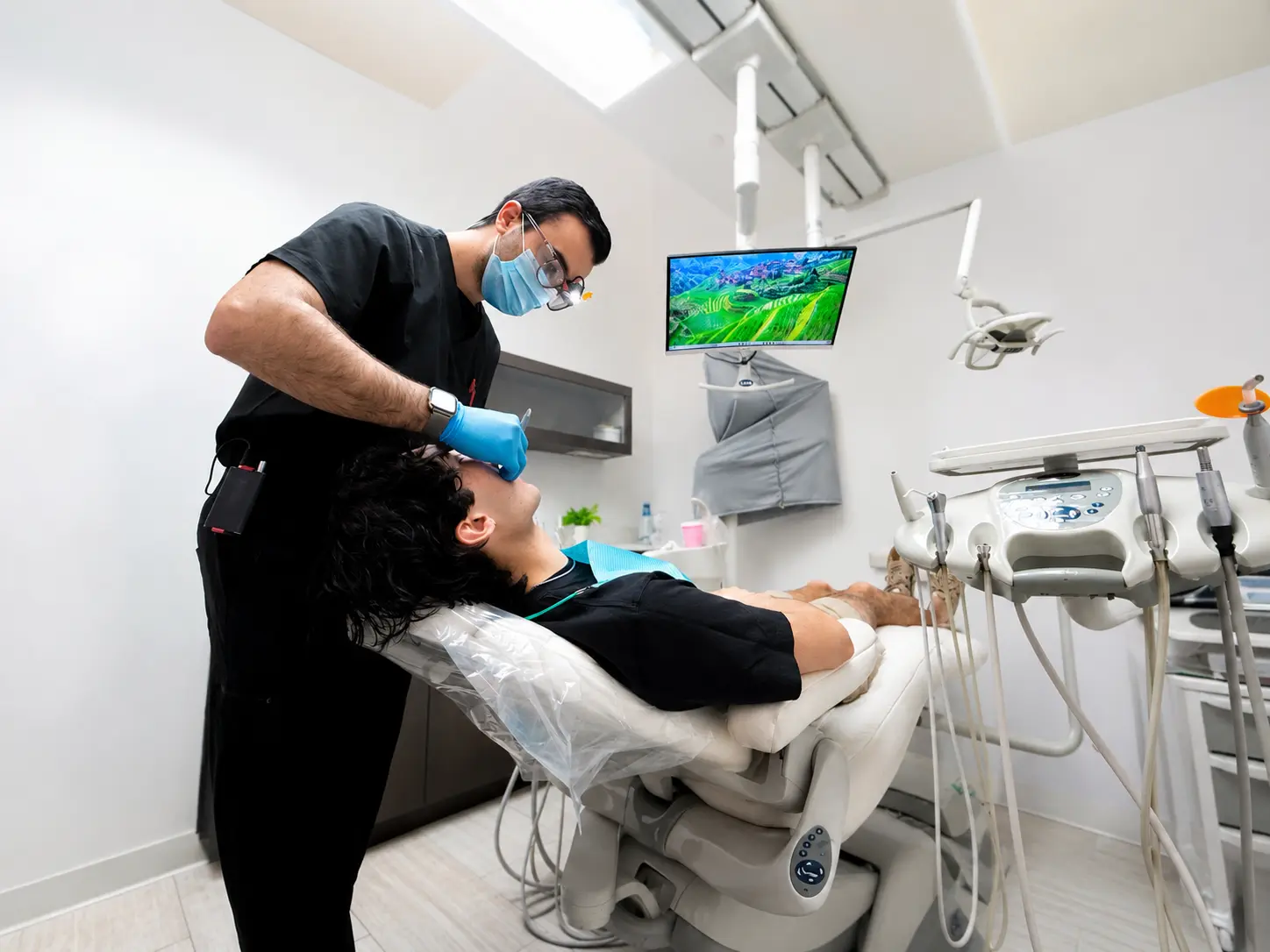
Restore lost gum tissue, cover selected exposed root surfaces, and support periodontal health. Gum grafting evaluations are available in Lower Manhattan.
The short answer
Gum recession quietly exposes your roots — and exposed roots are more vulnerable to decay, sensitivity, and further tissue loss. A gum graft covers those roots with tissue (from your own palate, donor tissue, or a collagen matrix), reducing sensitivity and guarding against future recession. It's outpatient under local anesthesia, and most patients are back at work the next day.
Gum recession occurs gradually as tissue pulls back, leaving delicate root surfaces exposed to temperature changes, bacteria, and decay. Whether caused by periodontitis, aggressive brushing, bruxism, or genetics, gum grafting surgery can rebuild the gumline, protect selected root surfaces, and may reduce sensitivity.
Covers selected exposed root surfaces and may reduce sensitivity to temperature or touch.
Rebuilds the band of keratinized gum tissue and may help protect vulnerable root surfaces and surrounding periodontal structures.
Can improve gumline symmetry and reduce the appearance of elongated teeth caused by recession.
Protects softer root dentin from bacterial invasion, plaque buildup, and aggressive root surface decay.
Connective tissue is obtained from beneath the palatal surface and positioned over an exposed root. It may be used for one or several recession sites depending on anatomy and treatment goals.
A layer of tissue is taken from the palate and attached to the recipient site. This approach may be considered when the primary goal is to increase the amount of firm keratinized gum tissue.
Nearby gum tissue is repositioned over the exposed root while maintaining part of its original blood supply. Not every recession pattern is suitable for this technique.
| Technique | When it's used |
|---|---|
| Connective-tissue graft | Connective tissue from the palate placed over the exposed root — common for root coverage. |
| Free gingival graft | A layer of palatal tissue to increase the amount of firm keratinized gum tissue. |
| Pedicle graft | Repositions nearby tissue while keeping part of its blood supply — not suitable for every recession pattern. |
Local anesthesia is used to support comfort. The surgical approach is selected based on the recession pattern and the type of graft planned.
Donor tissue is obtained from the palate or a biocompatible donor source using delicate microsurgical techniques.
The new tissue is precisely positioned over the exposed root and secured with ultra-fine sutures.
A protective dressing preserves the site as the graft integrates, restoring a healthy, strong gum barrier.
Patients searching “gum graft cost” want a number, and the honest answer is that the number depends on your mouth — which is why we give you an exact figure at your evaluation, never a guess online. What I can tell you straight: receded gums do not grow back, so the cost question is really “now, while the graft is smaller — or later, after more tissue and bone are gone?” These are the factors that set your exact number:
A single exposed root is a smaller procedure than several recession sites treated in one plan.
Connective-tissue, free gingival, and pedicle grafts involve different surgical work; your recession pattern decides which fits.
Your own palate, processed donor tissue, or a collagen matrix — each option carries different material and appointment considerations.
Active gum disease is addressed before grafting — sometimes in sequence with LANAP — so the graft is placed in a healthy foundation.
At your evaluation we examine the recession, confirm the plan, and give you an exact number with financing options. We don't bill insurance directly.
Gum recession is one of those problems that advances quietly. A millimeter here, another there — until one day you notice your teeth look longer, you feel sensitivity with something cold, or you see a yellowish tone near the gumline where root is exposed. Causes vary: aggressive brushing, gum disease, teeth grinding, even genetics. But the result is the same: exposed roots that are more vulnerable to decay, sensitivity, and further tissue loss.
Gum grafting reverses that process. We take tissue — from your own palate, processed donor tissue, or a collagen matrix — and place it carefully over the exposed roots, where it integrates with existing tissue. Beyond covering roots and reducing sensitivity, the graft creates a thicker, more resilient band of attached gum that guards against future recession. And there's a benefit our patients value enormously: the smile looks more balanced and youthful when the gumline returns to its natural position.
At Tribeca Dental Studio, we perform gum grafting as an outpatient procedure under local anesthesia, and most of our downtown Manhattan patients return to work the next day. The palate donor site — when we use your own tissue — heals within one to two weeks with the aftercare we provide. If the idea of a graft concerns you, a consultation at our Warren Street office will give you a clear picture of what to expect, with no obligation.
Patients often arrive asking for a gum graft when what they actually need is LANAP — or vice versa. They're two answers to two different problems, and the evaluation is what tells them apart. LANAP treats active gum disease: the laser clears infection from beneath the gumline and stimulates bone and tissue to regenerate, all without scalpels or stitches. It's for mouths where the disease is still doing damage right now.
Grafting is for what the disease — or aggressive brushing, grinding, or genetics — already took away. When roots are exposed and the gumline has receded, no laser can put that tissue back; a graft covers the roots, thickens the gum, and guards against future loss. Sometimes the honest answer is both: LANAP to stop the active infection, then grafting to rebuild what's missing. That's exactly the kind of sequencing our evaluation is designed to map out.
And whichever path your mouth needs, the approach here is minimally invasive. Dr. Sam Morhaim was one of the first periodontists to adopt LANAP — the healing is phenomenal, with recovery more like a filling than a surgical procedure. If the idea of gum surgery makes you nervous, come in for the evaluation first. You'll leave knowing exactly what your gums need and why — never a treatment you didn't ask to understand.
The question every patient asks before a graft is not about technique — it's about the week after. Here is what actually happens. The procedure is outpatient and performed under effective local anesthesia, so during surgery you feel nothing. The tissue is positioned over the exposed root and secured with ultra-fine sutures, and a protective dressing preserves the site as the graft begins to integrate. Most of our patients return to work the next day and to normal activities within 24 to 48 hours. Discomfort afterward is mild and managed with prescribed medication; nearly everyone describes the recovery as far easier than they expected.
If tissue is taken from your own palate, that donor site heals within one to two weeks with the aftercare we provide. At the recipient site, full graft integration takes several weeks: the tissue bonds, establishes its blood supply, and gradually becomes your own gum. Sensitivity usually improves early — many patients notice that cold and heat stop bothering them well before healing is complete — and the gumline settles gradually over that period. We give you clear aftercare instructions for each stage and see you for follow-up to confirm the integration is progressing as it should.
Protecting the result afterward is simple but important. Grafted tissue is thicker and more resilient than the original, which makes it far less prone to future recession — but the original cause still matters. If your recession came from aggressive brushing, we will work on a gentler technique; if gum disease was involved, regular periodontal maintenance is what keeps the foundation healthy. Periodic check-ups let us watch the gumline and act early if any area starts to pull back again. A well-cared-for graft is meant to last — and most of our patients need that single procedure in the treated area only.
It also helps to know what is normal and what deserves a call. Normal: mild discomfort in the first days, a gumline that looks like it is still settling for several weeks, and sensitivity that improves in stages. Worth a call: discomfort that increases instead of fading, or any change at the site that worries you. Our team would rather you call and hear that everything is on track than sit at home wondering. And if you are still deciding, the evaluation commits you to nothing: we examine the recession, confirm the plan, and give you an exact number with financing options — we don't bill insurance directly — so you can decide with the full picture.
One practical detail to finish: the protective dressing that preserves the site in the first days is part of the procedure, not an extra. It is there so the graft can integrate undisturbed while it establishes its blood supply — and at your follow-up we confirm it has done its job before it is removed or left to release as instructed. It is a small example of how the whole process is designed: every element, from the micro-sutures to the dressing, exists to protect the integration during the weeks when it happens.
“Gum graft” sounds like a single procedure, but it is really a family of techniques, and choosing the right one is much of what your evaluation decides. Your recession pattern leads: how many roots are exposed, how much firm tissue remains around them, the thickness of your current gum, and whether the main goal is covering roots, gaining keratinized tissue, or both. A connective-tissue graft — tissue taken from beneath the palatal surface and positioned over the exposed root — is the usual choice when root coverage is the goal, and it can treat one or several recession sites depending on the anatomy of the case.
When the main problem is not an exposed root but a band of firm gum that is too thin, a free gingival graft may be considered: a layer of palatal tissue attached at the recipient site to increase the amount of keratinized gum. And in some patterns, nearby tissue can be repositioned over the root while keeping part of its original blood supply — the pedicle graft — though not every recession pattern is suitable for it. The tissue source matters too: your own palate, processed donor tissue, or a collagen matrix, each with advantages we discuss at your consultation. The right technique is the one your anatomy asks for — and you will leave the evaluation knowing which it is and why.
And one plan can treat several areas. A single exposed root is a smaller procedure than several recession sites treated in one plan, and when there are multiple sites, the evaluation decides whether to address them together or in sequence — weighing your comfort, the tissue available, and how each site will heal. That planning up front is also what makes the cost predictable: instead of discovering the work site by site, you know the complete plan and its exact figure before anything begins.
“Dr. Sam did the FOX interview on the LANAP procedure — he was one of the first to start using it. The healing is phenomenal, the recovery minimal — similar to a regular filling rather than a full surgical recovery with stitches. We also add additional protocols that enhance the results and bone regeneration. It's really short of a magical wand!”
— Dr. Nina Izhaky, Tribeca Dental Studio
With effective local anesthesia, you feel nothing during the procedure. Afterward, discomfort is mild and managed with prescribed medication. Most describe recovery as far easier than expected.
It can come from your own palate (the gold standard), processed donor tissue, or a collagen matrix. Each option has advantages depending on your case, which we discuss at your consultation.
Most return to normal activities within 24 to 48 hours. Full graft integration takes several weeks, during which we give you clear aftercare instructions.
Yes. By covering exposed roots and restoring the natural gumline, teeth look more proportioned and the smile more youthful. It's one of the benefits patients notice immediately.
Grafted tissue is thicker and more resilient than the original, making it far less prone to future recession. Gentle brushing technique and regular check-ups protect the result long-term.
LANAP treats active infection beneath the gumline; grafting rebuilds tissue already lost to recession. A periodontal evaluation determines which your mouth needs — and sometimes the honest answer is both, in sequence.
Yes. First LANAP stops the active disease and stimulates regeneration; then grafting covers the roots that remain exposed. Our periodontal team plans the full sequence under one roof.
It depends on how many areas need grafting, the technique, and the tissue source — your own palate, donor tissue, or a collagen matrix. We'll give you an exact number at your evaluation and walk you through financing. We don't bill insurance directly.
Most return to normal activities within 24 to 48 hours, and full graft integration takes several weeks. Sensitivity usually improves early, and the gumline settles gradually as healing completes.
RELATED PERIODONTAL CARE
Learn how inflammation, periodontal pockets, and loss of supporting tissues are evaluated.
Review when laser-assisted periodontal therapy may be considered as part of a gum-disease treatment plan.
Explore gum and bone recontouring for selected restorative or aesthetic indications.
How we treat gum recession and exposed roots at our Tribeca studio.
See how the cause of a gummy smile — extra gum, lip movement, or tooth position — is evaluated and matched to the right correction.
What a gingivectomy treats, how excess gum tissue is reshaped with laser precision, and what healing is really like.
TRIBECA • NEW YORK
Schedule your consultation for gum grafting surgery in Lower Manhattan today.
SCHEDULE CONSULTATIONGum recession is the loss of the tissue margin around a tooth, exposing root surface that was never meant to meet the mouth. Roots are softer than enamel, so exposure brings a predictable list: sensitivity to cold and sweet, a higher risk of decay on the root itself, a notched, aged look to the tooth, and — where recession is progressing — a shrinking foundation for the tooth.
Gum grafting rebuilds that margin: tissue is added where it has been lost, covering the exposed root, thickening the tissue against further recession, and restoring the protective collar the tooth was designed with.
Why the gum receded decides whether a graft will hold. Recession has drivers — aggressive brushing, thin natural tissue, teeth positioned at the edge of their bone, grinding forces, gum disease — and grafting over an active driver builds on sand. Assessment here therefore reads the cause first: technique is coached where brushing is the culprit, bite forces are addressed where grinding loads the tissue, and inflammation is treated before any graft is planned.
The graft then succeeds because the conditions that caused the loss have been corrected, which is the difference between a procedure and a treatment plan.
The graft itself most often uses your own tissue, repositioned or transplanted from elsewhere in the mouth, or a processed graft material where that serves the case better — a choice we explain in terms of your sites, your tissue thickness, and how many teeth are involved. Healing is protected and reviewed, and the result is judged over months as the tissue matures into its final position.
The aim is a margin that looks natural, feels comfortable, and resists the forces that created the problem — measured at reviews against your starting photographs and probing records, so the improvement is documented rather than remembered.
It is one of the most worthwhile questions in periodontics, and the answer splits. Exposed root that is sensitive, or where decay has started on the root surface, or where recession is demonstrably progressing — those sites need treatment, and grafting addresses both the sensitivity and the cause. A stable, asymptomatic recession that has not changed across years of measurement may be a monitoring case, with grafting held in reserve.
The assessment measures your recession precisely, compares it to your records where they exist, and tells you which of your sites fall in which category — with the honest option of watching the stable ones on a defined review schedule.
Every treatment at Tribeca Dental Studio starts with a diagnosis, not a sales pitch. Before we recommend anything, we examine the tooth or area in question, review imaging taken here in the office, and talk through what we see in plain language. You will always know what we recommend, why we recommend it, and what could safely wait.
That recommendation becomes a written plan, so the sequence, the timing, and the reasoning are clear before any treatment begins — and if a simpler option would serve you just as well, that is the option we will put in front of you.
Our studio brings every dental specialty under one roof at 54 Warren St in Tribeca, and it has since 2007. General dentistry, cosmetic care, implant surgery, periodontics, endodontics, orthodontics, airway care, and pediatric dentistry are handled by one team in one place, which means a treatment that touches several specialties is planned as a whole rather than handed off between offices across town.
Your records, your imaging, and your history stay with the same team from the first visit through every follow-up, so nothing is lost between providers and no step is planned in isolation.
We are open Monday to Friday from 8:00 AM to 6:00 PM, Saturday from 9:00 AM to 4:00 PM, and Sunday from 9:00 AM to 2:00 PM. You can book online at any time or call us at (212) 561-5303.
The studio sits between Greenwich Street and West Broadway, steps from the Chambers Street subway hub (1, 2, 3, A, C, E), with attended garages on Warren Street and Greenwich Street within a block of our door for patients who drive in.
Care does not end when the procedure does. We schedule reviews and follow-ups around your life, group staged treatment into planned steps when we can, and use each return visit to check healing and watch the details we flagged together. Between appointments we stay in touch with recall reminders and clear next steps, and if something feels off, we would rather see you quickly than have you wait and wonder.
The goal is a plan you understand, a team you recognize, and results that are checked over time rather than assumed.