Factor 01
Dietary Stains
Coffee, red wine, dark teas, balsamic vinegar, curry, and highly pigmented foods.
Zoom teeth whitening at Tribeca Dental Studio in Lower Manhattan — Philips Zoom® in-office whitening and custom take-home options. Your treatment can be tailored to your goals, tooth shade, and sensitivity.
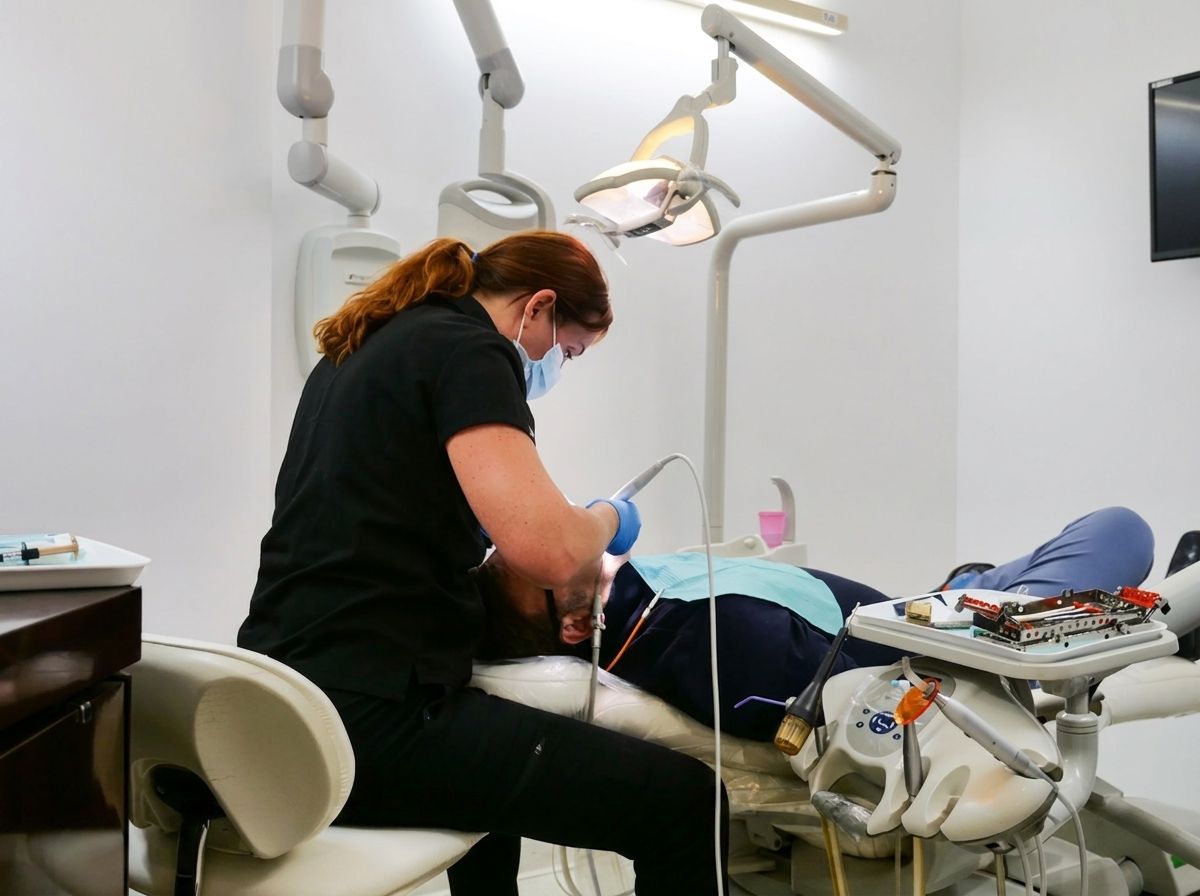
The short answer
Professional teeth whitening at our Tribeca studio brightens your smile up to 8 shades in a single 45-minute Philips Zoom® session. We also offer laser-activated whitening for deep stains and custom take-home kits made from 3D digital impressions. Every treatment is matched to your sensitivity level — because no two smiles whiten the same way.
Tribeca Dental Studio provides professional teeth whitening in NYC from our dental studio at 54 Warren Street in Tribeca, Lower Manhattan. Patients can choose from Philips Zoom® in-office teeth whitening and custom take-home whitening options based on their goals, current tooth shade, existing restorations, and sensitivity concerns.
For patients looking for Zoom teeth whitening in NYC, in-office treatment offers a dentist-supervised option for faster whitening, while custom whitening trays provide a more gradual and flexible approach at home. A consultation allows our dental team to evaluate which professional whitening option is appropriate for your smile.
Select the ideal whitening path tailored to your schedule, lifestyle, and sensitivity level:
Our flagship procedure. Professional-strength gel activated by intense blue LED light to brighten teeth up to 8 shades in just 45 minutes.
Employs a specialized dental laser to activate gel breakdown, ideal for tetracycline staining or patients wanting minimal session time.
Custom-molded trays created from 3D digital impressions, paired with clinical-grade gel for flexible, gradual home whitening.
| Option | Best for |
|---|---|
| Philips Zoom® in-office | Fastest results: up to 8 shades in 45 minutes |
| Laser-activated whitening | Deep stains or tetracycline, ultra-short sessions |
| Custom take-home kits | Gradual whitening with custom trays from 3D impressions |
A relaxed, clinically supervised in-office experience from start to finish:
We apply a protective barrier film over your lips and soft gums so only tooth enamel receives gel exposure.
Proprietary hydrogen peroxide formula is carefully painted across the front surfaces of your visible smile.
The Zoom® blue LED light illuminates the gel to speed up stain oxidation. Repeated up to 4 fifteen-minute cycles.
After the final cycle, we seal teeth with Relief® ACP desensitizing gel to instantly rehydrate enamel and block nerve sensitivity.
Outer enamel is naturally translucent, covering the yellow dentin below. As enamel thins or absorbs pigments, discoloration occurs:
Coffee, red wine, dark teas, balsamic vinegar, curry, and highly pigmented foods.
Tar and nicotine create stubborn brown and yellow surface deposits that toothbrushing cannot shift.
As enamel wears down over time, the naturally darker, yellow dentin layer beneath becomes visible.
Tetracycline exposure during tooth formation, nerve trauma, or legacy amalgam fillings.
Professional teeth whitening may be an option if you want to brighten the shade of your natural teeth or reduce visible staining associated with coffee, tea, red wine, tobacco, and other everyday pigments.
Whitening agents work on natural tooth structure but do not change the shade of porcelain crowns, veneers, or composite restorations. If you already have dental restorations, experience tooth sensitivity, or are unsure what is causing discoloration, an evaluation before whitening helps determine the appropriate approach.
Whitening is designed to brighten natural tooth structure and visible discoloration.
Crowns, veneers, and composite restorations do not change shade with whitening agents.
Results typically last between 1 and 4 years. You can maximize longevity by maintaining good oral hygiene, using a straw for dark drinks like coffee, and utilizing custom home touch-up trays occasionally.
No. Professional whitening agents only act on natural tooth enamel and dentin. They will not alter the shade of porcelain crowns, veneers, or composite restorations. We recommend whitening prior to placing new cosmetic work so ceramics can match your new bright shade.
Store-bought strips contain very weak peroxide concentrations and fit loosely over teeth, often leading to splotchy results or gum irritation. Clinical Zoom® uses potent, regulated gels and custom barrier technology under dentist supervision for dramatic, uniform shade transformation.
Yes. Tribeca Dental Studio offers Philips Zoom® in-office teeth whitening at 54 Warren Street in Tribeca, Lower Manhattan, along with custom take-home whitening options. During your consultation, our dental team can review your current tooth shade, existing restorations, and sensitivity concerns before selecting a whitening approach.
Philips states that Zoom® WhiteSpeed can produce noticeable whitening during approximately 45 minutes of treatment. The complete appointment may take longer because preparation, protection of the gums and soft tissues, evaluation, and post-treatment care are also part of the visit.
Temporary tooth sensitivity can occur with whitening procedures. If you already have sensitive teeth, let our dental team know before treatment. We can evaluate your sensitivity and discuss appropriate in-office or take-home whitening options along with measures intended to improve comfort.
We welcome teeth-whitening patients from across Lower Manhattan. Find your neighborhood below for directions, parking, and local details.
Transform your smile quickly and painlessly in the heart of Lower Manhattan.
Book Whitening Appointment NowGetting here from Tribeca is a short walk, not a trip, and that is how most of our neighbors arrive. If you are coming by subway, the 1, 2, 3, A, C, and E trains stop at Chambers Street, about a five-minute walk up Warren to our door. The 4, 5, and 6 at Brooklyn Bridge–City Hall are ten minutes on foot through the civic center, and the J and Z also stop at Chambers Street for the east-side connection. Citi Bike stations sit on Warren Street and Greenwich Street, and New Jersey commuters can take PATH to the World Trade Center Oculus.
When you arrive at 54 Warren Street, we keep the day simple and unhurried from the moment you check in. Our team works together under one roof, so your visit stays in one place instead of sending you across town for another appointment or another opinion. We talk through what brought you in, take any imaging we need here in the office, and explain what we are seeing in plain language before we discuss next steps together. You will always know what we recommend, why we recommend it, and what can wait, so you leave with a clear plan rather than unanswered questions.
Life in Tribeca moves between the cast-iron lofts on Franklin Street, the towers along West Street, and afternoons with families at Washington Market Park, and we schedule with that rhythm in mind. We are open Monday through Friday from 8 AM to 6 PM, Saturday from 9 AM to 4 PM, and Sunday from 9 AM to 2 PM, and you can book online any time or call us at (212) 561-5303. Street parking here is tight, with cobblestone blocks and film shoots, but attended garages on Warren Street and Greenwich Street sit within a block of our door. Follow-ups stay with our same team, so your care feels continuous.
Ongoing care is where being neighbors really pays off for our Tribeca patients. A six-month recall is just a short walk over, a quick check-in with the team who already knows your history, and a cleaning that fits between school drop-off and the rest of your day. When treatment takes more than one visit, we sequence it sensibly, review healing in person, and adjust the plan together rather than by phone tag. Because we have cared for families here since 2007, we notice small changes early, keep your records continuous, and remind you when you are due — so staying on track never feels like starting over.
Professional whitening suits patients in Tribeca whose natural teeth have picked up staining from coffee, tea, wine, or tobacco over the years. It works only on natural tooth enamel, so crowns, veneers, bonding, and fillings will not change shade during treatment. That is why we examine your teeth and gums first and talk honestly about what is realistic for your starting shade and type of staining. Surface stains usually respond well, while deep intrinsic stains from medications or trauma respond less. If whitening is not right for you, we will not sell it to you. Instead, we record your baseline shade, discuss any visible restorations, and plan the sequence so new dental work can be matched afterwards if needed.
Our in-office treatment uses Philips Zoom, a professional-strength hydrogen peroxide gel activated by blue LED light in controlled cycles. A single visit takes about forty-five minutes from start to finish, and most patients see several shades of improvement before they leave. Before any gel is applied, we carefully shield your gums and lips, because protection is the step bargain whitening often skips. The gel then works inside the enamel, breaking up years of staining in measured cycles rather than in one uncontrolled application. We record your starting shade first, so progress is measurable rather than guessed, and we whiten toward a target chosen for your skin tone and age, bright but still believable.
Sensitivity is the most common concern with whitening, and it is the number-one reason people quit halfway with unsupervised products. We screen for sensitivity before treatment, use desensitizing protocols during the visit, and adjust the plan when teeth are already sensitive. Some patients still feel temporary sensitivity during or after treatment, but for most it fades within a day or two. We finish with an anti-sensitivity protocol and clear aftercare guidance, including what to avoid for the first forty-eight hours. Compared with one-size strips, which use weaker gel and can leave uneven results and irritated gums, our approach is stronger, more even, and supervised after an examination, with your gums shielded and your starting shade recorded for comparison.
Results typically last one to three years with reasonable care, including brushing, flossing, and moderating coffee, tea, red wine, and tobacco. For patients who prefer to whiten gradually, or who want a simple way to maintain an in-office result, we make custom-fitted take-home trays. Because the trays fit your teeth exactly, they give even coverage without the gum irritation that comes with one-size strips. Touch-ups become straightforward whenever brightness begins to fade. Maintenance also means thinking ahead about restorations: whitening will not change crowns or fillings, so we plan the timing carefully and, when new work is needed, match it to your whitened shade rather than your older one. That planning keeps the overall result even, believable, and consistent across your whole smile.
At Tribeca Dental Studio, whitening for patients from Tribeca starts with diagnosis, not a special offer. We have served downtown since 2007 from 54 Warren Street, with every dental specialty under one roof, so whitening can be planned alongside the rest of your care in a written plan. Our hours are Monday to Friday 8 AM to 6 PM, Saturday 9 AM to 4 PM, and Sunday 9 AM to 2 PM, and you can reach us at (212) 561-5303. Whether you choose in-office Zoom, custom trays, or both, we begin with an exam, protect your gums, manage sensitivity, and aim for a shade that looks rested and natural, never templated.
Before you start, we suggest asking a few practical questions, starting with whether whitening is genuinely right for your teeth. At our exam for patients from Tribeca, we check your teeth and gums, record your starting shade, and talk through the type of staining you have, because surface stains usually respond well while deep intrinsic stains respond less. Ask whether you have crowns, veneers, bonding, or fillings that will not change shade, and how we would sequence any new work afterwards. Ask about sensitivity, too: we screen for it first and adjust the plan if needed. Finally, ask whether in-office Philips Zoom, custom take-home trays, or both fit your goals, and what target shade will look bright but believable for you. Ask also how long results typically last and what aftercare involves for the first forty-eight hours, so expectations are clear in your written plan before we begin.
Most patients see several shades of improvement from a single in-office Zoom session, although results vary by starting shade and the type of staining present. Surface stains from coffee, tea, and wine usually respond better than deep intrinsic stains from medications or trauma. At your visit, we assess your teeth honestly, record your starting shade, and tell you what is realistic before we begin treatment.
Strips use weaker gel in a one-size shape, which means uneven results and irritated gums for many people. Our custom trays are made to fit your teeth exactly, giving even coverage for gradual whitening or maintenance. Professional in-office whitening is stronger still, applied precisely with your gums protected and sensitivity managed, and it is supervised by a dentist who has examined your teeth first.
Whitening gel only works on natural tooth enamel, so crowns, veneers, bonding, and fillings will not change shade during treatment. If you have visible restorations, we plan around them from the start. The usual sequence is to whiten first, reach your target shade, and then match any new dental work to that new shade, so your smile looks even rather than patchy afterwards.
In-office Philips Zoom takes about forty-five minutes and most patients see several shades of improvement before they leave, which suits patients who want a supervised result in one visit. Custom trays are made to fit your teeth exactly for gradual whitening or maintenance, with even coverage. At your exam, we discuss your starting shade, staining type, sensitivity, and any restorations, then recommend the option, or combination, that fits your goals.
The whitening guide above gives the full treatment picture — how Philips Zoom works, how sensitivity is managed, what results realistically last. This section adds the two planning points that decide most whitening cases at this studio. The first is sequence: whitening changes only natural enamel, so it is scheduled before any new crowns, veneers, bonding, or fillings in the visible zone, and those restorations are then matched to your whitened shade. Whitening done after restorative work, or without asking what work is planned, produces the patchwork smile patients come to us to fix — the planning conversation is what prevents it, and it takes five minutes at your exam.
The second point is the target. Whitening is measured against a shade we choose together — bright, but believable for your skin tone, your age, and the natural character of your teeth — recorded before treatment so the result is verified against your starting point rather than judged by memory under different light. If your staining is the deep, intrinsic kind that responds poorly, we will tell you at the exam and discuss the options that genuinely reach it, rather than selling sessions whose ceiling we already know. Whitening done this way — examined first, sequenced correctly, aimed at a believable target — is why a supervised result looks different from a strip result, and lasts the way the guide describes.
The whitening guide above covers the treatment itself, so the practical answer: choose in-office Zoom when you want the result in one supervised visit — about forty-five minutes, several shades of improvement typical, sensitivity managed throughout — and custom trays when you prefer to whiten gradually at home over days, or to maintain an in-office result with easy touch-ups. Many patients do both in sequence. The exam decides eligibility first: whitening acts on natural enamel only, so existing crowns and fillings in your smile zone shape the plan, and we would rather sequence your whitening around any planned work than sell you a session whose result would come out uneven.
Every treatment at Tribeca Dental Studio starts with a diagnosis, not a sales pitch. Before we recommend anything, we examine the tooth or area in question, review imaging taken here in the office, and talk through what we see in plain language. You will always know what we recommend, why we recommend it, and what could safely wait. That recommendation becomes a written plan, so the sequence, the timing, and the reasoning are clear before any treatment begins — and if a simpler option would serve you just as well, that is the option we will put in front of you.
Our studio brings every dental specialty under one roof at 54 Warren St in Tribeca, and it has since 2007. General dentistry, cosmetic care, implant surgery, periodontics, endodontics, orthodontics, airway care, and pediatric dentistry are handled by one team in one place, which means a treatment that touches several specialties is planned as a whole rather than handed off between offices across town. Your records, your imaging, and your history stay with the same team from the first visit through every follow-up, so nothing is lost between providers and no step is planned in isolation.
We are open Monday to Friday from 8:00 AM to 6:00 PM, Saturday from 9:00 AM to 4:00 PM, and Sunday from 9:00 AM to 2:00 PM. You can book online at any time or call us at (212) 561-5303. The studio sits between Greenwich Street and West Broadway, steps from the Chambers Street subway hub (1, 2, 3, A, C, E), with attended garages on Warren Street and Greenwich Street within a block of our door for patients who drive in.
Care does not end when the procedure does. We schedule reviews and follow-ups around your life, group staged treatment into planned steps when we can, and use each return visit to check healing and watch the details we flagged together. Between appointments we stay in touch with recall reminders and clear next steps, and if something feels off, we would rather see you quickly than have you wait and wonder. The goal is a plan you understand, a team you recognize, and results that are checked over time rather than assumed.