Laser Gum Contouring: A Balanced Gumline, Sculpted Precisely
Laser gum contouring reshapes the gumline itself — lifting gum that covers too much tooth, evening an asymmetric line, and correcting the gummy smile — by sculpting soft tissue with the Fotona LightWalker laser. The laser's precision is the point: it removes exactly the tissue planned, seals as it works, and heals fast.
What gum contouring corrects
Teeth get the attention, but the gumline frames the smile — and small imbalances in the frame change the whole picture.
The gummy smile
When excess gum covers the upper teeth, the teeth look short and the smile reads as all gum. Removing the excess reveals the full natural tooth — often the single most dramatic cosmetic change available without touching the teeth themselves.
An uneven gumline
Gum levels that zigzag from tooth to tooth make straight teeth look crooked. Leveling the line — a millimeter here, two there — restores the symmetry the eye expects, and the difference shows in every photograph.
Gum that never receded evenly after orthodontics
Teeth that erupted passively incompletely keep a cuff of extra gum into adulthood. Contouring finishes what eruption started, exposing the enamel that was always there.
Preparation for veneers and crowns
Restorations follow the gumline. When veneers or crowns are planned, contouring first lets the restorations be made to the ideal length instead of inheriting a crooked frame.
Contouring, step by step
The new gumline is designed on your smile before any tissue is touched.
Smile analysis and design
We photograph and measure the smile: how much gum shows, where the line should sit on each tooth, and how much of the change is gum alone. If bone sits too close to the gumline, simple contouring is not enough — that is crown lengthening, and we will tell you plainly which case yours is.
Local anesthesia
The gum is numbed completely. The procedure is a sculpting, not an extraction — patients are surprised how quiet it is.
Laser sculpting
The LightWalker laser reshapes the gum tooth by tooth to the designed line, sealing as it goes. Bleeding is minimal, no stitches are needed, and the new line is visible immediately.
Fast healing, final check
The gum settles over the following days and matures over a few weeks. We review the healed line against the design photographs, and if veneers or crowns were the reason for contouring, their preparation follows once the gum is stable.
Contouring vs crown lengthening — the honest distinction
Gum contouring removes soft tissue only. It works when there is genuinely excess gum over enamel and the bone sits at a healthy distance. Crown lengthening is the bigger procedure: when bone hugs the tooth too closely, gum alone would grow back — so the bone is reshaped too, under the gum, to create a stable new level. The two are confused constantly in marketing, usually to sell the smaller procedure. Our assessment measures bone level on imaging first. If contouring alone will hold, that is what you get; if it would relapse, we say so at the consultation.
Hablamos español
Nuestro equipo incluye personal que habla español. Si prefiere hablar sobre el contorno de encías con láser en español — el diseño, el procedimiento y la recuperación — llámenos al (212) 561-5303 y le atendemos en su idioma.
Gum contouring questions, answered
01Does laser gum contouring hurt?
The area is fully numbed for the procedure. Afterward, the gum feels tender — like a mild burn — for a few days, managed with ordinary pain relief and soft foods. Because the laser seals as it sculpts and no stitches are used, recovery is notably easier than older scalpel gum surgery.
02Will the gum grow back?
If the case is truly excess soft tissue, the result is stable. If bone sits too close beneath the gum, tissue can regrow — which is exactly why we measure bone level first and recommend crown lengthening when that is the real anatomy. The right diagnosis is what makes the result last.
03How much gum shows is too much?
There is no universal number — proportion is judged against your teeth, lips, and how you smile when you are not posing. In the analysis we show you your measurements and photographs of realistic outcomes, and you decide whether the change is worth it. It is your smile, not a formula.
04Can contouring fix one tooth that looks shorter than the others?
Often, yes — a single tooth with a higher gum cuff is one of the cleanest contouring cases, provided the bone level allows it. Evening one tooth can transform the smile's symmetry more than treating the whole arch.
05How long before veneers can be made after contouring?
The gum needs to mature to its final position first — typically several weeks — so the veneer edges meet a stable line. Rushing it risks margins that show later. We sequence the plan at the consultation so the timeline is clear before anything starts.
06Is a gummy smile ever a jaw problem instead?
Sometimes. If the upper jaw itself is vertically long, or the lip lifts unusually high, gum contouring alone cannot fully correct the display — and we will tell you that honestly rather than oversell a gum procedure. Many cases are mixed, and the assessment separates what gum work can achieve from what it cannot.
Laser gum contouring in Tribeca
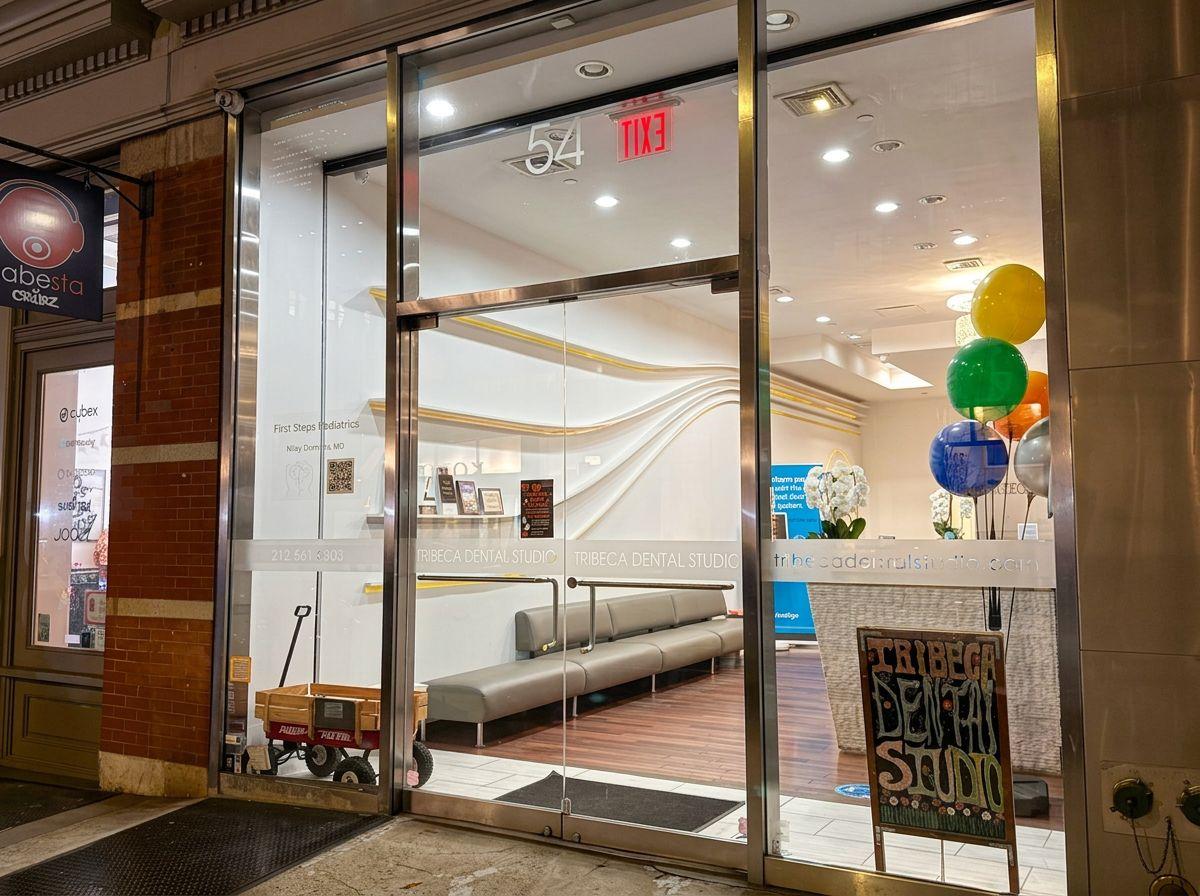
Tribeca Dental Studio is at 54 Warren Street in Tribeca, a short walk from the Chambers Street and City Hall stations. Laser gum contouring here is performed with the Fotona LightWalker laser, designed from photographs and measurements of your own smile. Call (212) 561-5303 to book a smile analysis.
Your teeth may already be the right length
If your smile shows more gum than tooth, the fix may be an hour of sculpting rather than new teeth. Book the smile analysis and see your own gumline measured and designed. Call (212) 561-5303.
Your Visit from Tribeca
Getting here from Tribeca is a short walk, not a trip, and that is how most of our neighbors arrive. If you are coming by subway, the 1, 2, 3, A, C, and E trains stop at Chambers Street, about a five-minute walk up Warren to our door. The 4, 5, and 6 at Brooklyn Bridge–City Hall are ten minutes on foot through the civic center, and the J and Z also stop at Chambers Street for the east-side connection.
Citi Bike stations sit on Warren Street and Greenwich Street, and New Jersey commuters can take PATH to the World Trade Center Oculus.
When you arrive at 54 Warren Street, we keep the day simple and unhurried from the moment you check in. Our team works together under one roof, so your visit stays in one place instead of sending you across town for another appointment or another opinion. We talk through what brought you in, take any imaging we need here in the office, and explain what we are seeing in plain language before we discuss next steps together.
You will always know what we recommend, why we recommend it, and what can wait, so you leave with a clear plan rather than unanswered questions.
Life in Tribeca moves between the cast-iron lofts on Franklin Street, the towers along West Street, and afternoons with families at Washington Market Park, and we schedule with that rhythm in mind. We are open Monday through Friday from 8 AM to 6 PM, Saturday from 9 AM to 4 PM, and open on select Sundays, and you can book online any time or call us at (212) 561-5303.
Street parking here is tight, with cobblestone blocks and film shoots, but attended garages on Warren Street and Greenwich Street sit within a block of our door. Follow-ups stay with our same team, so your care feels continuous.
Ongoing care is where being neighbors really pays off for our Tribeca patients. A six-month recall is just a short walk over, a quick check-in with the team who already knows your history, and a cleaning that fits between school drop-off and the rest of your day. When treatment takes more than one visit, we sequence it sensibly, review healing in person, and adjust the plan together rather than by phone tag.
Because we have cared for families here since 2007, we notice small changes early, keep your records continuous, and remind you when you are due — so staying on track never feels like starting over.
How Care Is Planned at Our Tribeca Studio
Every treatment plan at Tribeca Dental Studio begins with a diagnosis, not a recommendation made in the abstract. We examine the tooth or area in question, review imaging taken here in the office — including 3D CBCT scans when the case calls for them — and talk through what we see in plain language before any treatment is proposed. You will always know what we recommend, why we recommend it, and what could safely wait.
When several options would serve you well, we lay them side by side: what each involves, how many visits it takes, how long it is expected to last, and what it asks of the neighboring teeth and bone.
That conversation becomes a written plan. The sequence, the timing, and the reasoning are set down before treatment begins, so there are no surprises mid-course and no step is improvised. Staged treatment is grouped into planned steps when we can, and each stage is checked before the next one starts.
If a simpler option would serve you just as well, that is the option we will put in front of you — and if the honest answer is that a tooth or a treatment can be watched rather than treated today, we will say that instead.
Because every specialty sits under one roof at 54 Warren St, a plan that touches several disciplines is designed as a whole. Implant surgery, periodontics, endodontics, orthodontics, cosmetic work, airway care, and pediatric dentistry are handled by one team in one place, which means the implant plan accounts for the gum plan, the orthodontic plan accounts for the airway, and nothing is lost between offices across town.
Your records, your imaging, and your history stay with the same team from the first visit through every follow-up.
Technology We Use — and Why It Matters
Good planning depends on seeing clearly. Our studio works with 3D CBCT imaging, which shows bone volume, nerve positions, sinus anatomy, and root form in three dimensions rather than the flat shadow of a standard X-ray. Implant positions, grafting decisions, root canal anatomy, and expansion planning are all worked out on that imaging before treatment begins, so the day of the procedure holds as few unknowns as possible.
Digital planning carries the same approach into orthodontics and cosmetic work: tooth movement and smile design are mapped in advance, and you can see the intended direction before committing to it.
Laser technology is part of everyday care here, from gum therapy to the NightLase protocol we use for snoring. Lasers let us treat soft tissue with precision and, in many cases, with a quieter recovery than traditional surgery. For sleep concerns, we use at-home sleep testing rather than assumptions: your breathing is measured in your own bed, and the results — not a guess — decide whether an oral appliance, NightLase, or a referral is the right path.
Technology earns its place in the plan only when it changes a decision or improves an outcome; that is the standard each tool here is held to.
Costs, Insurance, and Written Estimates
Before treatment begins, you receive the plan in writing — including what each stage involves and what it costs — so you can decide with the full picture in front of you. There is no obligation attached to a consultation, and a second opinion is a reasonable thing to want; we would rather you choose with clear information than feel rushed into a chair.
If you have dental insurance, our team verifies your coverage and explains what it does and does not apply to before we start, and if you do not, the written plan still lets you stage treatment sensibly over time.
Dental treatment is often easier to approach in planned stages than all at once. A written plan lets you sequence what is urgent, what protects the teeth around it, and what is elective, so each visit moves the whole plan forward. If something changes along the way — a tooth responds better or worse than expected — the plan is revisited with you, in writing, before the next step. That discipline is what keeps a long course of treatment from becoming a series of surprises.
Comfort, Recovery, and Follow-Up
Most dental anxiety comes from the unknown, so we work to remove it: what will happen, how long it takes, what it will feel like, and what recovery looks like are all covered before we begin. During treatment we check in rather than push through, and after it we tell you plainly what is normal, what is not, and when to call.
Written aftercare instructions go home with you, and the precautions in them — protecting a healing site, eating soft foods for a few days, keeping the area clean — are the difference between an uneventful recovery and a complicated one.
Follow-up is part of the treatment, not an extra. We schedule reviews around your life, use return visits to check healing and the details we flagged together, and keep recall reminders running so maintenance does not drift. If something feels off between visits, we would rather see you quickly than have you wait and wonder.
Call us at (212) 561-5303 or book online at any time — the studio is open Monday to Friday from 8:00 AM to 6:00 PM, Saturday from 9:00 AM to 4:00 PM, and open on select Sundays.
Before You Book
A final word on how to use pages like this one. Treatment pages describe what is possible; a consultation decides what is appropriate — for your anatomy, your history, your goals, and your budget, in that order of conversation. If anything here has raised a question we have not answered, bring it with you: patients who arrive with marked-up pages and specific questions get the most from their first visit, and the plan we write together is better for it.
Tribeca Dental Studio is at 54 Warren St in Tribeca, and new patients are welcome at any of the services described on this site. Book online at any time or call (212) 561-5303. The first step is an examination and an honest conversation; everything else in dentistry follows from those two things done properly.
The Next Step Is a Conversation
Wherever this page found you — a search at midnight, a partner's forwarded link, a dentist's suggestion — the next step is smaller than the worry usually makes it feel. A consultation at the studio is an examination and a conversation, not a commitment: findings first, options with their honest trade-offs, a written plan with costs, and time to decide at home.
Patients tell us the plan is what they actually came for, whether they proceed here, proceed elsewhere, or proceed nowhere for now. That is the offer, and it stands on every page of this site: 54 Warren St, bookable online at any hour, or at (212) 561-5303 — Monday to Friday 8:00 AM to 6:00 PM, Saturday 9:00 AM to 4:00 PM; open on select Sundays.
The Consultation Is Not a Funnel
A last word that applies to every page in this series, whichever treatment brought you here: the consultation is not a funnel. Patients arrive at these pages mid-worry — about a tooth, a jaw, a night's sleep, a smile in photographs — and the studio's answer has been the same since 2007. An examination. Imaging where imaging decides. A written plan with the options and their costs, including the option of doing less, or nothing yet.
Then time to think, at home, without a follow-up call designed to hurry you. If that is the experience you were hoping dentistry could be, the door is at 54 Warren St, and it opens online at any hour or at (212) 561-5303.
How We Plan Your Care at Tribeca Dental Studio
Every treatment at Tribeca Dental Studio starts with a diagnosis, not a sales pitch. Before we recommend anything, we examine the tooth or area in question, review imaging taken here in the office, and talk through what we see in plain language. You will always know what we recommend, why we recommend it, and what could safely wait.
That recommendation becomes a written plan, so the sequence, the timing, and the reasoning are clear before any treatment begins — and if a simpler option would serve you just as well, that is the option we will put in front of you.
Our studio brings every dental specialty under one roof at 54 Warren St in Tribeca, and it has since 2007. General dentistry, cosmetic care, implant surgery, periodontics, endodontics, orthodontics, airway care, and pediatric dentistry are handled by one team in one place, which means a treatment that touches several specialties is planned as a whole rather than handed off between offices across town.
Your records, your imaging, and your history stay with the same team from the first visit through every follow-up, so nothing is lost between providers and no step is planned in isolation.
We are open Monday to Friday from 8:00 AM to 6:00 PM, Saturday from 9:00 AM to 4:00 PM, and open on select Sundays. You can book online at any time or call us at (212) 561-5303. The studio sits between Greenwich Street and West Broadway, steps from the Chambers Street subway hub (1, 2, 3, A, C, E), with attended garages on Warren Street and Greenwich Street within a block of our door for patients who drive in.
Care does not end when the procedure does. We schedule reviews and follow-ups around your life, group staged treatment into planned steps when we can, and use each return visit to check healing and watch the details we flagged together. Between appointments we stay in touch with recall reminders and clear next steps, and if something feels off, we would rather see you quickly than have you wait and wonder.
The goal is a plan you understand, a team you recognize, and results that are checked over time rather than assumed.