Is a Root Canal Painful? The Honest Answer
I'm Dr. Nina Izhaky. Ask anyone to name the worst dental appointment imaginable and they will say the same two words: root canal. The phrase has become a universal joke about misery. But that reputation is decades out of date — and it was never really about the procedure. The pain people remember belongs to the infected tooth. Done right, a root canal is not supposed to be painful, and it is not supposed to be an event.
Here is what it actually is: a filling — on the inside of the tooth.
At your evaluation we find the exact tooth, the exact cause, and the exact plan before anything begins — with 3D imaging, a full explanation in plain language, and a comfort plan agreed with you in advance. Most of our root canal patients tell us afterwards that the anticipation was the worst part.
Minute by minute, the visit feels ordinary: the numbing, a quiet check that it has taken hold, the soft sounds of instruments, a pause whenever you want one. Patients regularly tell us they kept waiting for the hard part — and then we were placing the temporary and they were sitting up, surprised that the appointment they had dreaded for weeks was already behind them.
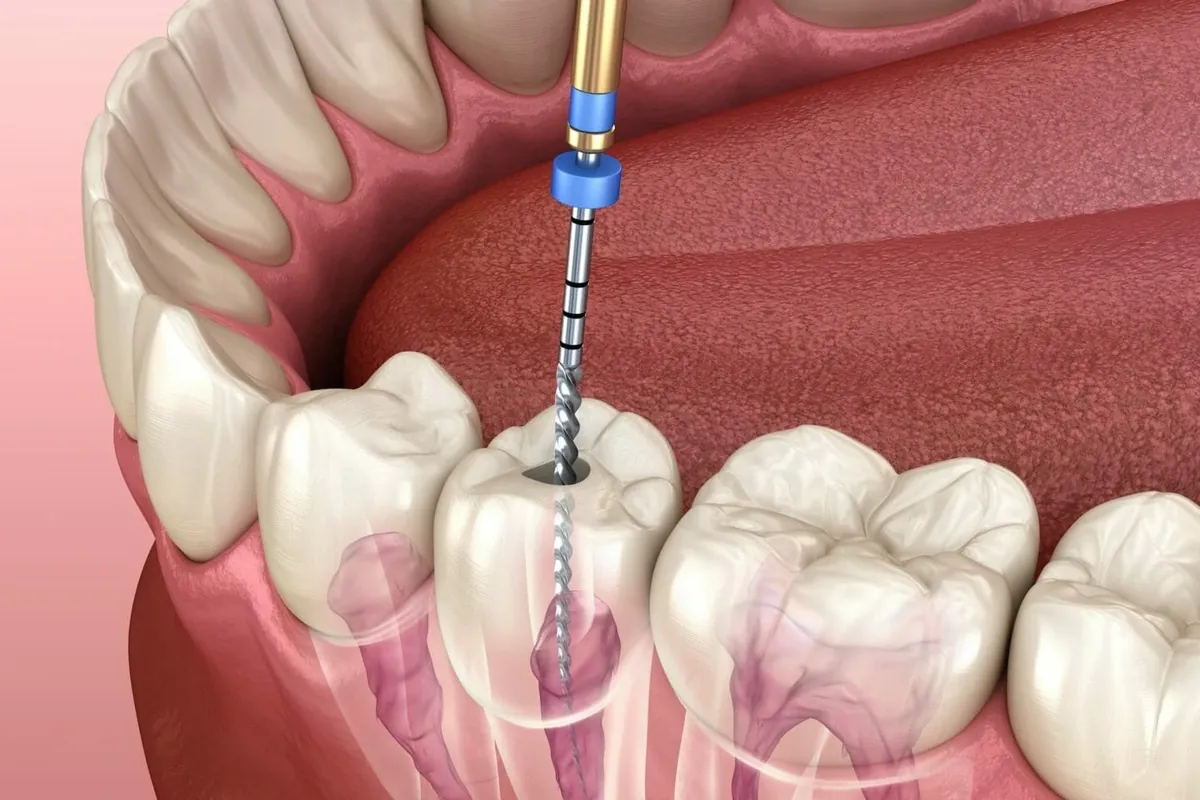
Where the reputation came from
Two sources — and neither one is the treatment itself.
The pain came first.
The inside of a tooth holds a soft living core of nerves and blood vessels. When decay or a crack lets bacteria reach it, it becomes infected and inflamed — but the tooth cannot swell, so the pressure builds inside a rigid shell. That pressure is the throbbing, sleep-stealing pain people remember. It is pain with a specific mechanism, which is why treating the inside of the tooth — not masking it — is what ends it.
The treatment ends the pain.
By the time a patient is in my chair, they have often been hurting for days. The root canal is the appointment that ends that pain — yet it gets blamed for the misery that made it necessary, like blaming the cast for the broken leg. Patients often arrive apologizing for having waited; they leave wondering why they did.
Old-era dentistry.
Root canals earned their name in an era without modern anesthesia, magnification, or imaging. That era is over. Judging today's procedure by it is like judging today's surgery by the Civil War. Rotary instruments, apex locators, ultrasonic cleaning, and microscope magnification changed the procedure's nature, not just its comfort.
Delay does the real damage.
The saddest effect of the legend is what it makes people do: wait. While they wait, infection spreads and cracks deepen — until a tooth that could have been saved with an internal filling can only be extracted. Bone lost around a root does not fully return, which is why the same tooth is easier to save this month than next.
The joke outlived the dentistry.
Pop culture keeps the old reputation on life support: 'I'd rather have a root canal' is still the punchline for anything unpleasant. The line survives because it is funny — not because it is current. The anesthesia, magnification, rotary instruments, and imaging behind a modern root canal share almost nothing with the procedure the joke was written about. Ask our patients instead of the punchline: their version of the story is shorter and much less dramatic.
Anxiety makes everything feel bigger.
A nervous patient feels every sensation more sharply, and a patient who expects pain braces for it through the whole visit. That is why comfort here is a protocol, not a hope: numbing is verified before we start, you can raise a hand and we stop, and the pace is set by you. Feeling in control is not a small thing — for most anxious patients, it is the thing. We would rather spend ten minutes earning calm than one minute working against fear.
What a root canal actually is
A filling — done on the inside of the tooth instead of the top.
Completely numb first.
The tooth is made completely numb. We do not begin until it is. Topical gel goes on before the injection itself, so even the numbing is gentle.
The infected inside is removed.
Through a small opening, the inflamed or infected pulp — the tooth's soft living core — is removed. A thin rubber sheet isolates the tooth and keeps the field clean and dry throughout.
The canals are cleaned.
The canals inside the roots — fine, branching channels — are cleaned, disinfected, and shaped. Electronic measurement confirms the exact length of each canal, so cleaning reaches the tip — and only the tip.
Filled and sealed.
That cleaned space is then filled and sealed, exactly the way a filling seals a cavity — only inside the tooth. The filling material flows into the cleaned shape and sets as a single sealed unit with the tooth.
Protected afterward.
In most cases a crown is placed over the tooth afterward to protect it, the way a helmet protects what is underneath. Until the crown is placed, a sound temporary seal guards the tooth — treat it kindly and avoid hard chewing on that side.
Imaging first.
Before anything begins, imaging — including a 3D scan when the anatomy calls for it — maps the canals inside your tooth: how many there are, where they curve, and where the infection sits. No guessing, and no surprises halfway through. The scan also shows the bone around the root, where infection leaves its earliest traces.
Checked before you leave.
A final image confirms the canals are cleaned and sealed to their tips. Before you go, you get plain aftercare instructions — what to expect that evening, what to eat, and exactly when to call us. You will also know exactly what the next step is — crown, review, or simply healing — before you walk out.
Why an internal filling costs what it costs
Patients sometimes ask why a filling on the inside of a tooth carries a serious cost. The honest answer: the inside of a tooth is some of the most demanding real estate in dentistry. Root canals can be thinner than a needle, curved, forked, and different in every tooth — sometimes in every root of the same tooth. Working in them is microscope work: magnification, fine single-use instruments, precision imaging, careful disinfection, and engineered sealing materials, all inside a space you cannot see with the naked eye.
It takes time, and it has to be done completely — a canal missed is a tooth that fails later.
And it is worth pricing against the alternative: removing the tooth and replacing it with an implant. Saving your own tooth, when it can be saved, is almost always the better outcome — and the better value. I have practiced in Tribeca since 2007, and the sentence I hear most after a root canal is some version of: that was it?
There is also the question of visits. A straightforward case is often finished in one appointment; a tooth with an active infection is sometimes better treated in two, with medication placed inside the tooth between visits to quiet it fully before sealing. Neither is a shortcut or an upsell — it is the difference between a tooth that settles and a tooth that keeps talking to you. What never changes is the standard: every canal found, cleaned, disinfected, and sealed, verified on imaging before you leave the chair.
And if a tooth truly cannot be saved? Then we say so, plainly, at the evaluation — before treatment, not after. A tooth with a vertical root fracture, or one whose remaining structure cannot hold a crown, is not a candidate for heroics. In that case the honest plan is removal and replacement, and we walk through those options with the same care. The goal was never to sell a root canal; it is to keep you chewing comfortably on teeth that last — yours where possible, well-made replacements where not.
Care in your language
Our team speaks English, Spanish, Ukrainian, Farsi, Hebrew, Polish, Russian, Korean, Arabic, and French. Your diagnosis, your options, and your plan — explained in the language you think in. Call (212) 561-5303.
That includes the details, not just the headline: what the imaging shows, why a canal is shaped the way it is, what the sealed tooth needs afterward, and what your crown appointment will involve — asked and answered in your language, with written instructions to take home. If a family member helps you make decisions, we are glad to explain it to them as well.
Language should never be the reason a patient endures pain longer than they have to, or agrees to a plan they only half understand. Bring your questions in the language you dream in — about the tooth, the timing, the cost, the alternatives — and expect complete answers before anyone picks up an instrument.
Inside the tooth: a closer look
A tooth is not a solid pebble. Under the enamel and the dentin sits a chamber, and inside that chamber lives the pulp — a soft bundle of nerve, blood vessels, and connective tissue that built the tooth when you were young and stays on as its sensor and supply line. From the chamber, the pulp continues down through the roots in the canals: narrow, curving tunnels that end at a pinpoint opening at each root tip, where the nerve and vessels connect to the jaw. When decay, a deep filling, or a crack lets bacteria reach that living core, the pulp has nowhere to go. It is soft tissue sealed inside a hard box, so inflammation becomes pressure, and pressure becomes the deep, throbbing pain that heat makes worse and that painkillers only partly quiet.
This is why the operating microscope is not a luxury in this work. At up to twenty times magnification, a canal opening the width of a hair becomes a doorway you can actually see into. Upper molars famously hide a fourth canal — the second mesiobuccal — in the majority of cases, small enough that generations of dentists, working by eye and by feel, missed it; a missed canal keeps its bacteria, and the tooth fails quietly months or years later. Under magnification, extra canals are found, hairline cracks are seen before they are trusted, separated instruments can often be retrieved, and the cleaning reaches anatomy that fingers alone cannot map. The microscope is the difference between hoping the inside of the tooth is clean and knowing it.
Sometimes the tooth in the chair has already had a root canal — somewhere else, years ago — and it hurts again, or a shadow shows on its imaging. Retreatment means opening the tooth, removing the old filling material, finding what was missed or what has changed, disinfecting the system again, and resealing it. The usual causes of failure are specific and findable: a canal that was never located, a seal that stopped short, new decay leaking bacteria under a crown, a crack that developed with time. Retreatment is more demanding than first treatment, which is why the evaluation matters so much — imaging first, an honest account of what can be corrected, and a plain statement if the tooth's remaining structure no longer justifies the effort.
Healing has a timetable of its own. The evening after treatment, tenderness when you bite is common; by the end of the first week, most teeth feel unremarkable again. Inside, though, the bone around the root tip — which infection had been quietly dissolving — rebuilds over months, and the dark shadow on the first image shrinks on the review images taken later in the year. That is why follow-up is part of the treatment rather than an optional extra: a treated tooth should get quieter on the images as surely as it gets quieter in your mouth. We keep the record — the before image, the working images, the final seal, the reviews — so that your tooth's story is documented, not remembered.
Our standard for this work is simple to state and strict to keep. Numbing is verified, never assumed. A rubber dam isolates every tooth, every time — it keeps the field clean, keeps irrigants where they belong, and keeps you comfortable. Instruments that shape the canals are single-use: a file that has served in one tooth is retired, because fatigued metal breaks and tired edges cut corners. Every canal's length is measured electronically and confirmed on imaging; every seal is radiographed before the temporary goes on. And the prognosis is spoken out loud before treatment begins — excellent, guarded, or poor — because a patient who knows what to expect is a partner in the result, not a passenger.
Root canal pain questions, answered
01Is a root canal painful?
It is not supposed to be. The tooth is made completely numb before anything begins, and we do not start until it is. The pain people associate with root canals is the pain of the infected tooth before treatment — the procedure is what ends it. Done right, a root canal should feel like an uneventful filling appointment, because that is what it is: a filling on the inside of the tooth.
02What does a root canal actually feel like?
Mostly, nothing — the tooth is numb. You may sense pressure or vibration, much like an ordinary filling. Most patients are surprised by how routine it feels, and the relief afterward is usually the memorable part.
03Why do people say root canals are so painful?
Two reasons. First, the tooth itself: an infected pulp swelling inside a tooth that cannot expand is genuinely painful, and people remember the days of pain before the appointment — then credit them to the treatment. Second, history: the procedure's reputation was earned in an era before modern anesthesia, magnification, and imaging.
04How long does a root canal take?
It varies with the tooth — front teeth have simpler canals, molars have more, and previously treated or infected teeth take longer. Some cases are completed in one visit; others are better done in more than one. Your evaluation gives you the exact plan before anything begins.
05Why is a root canal expensive?
Because of where the filling goes. The canals inside a tooth can be thinner than a needle, curved and branching, and different in every tooth. Cleaning and sealing them completely is microscope work with fine single-use instruments, precision imaging, and engineered materials — and it has to be done completely, because a missed canal is a tooth that fails later. Priced against extraction plus an implant, saving your own tooth is usually the better value.
06Can antibiotics fix an infected tooth instead?
No. Antibiotics travel through the bloodstream, and an infected pulp has almost no blood flow left to carry them in. They can calm a spreading infection temporarily, but they cannot clean the inside of a tooth — and the infection returns. The inside of the tooth has to be physically cleaned and sealed.
07What happens if I wait?
Usually, the situation gets worse and the options get narrower. The infection can spread, a crack can deepen, and bone around the root can be lost — until a tooth that could have been saved with an internal filling can only be extracted. The earlier we see it, the more likely the tooth is saved.
08Will I need a crown after a root canal?
In most cases, yes — especially on back teeth, which carry heavy chewing forces. The crown protects the treated tooth the way a helmet protects what is underneath. Front teeth with plenty of healthy structure are sometimes restored more simply. The recommendation follows your tooth, and it is part of the plan you hear at your evaluation.
09Is saving the tooth better than getting an implant?
When a tooth can be predictably saved, keeping your natural tooth is almost always the better outcome — biologically and financially. An implant is an excellent replacement when a tooth truly cannot be saved, but it is a replacement. Our bias is toward the tooth nature gave you, and we will tell you honestly when saving it is no longer the right call.
010Does a root canal hurt afterwards?
Afterwards is different from during. Once the numbing wears off, the tissues around the tooth — which were inflamed before we ever touched them — are often tender for two or three days, especially when you bite. That soreness is the healing kind, it responds well to ordinary pain relievers, and it fades day by day. Sharp pain that grows instead of fading, swelling, or a bad taste is not part of normal healing — call us and we will see you. Keep the area clean with gentle brushing, and avoid very hard or sticky foods on that side for the first days.
011What are the signs I might need a root canal?
The classic signs are pain that lingers after hot or cold food is gone, a tooth that throbs on its own or wakes you at night, pain when you bite, a small pimple-like bump on the gum, a tooth that has darkened, or a deep cavity or crack. But not every infected tooth announces itself — some are quiet and show up only on imaging at a regular visit. That is one more reason the evaluation matters more than the guess. A tooth that hurts when hot food touches it, then aches for minutes afterward, is telling a particularly clear story.
012Can a root canal be done in one visit?
Often, yes. A tooth whose infection is limited and whose canals are straightforward can usually be cleaned and sealed in a single appointment. When an infection is active or the anatomy is complex, two visits — with medication resting inside the tooth between them — produce a better, quieter result. Your imaging at the evaluation tells us which case yours is, and we tell you before we begin. Either way, you leave with the tooth sealed and protected between visits.
013What if I am anxious about the appointment?
Tell us — it changes how we run your visit, in your favor. Numbing is placed slowly and verified before anything starts. You can raise a hand at any point and we stop. We explain each step before it happens, or skip the commentary entirely if you prefer headphones and quiet. For patients whose anxiety runs deeper, options to take the edge off can be discussed at the evaluation. Control is the antidote to most dental fear, and here you keep it. Many of our most anxious first-time patients become our calmest returning ones — the memory of an uneventful visit rewrites the expectation.
014How long will the treated tooth last?
A well-cleaned, well-sealed tooth protected by a sound crown can serve for decades — often for life. The two things that decide it are completeness (every canal found and sealed, which is why we verify with imaging) and protection (the crown, plus ordinary care: brushing, flossing, and regular checkups). Saving the tooth is the treatment; keeping it is a partnership. Treated teeth in our own patient family have been in comfortable service for well over a decade, and counting.
015Can I go back to work after a root canal?
Most patients do. The numbing wears off over a few hours, and the aftercare is simple: avoid chewing hard on the treated side until the crown is placed, keep up ordinary pain relievers if the area is tender, and eat normally otherwise. Desk work the same day is routine. If your case involved a spreading infection or a long molar procedure, we may suggest taking the rest of the day — we will tell you honestly which to expect before your visit.
016What happens at the crown appointment?
Once the inside of the tooth is cleaned and sealed, the crown appointment shapes the outside: the tooth is prepared, a precise digital scan or impression is taken, and a temporary protects the tooth while the laboratory makes the final crown. At the second short visit the crown is fitted, checked against your bite, and bonded in place. Between the two, the tooth is sealed and safe — just treat the temporary gently, the way you would a healing filling.
017Can a tooth that already has a crown need a root canal?
Yes. A crown protects the outside of a tooth, but the living tissue inside can still become infected — through deep decay at the crown's edge, a crack, or an injury that reaches the pulp slowly over years. When the tooth's structure is sound, the root canal can often be performed through the existing crown, keeping both the tooth and the crown. Your imaging at the evaluation shows whether that is possible in your case.
018How do I know if my toothache is an emergency?
Treat it as urgent if the pain is severe or throbbing, if it wakes you at night, if there is swelling of the gum, cheek, or jaw, if you have fever, a bad taste, or trouble opening your mouth or swallowing, or if pain follows an injury or a broken tooth. Those are signs of an active infection, and infections do not improve by waiting. Call us — emergency patients are seen as quickly as the schedule can possibly take them, and the evaluation itself is where the pain starts ending.
019Will I know the cost before treatment starts?
Yes. The evaluation establishes the full picture — the tooth's condition, the number of canals, whether a crown is needed, and how many visits — and with it the plan and its expected cost. If something additional becomes necessary along the way, we explain why and what it involves before starting it. There should be no surprises in treatment or in payment. Payment plans, card payment, insurance handling, and what falls outside coverage can all be asked about openly at the evaluation.
020Root canal or extraction — how do I choose?
When a tooth can be predictably saved, keeping your own tooth is almost always the better result, biologically and financially. An implant is an excellent replacement when a tooth truly cannot be saved, but it is a replacement. We compare the options completely — chewing feel, bone preservation, effects on neighboring teeth, treatment time, total cost, future maintenance — and give you an honest recommendation for your tooth. The final decision is yours; our job is to assemble everything you need to make it, in your language.
021Do children get root canals too?
Baby teeth have their own treatments, and they proceed differently from root canal treatment on adult teeth. The back teeth of the mixed-dentition years may have root tips that are not yet fully formed, which calls for special care. We also have a pediatric team here, and we consider the best approach together according to age and the tooth's stage of development. For a child in pain, being evaluated promptly comes first — a lingering infection can even affect the bud of the permanent tooth forming beneath it.
022Do I need checkups after the treatment?
Yes. Review visits confirm on imaging that the sealed tooth is healing quietly and that the bone around the root is recovering, and they also check the crown's fit, your bite, the gum, and the tooth's neighbors and counterparts. A quiet reinfection can happen even without pain. Within the regular six-month checkups and cleanings, the treated tooth continues to be watched as a matter of course — and if anything changes, contact us rather than waiting for the next review date.
Root canal care in the heart of Tribeca
Find us at 54 Warren Street, New York, NY 10007 — in the heart of Tribeca, serving Tribeca, SoHo, Battery Park City, the Financial District, and Downtown Manhattan. Hours: Monday–Friday 8 AM–6 PM, Saturday 9 AM–4 PM. The Chambers Street and Franklin Street stations put the A, C, E, 1, 2, 3, and R lines within a few minutes' walk, and patients come to us from across Lower Manhattan and Brooklyn for endodontic care explained in their own language.
The appointment that ends the pain.
A diagnosis, a comfortable visit, and your own tooth kept. Call (212) 561-5303 or book online. 54 Warren St, Tribeca.
No referral is needed, and you do not have to decide anything today. Start with the evaluation: know which tooth, know why, know the plan — then choose with the full picture in front of you.
If the tooth has been hurting, every day of waiting is a day the infection spends growing. The evaluation is short, the imaging is immediate, and the answer — save it, treat it, or replace it — is one you will understand completely before you leave.