Failed Root Canal: Signs, Causes, and How the Tooth Can Still Be Saved
A failed root canal rarely announces itself all at once. More often it whispers — pain that returns months or years after treatment, a small pimple on the gum that comes and goes, a shadow on a routine X-ray. This page explains the signs, the four reasons root canals fail, and the path that usually saves the tooth: retreatment.
Signs a root canal has failed
A treated tooth should be quiet. Any of these — even one, even mild — is a reason to have it looked at.
Pain that returns after a quiet period
The tooth felt fine for months or years, then started aching again — spontaneously, or when you bite. Returning pain means the tissues around the root are inflamed again, and the usual reason is bacteria back inside the tooth.
A pimple on the gum that comes and goes
A small bump on the gum near the treated tooth that swells, drains, and vanishes is a sinus tract — a pressure valve for a chronic infection at the root tip. It often does not hurt, which is exactly why it gets ignored for years.
Tenderness when you bite on that tooth
A treated tooth that stays tender to biting pressure, or feels 'different' from its neighbors, is telling you the ligament around the root is irritated — frequently the first and only sign of a failing treatment.
A shadow on the X-ray that is not shrinking
Some failures have no symptoms at all and are found at checkups: the dark area at the root tip that should heal after treatment instead stays the same or grows. Silent does not mean harmless — the infection is still destroying bone, slowly.
Why root canals fail
Almost every failure is bacteria finding a way back in — through anatomy, damage, or a new leak.
A canal that was missed
Roots hide extra canals — molars especially. A canal that was never found was never cleaned, and the bacteria left inside eventually re-establish the infection. This is the most common single cause, and the most fixable.
A crack in the root
A vertical root fracture gives bacteria a highway that no cleaning can seal. Cracks are the hardest cause to treat — many cracked teeth cannot be saved — which is why imaging and an honest prognosis come before any retreatment.
New decay or a leaking crown
Years later, decay at the crown's edge or a failing filling can leak bacteria back down into the sealed canals. The original treatment may have been perfect; the seal above it gave way.
A canal that could not be fully cleaned
Severely curved, narrowed, or blocked canals sometimes cannot be cleaned to the tip. Modern microscopy and 3D imaging reach many of these on a second attempt — one reason retreatment succeeds where the first pass could not.
What happens next: saving the tooth
The usual answer is retreatment: the tooth is reopened, the old filling material removed, every canal — including any that were missed — cleaned and disinfected under magnification, then resealed and crowned. When retreatment is not the right shape for the problem, a small surgical procedure at the root tip (apicoectomy) is the alternative; extraction and replacement is the last resort, not the first. Our emergency evaluation is $250, including X-rays, credited toward your treatment — with 3D imaging when the cause is not obvious.
Hablamos español
We warmly welcome Spanish-speaking patients. Our team will explain in your language what is happening and how it is treated — call us at (212) 561-5303.
Failed root canal — questions
01How soon can a root canal fail?
Anywhere from weeks to many years later. Early failures usually mean a canal was missed or the infection never fully cleared; late failures more often come from a new leak — decay, a cracked crown, a lost filling. The timeline hints at the cause, which is why we ask when the tooth was treated and when it last felt normal.
02Can a failed root canal be fixed?
Often, yes. Retreatment removes the old material, finds and cleans every canal, and reseals the tooth — and with today's microscopy and 3D imaging, canals that defeated the first attempt are frequently reached on the second. The exception is a vertically cracked root, which usually cannot be saved; we will tell you plainly if that is what the imaging shows.
03Retreatment or extraction — how do you decide?
On three things: whether the tooth's structure can hold a crown afterward, whether the cause of failure is one retreatment can actually fix, and how much bone the infection has taken. A natural tooth that can be predictably saved is worth saving; a tooth with a cracked root or too little support is not, and we will show you the imaging behind the recommendation.
04Is a failed root canal an emergency?
If it comes with swelling, fever, a bad taste, or significant pain, yes — be seen the same day. A silent failure found on a checkup X-ray is not an emergency, but it is not a someday item either: the infection is slowly taking bone, and earlier retreatment keeps more options open.
05What are the signs of infection from a failed root canal?
The same family as any tooth infection: returning pain, swelling of the gum or face, a pimple-like bump that drains, a bad taste, and tenderness when biting. Fever or swelling that is spreading means same-day care — do not wait for a routine appointment.
06What does it cost to have a failed root canal checked?
Our emergency evaluation is $250, including X-rays, credited toward whatever treatment follows; 3D imaging is added when the cause is not clear from a standard X-ray. If the tooth needs retreatment, we lay out the full cost, the alternatives, and payment plans before any work begins.
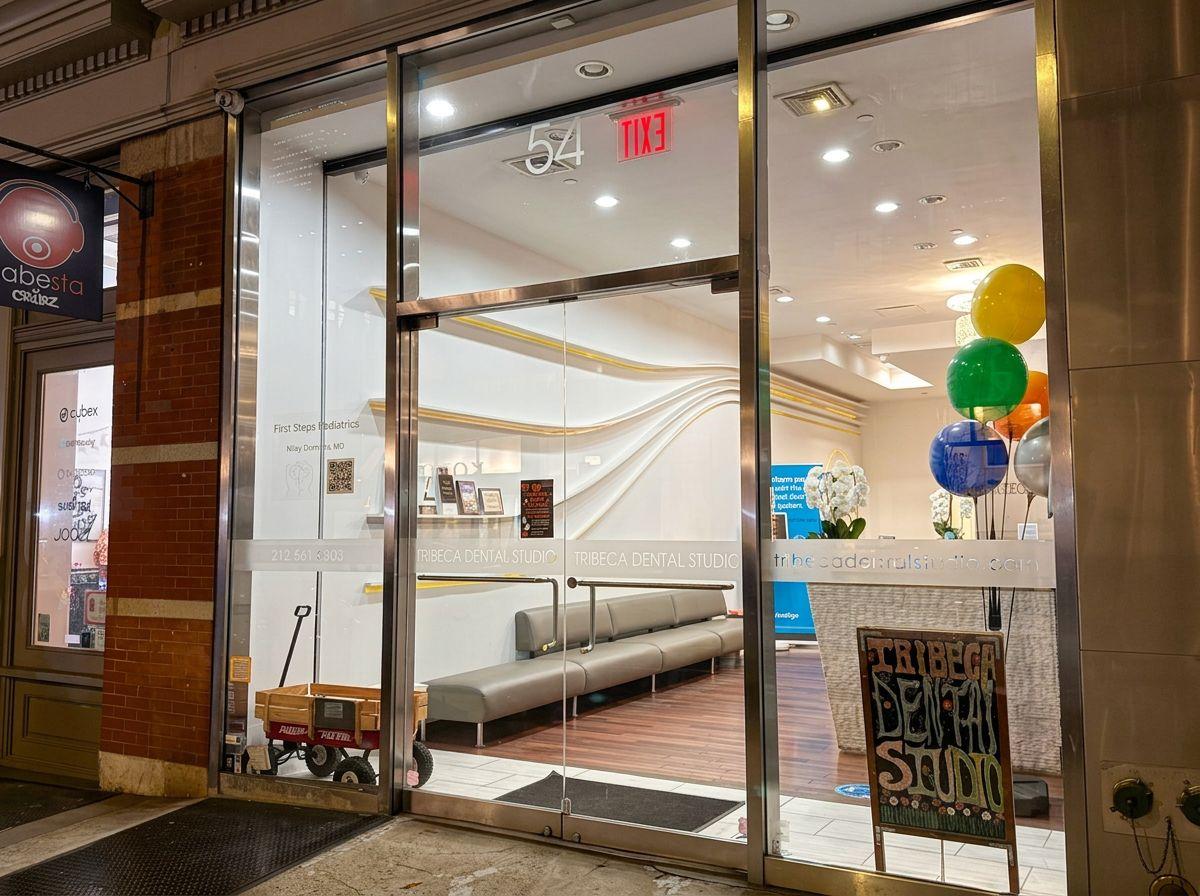
In Tribeca, at 54 Warren Street
Tribeca Dental Studio is at 54 Warren Street, New York, NY 10007 — a short walk from the Chambers Street and City Hall stations, and easy to reach from the Financial District, Battery Park City and SoHo. Root canal assessment visits start with an exam and imaging, and the plan is explained before anything is done. Call (212) 561-5303.
A treated tooth talking to you again?
Book an exam at Tribeca Dental Studio, 54 Warren Street, New York, NY 10007, or call (212) 561-5303. Returning pain, a gum pimple, or a shadow that will not heal — each is a tooth asking for a second chance, and retreatment very often gives it one.
Your Visit from Tribeca
Getting here from Tribeca is a short walk, not a trip, and that is how most of our neighbors arrive. If you are coming by subway, the 1, 2, 3, A, C, and E trains stop at Chambers Street, about a five-minute walk up Warren to our door. The 4, 5, and 6 at Brooklyn Bridge–City Hall are ten minutes on foot through the civic center, and the J and Z also stop at Chambers Street for the east-side connection.
Citi Bike stations sit on Warren Street and Greenwich Street, and New Jersey commuters can take PATH to the World Trade Center Oculus.
When you arrive at 54 Warren Street, we keep the day simple and unhurried from the moment you check in. Our team works together under one roof, so your visit stays in one place instead of sending you across town for another appointment or another opinion. We talk through what brought you in, take any imaging we need here in the office, and explain what we are seeing in plain language before we discuss next steps together.
You will always know what we recommend, why we recommend it, and what can wait, so you leave with a clear plan rather than unanswered questions.
Life in Tribeca moves between the cast-iron lofts on Franklin Street, the towers along West Street, and afternoons with families at Washington Market Park, and we schedule with that rhythm in mind. We are open Monday through Friday from 8 AM to 6 PM, Saturday from 9 AM to 4 PM, and Sunday from 9 AM to 2 PM, and you can book online any time or call us at (212) 561-5303.
Street parking here is tight, with cobblestone blocks and film shoots, but attended garages on Warren Street and Greenwich Street sit within a block of our door. Follow-ups stay with our same team, so your care feels continuous.
Ongoing care is where being neighbors really pays off for our Tribeca patients. A six-month recall is just a short walk over, a quick check-in with the team who already knows your history, and a cleaning that fits between school drop-off and the rest of your day. When treatment takes more than one visit, we sequence it sensibly, review healing in person, and adjust the plan together rather than by phone tag.
Because we have cared for families here since 2007, we notice small changes early, keep your records continuous, and remind you when you are due — so staying on track never feels like starting over.
How Care Is Planned at Our Tribeca Studio
Every treatment plan at Tribeca Dental Studio begins with a diagnosis, not a recommendation made in the abstract. We examine the tooth or area in question, review imaging taken here in the office — including 3D CBCT scans when the case calls for them — and talk through what we see in plain language before any treatment is proposed. You will always know what we recommend, why we recommend it, and what could safely wait.
When several options would serve you well, we lay them side by side: what each involves, how many visits it takes, how long it is expected to last, and what it asks of the neighboring teeth and bone.
That conversation becomes a written plan. The sequence, the timing, and the reasoning are set down before treatment begins, so there are no surprises mid-course and no step is improvised. Staged treatment is grouped into planned steps when we can, and each stage is checked before the next one starts.
If a simpler option would serve you just as well, that is the option we will put in front of you — and if the honest answer is that a tooth or a treatment can be watched rather than treated today, we will say that instead.
Because every specialty sits under one roof at 54 Warren St, a plan that touches several disciplines is designed as a whole. Implant surgery, periodontics, endodontics, orthodontics, cosmetic work, airway care, and pediatric dentistry are handled by one team in one place, which means the implant plan accounts for the gum plan, the orthodontic plan accounts for the airway, and nothing is lost between offices across town.
Your records, your imaging, and your history stay with the same team from the first visit through every follow-up.
Technology We Use — and Why It Matters
Good planning depends on seeing clearly. Our studio works with 3D CBCT imaging, which shows bone volume, nerve positions, sinus anatomy, and root form in three dimensions rather than the flat shadow of a standard X-ray. Implant positions, grafting decisions, root canal anatomy, and expansion planning are all worked out on that imaging before treatment begins, so the day of the procedure holds as few unknowns as possible.
Digital planning carries the same approach into orthodontics and cosmetic work: tooth movement and smile design are mapped in advance, and you can see the intended direction before committing to it.
Laser technology is part of everyday care here, from gum therapy to the NightLase protocol we use for snoring. Lasers let us treat soft tissue with precision and, in many cases, with a quieter recovery than traditional surgery. For sleep concerns, we use at-home sleep testing rather than assumptions: your breathing is measured in your own bed, and the results — not a guess — decide whether an oral appliance, NightLase, or a referral is the right path.
Technology earns its place in the plan only when it changes a decision or improves an outcome; that is the standard each tool here is held to.
Costs, Insurance, and Written Estimates
Before treatment begins, you receive the plan in writing — including what each stage involves and what it costs — so you can decide with the full picture in front of you. There is no obligation attached to a consultation, and a second opinion is a reasonable thing to want; we would rather you choose with clear information than feel rushed into a chair.
If you have dental insurance, our team verifies your coverage and explains what it does and does not apply to before we start, and if you do not, the written plan still lets you stage treatment sensibly over time.
Dental treatment is often easier to approach in planned stages than all at once. A written plan lets you sequence what is urgent, what protects the teeth around it, and what is elective, so each visit moves the whole plan forward. If something changes along the way — a tooth responds better or worse than expected — the plan is revisited with you, in writing, before the next step. That discipline is what keeps a long course of treatment from becoming a series of surprises.
Comfort, Recovery, and Follow-Up
Most dental anxiety comes from the unknown, so we work to remove it: what will happen, how long it takes, what it will feel like, and what recovery looks like are all covered before we begin. During treatment we check in rather than push through, and after it we tell you plainly what is normal, what is not, and when to call.
Written aftercare instructions go home with you, and the precautions in them — protecting a healing site, eating soft foods for a few days, keeping the area clean — are the difference between an uneventful recovery and a complicated one.
Follow-up is part of the treatment, not an extra. We schedule reviews around your life, use return visits to check healing and the details we flagged together, and keep recall reminders running so maintenance does not drift. If something feels off between visits, we would rather see you quickly than have you wait and wonder.
Call us at (212) 561-5303 or book online at any time — the studio is open Monday to Friday from 8:00 AM to 6:00 PM, Saturday from 9:00 AM to 4:00 PM, and Sunday from 9:00 AM to 2:00 PM.
Before You Book
A final word on how to use pages like this one. Treatment pages describe what is possible; a consultation decides what is appropriate — for your anatomy, your history, your goals, and your budget, in that order of conversation. If anything here has raised a question we have not answered, bring it with you: patients who arrive with marked-up pages and specific questions get the most from their first visit, and the plan we write together is better for it.
Tribeca Dental Studio is at 54 Warren St in Tribeca, and new patients are welcome at any of the services described on this site. Book online at any time or call (212) 561-5303. The first step is an examination and an honest conversation; everything else in dentistry follows from those two things done properly.
The Next Step Is a Conversation
Wherever this page found you — a search at midnight, a partner's forwarded link, a dentist's suggestion — the next step is smaller than the worry usually makes it feel. A consultation at the studio is an examination and a conversation, not a commitment: findings first, options with their honest trade-offs, a written plan with costs, and time to decide at home.
Patients tell us the plan is what they actually came for, whether they proceed here, proceed elsewhere, or proceed nowhere for now. That is the offer, and it stands on every page of this site: 54 Warren St, bookable online at any hour, or at (212) 561-5303 — Monday to Friday 8:00 AM to 6:00 PM, Saturday 9:00 AM to 4:00 PM, Sunday 9:00 AM to 2:00 PM.
The Consultation Is Not a Funnel
A last word that applies to every page in this series, whichever treatment brought you here: the consultation is not a funnel. Patients arrive at these pages mid-worry — about a tooth, a jaw, a night's sleep, a smile in photographs — and the studio's answer has been the same since 2007. An examination. Imaging where imaging decides. A written plan with the options and their costs, including the option of doing less, or nothing yet.
Then time to think, at home, without a follow-up call designed to hurry you. If that is the experience you were hoping dentistry could be, the door is at 54 Warren St, and it opens online at any hour or at (212) 561-5303.
How We Plan Your Care at Tribeca Dental Studio
Every treatment at Tribeca Dental Studio starts with a diagnosis, not a sales pitch. Before we recommend anything, we examine the tooth or area in question, review imaging taken here in the office, and talk through what we see in plain language. You will always know what we recommend, why we recommend it, and what could safely wait.
That recommendation becomes a written plan, so the sequence, the timing, and the reasoning are clear before any treatment begins — and if a simpler option would serve you just as well, that is the option we will put in front of you.
Our studio brings every dental specialty under one roof at 54 Warren St in Tribeca, and it has since 2007. General dentistry, cosmetic care, implant surgery, periodontics, endodontics, orthodontics, airway care, and pediatric dentistry are handled by one team in one place, which means a treatment that touches several specialties is planned as a whole rather than handed off between offices across town.
Your records, your imaging, and your history stay with the same team from the first visit through every follow-up, so nothing is lost between providers and no step is planned in isolation.
We are open Monday to Friday from 8:00 AM to 6:00 PM, Saturday from 9:00 AM to 4:00 PM, and Sunday from 9:00 AM to 2:00 PM. You can book online at any time or call us at (212) 561-5303.
The studio sits between Greenwich Street and West Broadway, steps from the Chambers Street subway hub (1, 2, 3, A, C, E), with attended garages on Warren Street and Greenwich Street within a block of our door for patients who drive in.
Care does not end when the procedure does. We schedule reviews and follow-ups around your life, group staged treatment into planned steps when we can, and use each return visit to check healing and watch the details we flagged together. Between appointments we stay in touch with recall reminders and clear next steps, and if something feels off, we would rather see you quickly than have you wait and wonder.
The goal is a plan you understand, a team you recognize, and results that are checked over time rather than assumed.