Root Canal Retreatment: When a Treated Tooth Needs a Second Chance
Root canal retreatment is the redo of a root canal that has not healed or has become reinfected — pain, swelling, or a shadow on the X-ray months or years after the first treatment. This page explains why treated teeth fail, how retreatment compares with apicoectomy and extraction, and what the procedure itself actually involves.
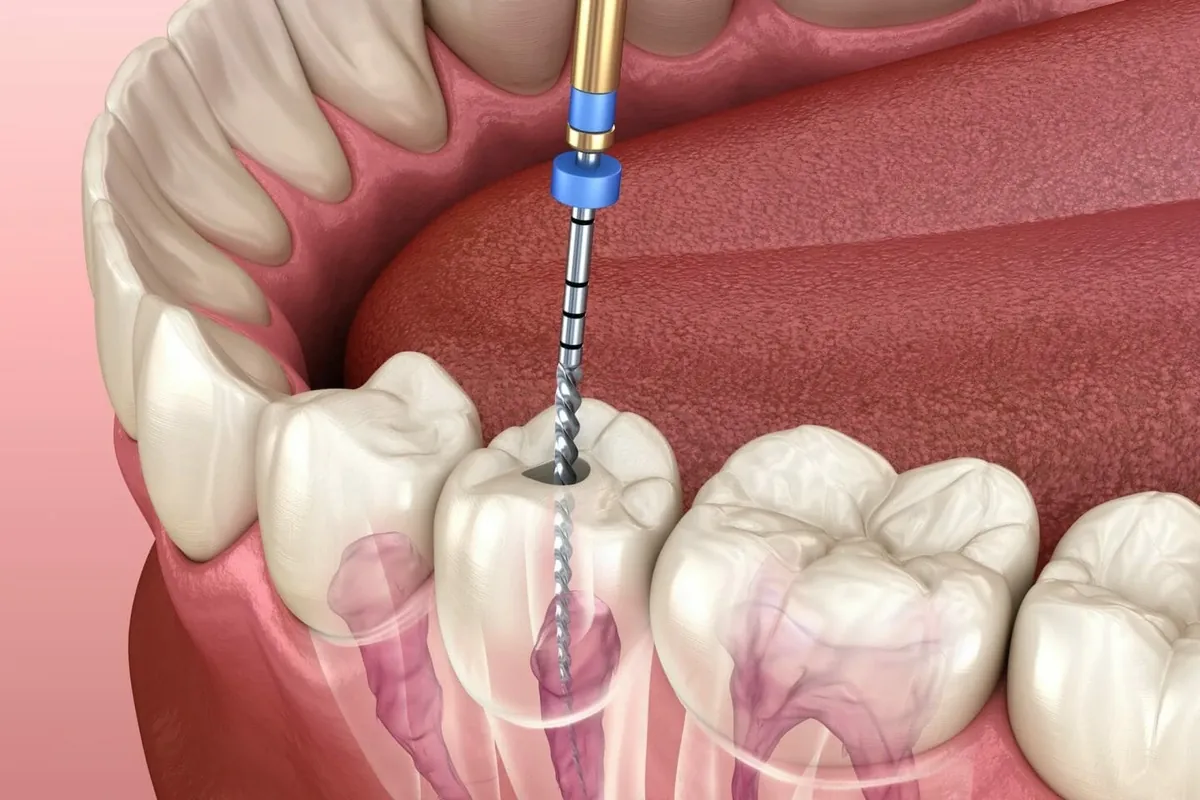
Why a treated tooth can fail
A root canal can be done well and still meet a problem later. The causes are specific, and identifying which one is yours decides whether retreatment makes sense.
A canal was missed the first time.
Roots hide extra canals, especially molars, and a canal that was never found was never cleaned or sealed. Bacteria persist in it and the infection at the root tip never fully resolves. This is one of the most correctable causes of failure — retreatment is designed to find what was missed.
The seal leaked over time.
A crown or filling that chips, loosens, or decays at its margin lets saliva and bacteria back into the treated canals. The tooth was sealed once, but the seal is only as durable as the restoration guarding it. Delayed or damaged restoration after the first treatment is a common story behind late failures.
The anatomy was more complex than expected.
Curved, narrow, or branching canals can resist complete cleaning even with careful work. What remains deep in a complex canal can sustain a low-grade infection that shows up months later as tenderness or a spot on the X-ray. Magnification and imaging decide whether a second attempt can do better.
New problems arrived later.
A treated tooth can crack, develop new decay, or suffer gum disease around it years after a successful root canal. Those are new insults, not failures of the original treatment — but they can look identical from the patient's side of the chair. Diagnosis separates a retreatable infection from a tooth that is simply done.
What retreatment involves
Imaging comes first — the shape of the previous treatment, the roots, and the bone decide whether retreatment, surgery, or extraction is the honest recommendation.
Exam and detailed imaging.
We examine the tooth and take imaging that shows the previous filling material, the roots, and the bone at the tips. Where the first treatment fell short — a missed canal, a short fill, a leaking crown — usually shows here, and it drives everything after.
An honest prognosis for a second attempt.
You hear whether retreatment has a realistic chance on this tooth, or whether the anatomy, a crack, or the remaining structure points to apicoectomy or extraction instead. A redo with poor odds is not a favor, and we will tell you if that is the picture.
Reopening, cleaning, and resealing.
The crown or filling is opened, the old filling material is removed from the canals, and the system is cleaned and disinfected along its full length — including any canal missed before. The canals are then sealed again, and the tooth is closed with a sound restoration.
Restoration and follow-up imaging.
A treated tooth usually needs a well-sealed crown to protect it from the leaking that caused trouble in the first place. Healing is then checked over the following months with follow-up imaging, because bone at the root tip rebuilds slowly and the X-ray, not symptoms alone, confirms success.
Retreatment vs apicoectomy vs extraction
Three paths answer a failing root canal. Retreatment re-enters through the crown and cleans the whole canal system — the right move when the problem is a missed canal or a leaking seal. Apicoectomy approaches from the root tip, removing the end of the root and sealing it, when the canal cannot be reached from above or a prior retreatment has failed. Extraction ends the problem and starts the replacement question. The findings — not preference — usually point to one, and we will show you why.
Hablamos español
We warmly welcome Spanish-speaking patients. A second endodontic decision deserves a clear head, and every finding, option, and cost factor is explained in your language — call us at (212) 561-5303. If you are uninsured, ask about membership and financing when you call.
Root canal retreatment questions, answered
01What is root canal retreatment?
It is a second root canal on a tooth that was already treated. The existing crown or filling is opened, the old canal filling material is removed, and the canals are cleaned, disinfected, and sealed again along their full length — this time with the benefit of knowing where the first treatment fell short. A missed canal can be found, a leaking seal replaced, and residual infection addressed. Afterward the tooth is restored, usually with a new crown, and healing is monitored with imaging.
02Why did my root canal fail?
The common causes are anatomical and restorative. A canal that was missed the first time was never disinfected. A canal that was cleaned but difficult — sharply curved, narrow, branching — may have kept a bacterial foothold. And a seal that later leaked through a cracked crown, a loose filling, or new decay lets bacteria re-enter a well-treated tooth. Less often, the tooth itself cracks or develops gum disease. The point of the diagnostic step is to name your cause, because each one changes whether retreatment is the right answer.
03What is the difference between retreatment and apicoectomy?
Retreatment works from the top: through the crown, down the full length of the canals, cleaning the whole system. Apicoectomy is a surgical approach from the bottom: the gum is opened, the very tip of the root is removed, and the canal is sealed from that end. Apicoectomy is considered when the canal cannot be reached from above — a post blocks the way, for example — or when a sound retreatment has still not resolved the problem. Sometimes the plans are sequenced; your imaging and the state of the existing restoration decide.
04Should I retreat, or just extract the tooth?
Retreatment makes sense when the tooth is structurally sound, the cause of failure is identifiable and reachable, and the bone support is good — a saved natural tooth needs no replacement and keeps doing its job. Extraction becomes the honest recommendation when the tooth is cracked into the root, too little structure remains to restore, or a second attempt has poor odds; then the comparison shifts to extraction plus a replacement such as an implant. We will lay out the prognosis and the complete cost of each path before you decide.
05Does retreatment hurt?
The procedure is done under local anesthesia and is generally comparable in comfort to the original root canal — for many patients the main difference is that it can take a little longer, since old filling material must be removed carefully. The discomfort that brings most people in is the reinfection itself, and treating it removes that source. Some tenderness for a few days afterward is normal. If the tooth is acutely swollen, the plan may stage the work so comfort comes first.
06How much does retreatment cost, and does insurance cover it?
Retreatment is typically priced as its own endodontic procedure, and the tooth usually needs a new crown afterward — that restoration is part of the complete cost to compare. Many plans cover retreatment under the same endodontic category as a first root canal, though frequency limits and prior-treatment clauses exist in some policies, so the actual benefit has to be checked rather than assumed. We will verify your plan and itemize the full path — retreatment plus restoration — before any work begins.
07Where are you located?
54 Warren Street, New York, NY 10007, in the heart of Tribeca — serving Tribeca, SoHo, Battery Park City, the Financial District, and Downtown Manhattan. Evaluations of a previously treated tooth include detailed imaging, so the recommendation you hear rests on what the first treatment actually looks like inside.
Endodontics in the heart of Tribeca
Find us at 54 Warren Street, New York, NY 10007 — in the heart of Tribeca, serving Tribeca, SoHo, Battery Park City, the Financial District, and Downtown Manhattan.
A treated tooth acting up? Start with imaging.
Call (212) 561-5303 or book online. We will examine the tooth, show you what the imaging reveals about the first treatment, and lay out retreatment, surgery, and extraction with their real commitments — so the second decision is better informed than the first.
Your Visit from Tribeca
Getting here from Tribeca is a short walk, not a trip, and that is how most of our neighbors arrive. If you are coming by subway, the 1, 2, 3, A, C, and E trains stop at Chambers Street, about a five-minute walk up Warren to our door. The 4, 5, and 6 at Brooklyn Bridge–City Hall are ten minutes on foot through the civic center, and the J and Z also stop at Chambers Street for the east-side connection.
Citi Bike stations sit on Warren Street and Greenwich Street, and New Jersey commuters can take PATH to the World Trade Center Oculus.
When you arrive at 54 Warren Street, we keep the day simple and unhurried from the moment you check in. Our team works together under one roof, so your visit stays in one place instead of sending you across town for another appointment or another opinion. We talk through what brought you in, take any imaging we need here in the office, and explain what we are seeing in plain language before we discuss next steps together.
You will always know what we recommend, why we recommend it, and what can wait, so you leave with a clear plan rather than unanswered questions.
Life in Tribeca moves between the cast-iron lofts on Franklin Street, the towers along West Street, and afternoons with families at Washington Market Park, and we schedule with that rhythm in mind. We are open Monday through Friday from 8 AM to 6 PM, Saturday from 9 AM to 4 PM, and Sunday from 9 AM to 2 PM, and you can book online any time or call us at (212) 561-5303.
Street parking here is tight, with cobblestone blocks and film shoots, but attended garages on Warren Street and Greenwich Street sit within a block of our door. Follow-ups stay with our same team, so your care feels continuous.
Ongoing care is where being neighbors really pays off for our Tribeca patients. A six-month recall is just a short walk over, a quick check-in with the team who already knows your history, and a cleaning that fits between school drop-off and the rest of your day. When treatment takes more than one visit, we sequence it sensibly, review healing in person, and adjust the plan together rather than by phone tag.
Because we have cared for families here since 2007, we notice small changes early, keep your records continuous, and remind you when you are due — so staying on track never feels like starting over.
How Care Is Planned at Our Tribeca Studio
Every treatment plan at Tribeca Dental Studio begins with a diagnosis, not a recommendation made in the abstract. We examine the tooth or area in question, review imaging taken here in the office — including 3D CBCT scans when the case calls for them — and talk through what we see in plain language before any treatment is proposed. You will always know what we recommend, why we recommend it, and what could safely wait.
When several options would serve you well, we lay them side by side: what each involves, how many visits it takes, how long it is expected to last, and what it asks of the neighboring teeth and bone.
That conversation becomes a written plan. The sequence, the timing, and the reasoning are set down before treatment begins, so there are no surprises mid-course and no step is improvised. Staged treatment is grouped into planned steps when we can, and each stage is checked before the next one starts.
If a simpler option would serve you just as well, that is the option we will put in front of you — and if the honest answer is that a tooth or a treatment can be watched rather than treated today, we will say that instead.
Because every specialty sits under one roof at 54 Warren St, a plan that touches several disciplines is designed as a whole. Implant surgery, periodontics, endodontics, orthodontics, cosmetic work, airway care, and pediatric dentistry are handled by one team in one place, which means the implant plan accounts for the gum plan, the orthodontic plan accounts for the airway, and nothing is lost between offices across town.
Your records, your imaging, and your history stay with the same team from the first visit through every follow-up.
Technology We Use — and Why It Matters
Good planning depends on seeing clearly. Our studio works with 3D CBCT imaging, which shows bone volume, nerve positions, sinus anatomy, and root form in three dimensions rather than the flat shadow of a standard X-ray. Implant positions, grafting decisions, root canal anatomy, and expansion planning are all worked out on that imaging before treatment begins, so the day of the procedure holds as few unknowns as possible.
Digital planning carries the same approach into orthodontics and cosmetic work: tooth movement and smile design are mapped in advance, and you can see the intended direction before committing to it.
Laser technology is part of everyday care here, from gum therapy to the NightLase protocol we use for snoring. Lasers let us treat soft tissue with precision and, in many cases, with a quieter recovery than traditional surgery. For sleep concerns, we use at-home sleep testing rather than assumptions: your breathing is measured in your own bed, and the results — not a guess — decide whether an oral appliance, NightLase, or a referral is the right path.
Technology earns its place in the plan only when it changes a decision or improves an outcome; that is the standard each tool here is held to.
Costs, Insurance, and Written Estimates
Before treatment begins, you receive the plan in writing — including what each stage involves and what it costs — so you can decide with the full picture in front of you. There is no obligation attached to a consultation, and a second opinion is a reasonable thing to want; we would rather you choose with clear information than feel rushed into a chair.
If you have dental insurance, our team verifies your coverage and explains what it does and does not apply to before we start, and if you do not, the written plan still lets you stage treatment sensibly over time.
Dental treatment is often easier to approach in planned stages than all at once. A written plan lets you sequence what is urgent, what protects the teeth around it, and what is elective, so each visit moves the whole plan forward. If something changes along the way — a tooth responds better or worse than expected — the plan is revisited with you, in writing, before the next step. That discipline is what keeps a long course of treatment from becoming a series of surprises.
Comfort, Recovery, and Follow-Up
Most dental anxiety comes from the unknown, so we work to remove it: what will happen, how long it takes, what it will feel like, and what recovery looks like are all covered before we begin. During treatment we check in rather than push through, and after it we tell you plainly what is normal, what is not, and when to call.
Written aftercare instructions go home with you, and the precautions in them — protecting a healing site, eating soft foods for a few days, keeping the area clean — are the difference between an uneventful recovery and a complicated one.
Follow-up is part of the treatment, not an extra. We schedule reviews around your life, use return visits to check healing and the details we flagged together, and keep recall reminders running so maintenance does not drift. If something feels off between visits, we would rather see you quickly than have you wait and wonder.
Call us at (212) 561-5303 or book online at any time — the studio is open Monday to Friday from 8:00 AM to 6:00 PM, Saturday from 9:00 AM to 4:00 PM, and Sunday from 9:00 AM to 2:00 PM.
Before You Book
A final word on how to use pages like this one. Treatment pages describe what is possible; a consultation decides what is appropriate — for your anatomy, your history, your goals, and your budget, in that order of conversation. If anything here has raised a question we have not answered, bring it with you: patients who arrive with marked-up pages and specific questions get the most from their first visit, and the plan we write together is better for it.
Tribeca Dental Studio is at 54 Warren St in Tribeca, and new patients are welcome at any of the services described on this site. Book online at any time or call (212) 561-5303. The first step is an examination and an honest conversation; everything else in dentistry follows from those two things done properly.
The Next Step Is a Conversation
Wherever this page found you — a search at midnight, a partner's forwarded link, a dentist's suggestion — the next step is smaller than the worry usually makes it feel. A consultation at the studio is an examination and a conversation, not a commitment: findings first, options with their honest trade-offs, a written plan with costs, and time to decide at home.
Patients tell us the plan is what they actually came for, whether they proceed here, proceed elsewhere, or proceed nowhere for now. That is the offer, and it stands on every page of this site: 54 Warren St, bookable online at any hour, or at (212) 561-5303 — Monday to Friday 8:00 AM to 6:00 PM, Saturday 9:00 AM to 4:00 PM, Sunday 9:00 AM to 2:00 PM.
The Consultation Is Not a Funnel
A last word that applies to every page in this series, whichever treatment brought you here: the consultation is not a funnel. Patients arrive at these pages mid-worry — about a tooth, a jaw, a night's sleep, a smile in photographs — and the studio's answer has been the same since 2007. An examination. Imaging where imaging decides. A written plan with the options and their costs, including the option of doing less, or nothing yet.
Then time to think, at home, without a follow-up call designed to hurry you. If that is the experience you were hoping dentistry could be, the door is at 54 Warren St, and it opens online at any hour or at (212) 561-5303.
How We Plan Your Care at Tribeca Dental Studio
Every treatment at Tribeca Dental Studio starts with a diagnosis, not a sales pitch. Before we recommend anything, we examine the tooth or area in question, review imaging taken here in the office, and talk through what we see in plain language. You will always know what we recommend, why we recommend it, and what could safely wait.
That recommendation becomes a written plan, so the sequence, the timing, and the reasoning are clear before any treatment begins — and if a simpler option would serve you just as well, that is the option we will put in front of you.
Our studio brings every dental specialty under one roof at 54 Warren St in Tribeca, and it has since 2007. General dentistry, cosmetic care, implant surgery, periodontics, endodontics, orthodontics, airway care, and pediatric dentistry are handled by one team in one place, which means a treatment that touches several specialties is planned as a whole rather than handed off between offices across town.
Your records, your imaging, and your history stay with the same team from the first visit through every follow-up, so nothing is lost between providers and no step is planned in isolation.
We are open Monday to Friday from 8:00 AM to 6:00 PM, Saturday from 9:00 AM to 4:00 PM, and Sunday from 9:00 AM to 2:00 PM. You can book online at any time or call us at (212) 561-5303.
The studio sits between Greenwich Street and West Broadway, steps from the Chambers Street subway hub (1, 2, 3, A, C, E), with attended garages on Warren Street and Greenwich Street within a block of our door for patients who drive in.
Care does not end when the procedure does. We schedule reviews and follow-ups around your life, group staged treatment into planned steps when we can, and use each return visit to check healing and watch the details we flagged together. Between appointments we stay in touch with recall reminders and clear next steps, and if something feels off, we would rather see you quickly than have you wait and wonder.
The goal is a plan you understand, a team you recognize, and results that are checked over time rather than assumed.