How to Choose a Dental Clinic in Manhattan
October 27, 2026
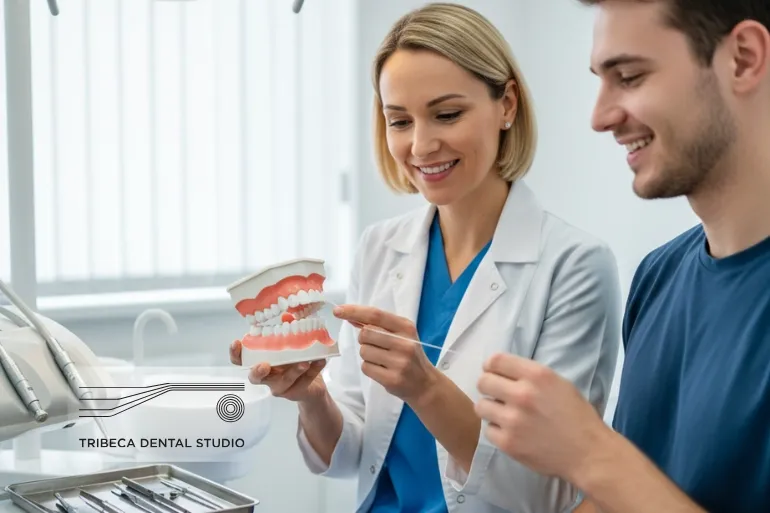
When choosing a Manhattan dental clinic, check nine things: whether specialists work in-house or you will be referred across town; how fast they can see you in an emergency; whether they use modern imaging and digital scanning; whether prices are given in writing before treatment; what their reviews actually say when read for patterns; whether licenses and board certifications check out; whether they treat your whole family; how well they communicate; and whether sterilization is visible and willingly explained.
Manhattan has hundreds of dental practices within a few subway stops of each other, and their websites all promise gentle care and beautiful smiles. The differences that matter only show up when you know what to ask. This guide walks through each factor, what to verify, and the red flags that should send you to the next practice on your list.
Specialists in the Building, Not Across Town
The first question to settle is who actually performs your treatment. A clinic with specialists in-house — a periodontist for gums and implants, an oral surgeon, an orthodontist, a pediatric dentist — can plan and complete complex care under one roof, with one set of records and one team that talks to each other.
Referrals are not automatically a problem; a good general dentist refers when a case needs it. The problem is a practice where nearly everything is sent out. Each referral means a new office, new intake forms, often new imaging, weeks of scheduling gaps, and split responsibility if something goes wrong mid-treatment. Ask directly: "If I need an implant, gum surgery, or a root canal, who does it, and where?" A confident, specific answer names the clinician and their training.
Red flags: vague answers about who performs surgery, treatment plans that stall while you wait for outside appointments, or a practice that seems surprised by the question. Persistent, hard-to-pin-down symptoms — pain when you chew, for example — are diagnosed faster when the relevant specialists share the same chart and the same imaging.
Emergency Care: How Fast Can They See You?
Judge a clinic's emergency care before you need it. Ask whether they hold same-day or next-day slots for urgent problems, and what counts as urgent in their book: severe pain, swelling, a broken tooth, a lost crown, or a tooth that has been knocked out.
Then ask about after hours. If you develop swelling on a Sunday night, is there an on-call dentist, a phone number that reaches a person, or clear instructions on what to do? Swelling with fever, or any swelling that affects swallowing or breathing, is a medical emergency — a good practice will tell you that plainly and direct you to urgent care rather than a Monday appointment.
Red flags: the first available appointment for a patient in pain is weeks away, there is no after-hours path at all, or the front desk cannot explain how emergencies are handled. Knowing what a practice considers an emergency — and how its emergency appointments work — tells you a great deal about how it treats patients when it matters most.
Technology That Actually Changes Your Visit
Modern equipment is worth asking about only when you understand what it changes for you. Four technologies matter most. Three-dimensional CBCT imaging shows bone, nerves, and sinuses in 3D, which makes implant planning and difficult diagnoses far more precise than flat X-rays alone. A digital scanner such as iTero replaces the gag-inducing impression tray with a quick scan, and produces a more accurate model for crowns, aligners, and restorations.
Digital X-rays display images instantly and typically use less radiation than traditional film. Laser dentistry is used for a range of gum and soft-tissue procedures and, for some treatments, can mean less bleeding and no sutures. None of this replaces clinical judgment, but together it usually means fewer appointments, better-fitting work, and diagnoses based on more information.
Red flags: a practice that advertises technology but cannot explain how it applies to your case, or one still relying on film X-rays and impression putty for everything. Ask, "What will you use to plan my treatment, and why?"
Transparent Pricing: Written Numbers Before the Chair
You should never learn what your treatment costs after it is done. A trustworthy clinic gives you a written treatment plan before major work begins: each procedure listed, the total price, what insurance is expected to cover, and what you will owe.
Ask what the price includes — follow-up visits, adjustments, lab work — and what could change it. Ask whether the plan separates what is urgent from what can safely wait, so you can phase treatment to your budget instead of feeling cornered into all of it at once. The clinic should also verify your insurance coverage and, for larger work, seek pre-authorization before treatment, not after a claim is denied.
To compare quotes between clinics fairly, line up the same procedures, materials, and follow-ups. A noticeably lower quote usually means something was left out; find out what before you decide. Red flags: refusal to put an estimate in writing, a total that changes mid-treatment without explanation, or pressure to commit to elective work the same day it is proposed.
Reviews: Read for Patterns, Not Averages
Star ratings alone tell you little. Read reviews the way you would read references: for volume, recency, and recurring themes. A steady stream of specific reviews over several years is far more meaningful than a burst of short, generic five-star reviews posted in a single week, which can indicate solicitation or worse.
Read the negative reviews carefully and sort them by pattern. Repeated complaints about surprise bills, rushed visits, or difficulty reaching the office point to operational problems. A single angry review about parking does not. Notice how the practice responds: a professional reply that invites the patient to resolve the issue offline is a good sign; arguing with reviewers is not.
Cross-check at least two platforms — Google, Yelp, Zocdoc — and be skeptical when the story differs wildly between them. You are looking for consistency over time, not perfection.
Credentials You Can Verify
Do not take a biography page at face value; dental credentials are publicly verifiable. In New York, every practicing dentist must hold a state license, and you can confirm it — and check for disciplinary actions — through the New York State Office of the Professions' online verification search at op.nysed.gov. The American Dental Association also offers background on specialties and a dentist directory.
Understand the difference between a general dentist and a specialist. Specialists complete accredited residency training after dental school in fields such as periodontics, orthodontics, pediatric dentistry, endodontics, oral surgery, and prosthodontics, and many hold board certification in their specialty on top of that.
Note that "cosmetic dentist" is not a recognized specialty — for veneers or a smile makeover, the evidence to ask for is experience and results: before-and-after photographs of the dentist's own patients with cases like yours.
Red flags: evasiveness about training, credentials that do not appear in the state lookup, or cosmetic portfolios the practice cannot confirm are its own work.
One Roof for the Whole Family
A full-service clinic covers preventive care, fillings, crowns, implants, orthodontics, and cosmetic work, so your history stays in one chart as your needs change. If you have children, check whether care is provided by pediatric dentists — specialists trained in children's dentistry — ideally in a space designed for kids, rather than a general office that simply accepts young patients.
Continuity pays off in unglamorous ways: the dentist who has your imaging from five years ago can spot changes faster; a teenager aging out of pediatric care transfers records across the hall instead of across town; a parent and child can be seen on the same morning. For complex adult work such as full-arch implants, having the surgical and restorative teams in one practice removes the handoffs where details get lost.
Red flags: a narrow service list that guarantees referrals for anything beyond cleanings and fillings, or children's care with no pediatric specialist involved.
Location, Hours, and Communication
The best clinic is the one you will actually visit twice a year. Weigh the location against your real life — near your home or office, on a route you already travel — and check that the hours fit your schedule, including early or late appointments if your workday demands them.
Communication deserves a test before you book. Send a question through the website or call with a simple query and judge the response: how fast, how clear, how human? Look for online booking, appointment reminders, and — most importantly — explanations in plain language. A dentist who walks you through your options, including the option of doing nothing for now, with honest trade-offs for each, is one you can make decisions with.
Red flags: you cannot reach a person, explanations arrive as jargon, or a treatment plan is presented as take-it-or-leave-it with no alternatives discussed.
Safety and Sterilization You Can See
Infection control is one area where a patient can verify a great deal firsthand. Instruments should come from sealed sterilization pouches opened in front of you. Gloves, needles, and suction tips are single-use and discarded after your visit. Surfaces in the treatment room should be barrier-wrapped or disinfected between patients.
You are entitled to ask how instruments are sterilized (steam autoclaves are the standard), how often sterilizers are tested, and whether the practice maintains its dental waterlines — the narrow tubes that supply water to handpieces — in line with CDC guidance on infection control in dental settings. A well-run practice answers these questions without defensiveness; many will happily show you the sterilization area.
Red flags: unsealed instrument packs already laid out before you sit down, visible shortcuts on gloves or barriers, or irritation when a patient asks a reasonable safety question.
The Side-by-Side Clinic Checklist
Use this table to score any two clinics you are comparing. The "what good looks like" column is the standard; note honestly how each clinic measures up.
| Factor | What good looks like | Clinic 1 | Clinic 2 |
|---|---|---|---|
| Specialists | Periodontist, surgery, orthodontics, pediatric in-house | ||
| Emergency access | Same/next-day urgent slots; clear after-hours plan | ||
| Technology | 3D imaging, digital scanning, digital X-rays, laser | ||
| Transparent pricing | Written plan and total before treatment; phases explained | ||
| Insurance | Coverage verified, pre-authorization for major work | ||
| Reviews | Steady, specific, over years; negatives answered professionally | ||
| Credentials | NY license verified; specialists board-certified | ||
| Full-service & family | Preventive through implants; pediatric specialists for kids | ||
| Access & communication | Convenient hours, online booking, plain-language answers | ||
| Sterilization | Sealed pouches opened chairside; protocols explained on request |
Questions to Ask at a First Visit
Bring these questions to any first appointment. The quality of the answers matters more than their polish.
- Who will actually perform my treatment, and what is their training in it?
- What are my options — including waiting — and what happens if I wait?
- Can I have the full treatment plan and price in writing before we start?
- What does that price include: follow-up visits, adjustments, lab work?
- Will you verify my insurance and get pre-authorization before major work?
- If I am in severe pain at night or on a weekend, what exactly should I do?
- How do you sterilize instruments, and how often is the sterilizer tested?
- For cosmetic work, may I see before-and-after photos of your own patients?
- How much experience do you have with the procedure you are recommending for me?
- What maintenance will this treatment need, and how often will you want to see me?
Frequently Asked Questions
How can I verify a dentist's credentials in New York?
Use the New York State Office of the Professions' online license verification at op.nysed.gov. Search by name to confirm the license is current and to see any disciplinary history. For specialists, you can also confirm board certification through the relevant specialty board, and the ADA's site, ada.org, explains what each specialty covers.
What should a first dental visit include?
A thorough first visit usually includes a review of your medical and dental history, a full examination of your teeth and gums, X-rays where needed, an oral cancer screening, and a professional cleaning — though the cleaning may be scheduled separately if the exam finds gum disease or treatment needs that change the order of care. It should end with a clear explanation of findings and a written plan for anything recommended.
How do I compare prices between clinics fairly?
Get an itemized written plan from each clinic for the same treatment, then compare procedure by procedure: same teeth, same materials, same inclusions such as lab work and follow-up visits. Ask each clinic what is urgent and what can wait. When one quote is far lower, it usually excludes something the other includes — finding that difference is the comparison.
Do I need a specialist, or is a general dentist enough?
A general dentist handles prevention, fillings, crowns, and routine care for most people. Specialists earn their place in specific situations: a periodontist for gum disease and implants, an endodontist for complex root canals, an orthodontist for bite correction, an oral surgeon for difficult extractions, and a pediatric dentist for children. A good general dentist refers appropriately; a multi-specialty practice keeps that care in-house.
What if I have dental anxiety?
Say so when you book — you will not be the first, and it changes how a good practice schedules and paces your visit. Ask about longer appointments, agreed signals to pause, and unhurried explanations before anything begins. For some patients, sedation options are appropriate; ask what the practice offers and whether it fits your medical history. Anxiety that keeps you away entirely is the real risk, so choose a clinic whose manner makes returning easier.
How often should I change dentists — and when is it time to switch?
There is no schedule; continuity with a dentist who knows your history is valuable. It is time to switch when trust breaks down: prices that change without explanation, treatment pushed without a clear reason, pain that is repeatedly dismissed, billing surprises, or a practice you cannot reach when something hurts. You are entitled to your records and X-rays, and a new clinic can request them on your behalf.
How Tribeca Dental Studio Fits This Checklist
Apply the same checklist to us. Tribeca Dental Studio is at 54 Warren St in Tribeca, New York, NY 10007, and treats both adults and children — the pediatric team works in its own children's studio, TDS 4 Kids. The multi-specialty team is in-house, including periodontist Dr.
Sam Morhaim, pediatric dentists, and general and cosmetic dentists, and care runs from hygiene and laser cleaning through implants — including All-on-4 and zygomatic implants — veneers, Invisalign, emergency dentistry, and NightLase sleep and snoring treatment.
The practice works with 3D imaging, iTero digital scanning, and laser dentistry, and offers emergency appointments — for urgent problems, call (212) 561-5303. For the factors this page cannot show you, such as pricing in writing and sterilization protocols, bring the questions above to your first visit and judge the answers yourself. That is the point of a checklist: it should work on every clinic, including ours.
You can book a first visit online here: book an appointment at Tribeca Dental Studio.