Does Invisalign Change Face Shape? Effects on Jawline, Lips, and Bite
September 29, 2025
Does Invisalign Change Face Shape? Effects on Jawline, Lips, and Bite
Can orthodontic treatment affect more than just the appearance of your smile? Many people begin treatment to straighten their teeth, but changes in tooth position and bite can also influence how the lips, smile, and lower facial profile appear. Braces and Invisalign primarily move teeth, but those dental changes may subtly affect facial balance in some patients.
The extent of any visible change depends on the original bite, tooth position, facial anatomy, age, and treatment plan. Invisalign should not be viewed as a treatment for dramatically reshaping the jawbone or facial structure, but correcting certain alignment and bite problems may create a more balanced relationship between the teeth, lips, and profile.
Invisalign and Facial Changes at a Glance
- Invisalign primarily moves teeth rather than surgically changing the jawbone.
- Bite correction can affect facial appearance by changing the relationship between the teeth, lips, and profile.
- Jawline changes are usually subtle and vary significantly from one patient to another.
- Invisalign does not make the face physically thinner or enlarge the chin.
- Severe skeletal jaw discrepancies may require a different orthodontic or surgical treatment plan.
What Is Invisalign and How Does It Work?
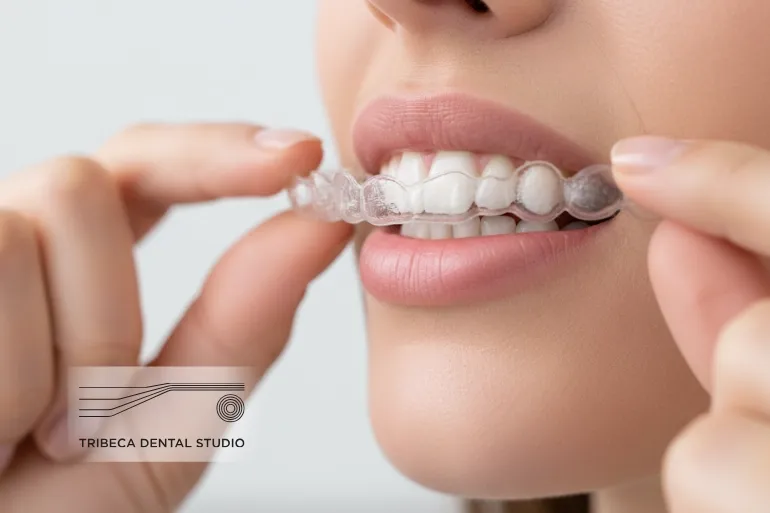
Invisalign is an orthodontic system that uses a sequence of custom-made clear aligners to gradually move teeth into planned positions. Each aligner applies controlled forces to selected teeth, allowing the treatment to progress in stages.
Unlike traditional braces, Invisalign aligners are removable and nearly transparent. Patients can remove them for eating, brushing, and flossing, although consistent wear according to the prescribed treatment plan is important for predictable tooth movement.
The exact number of aligners, treatment duration, attachments, elastics, or refinement stages depends on the complexity of the individual case.
How Invisalign Affects Bite Alignment and Jaw Relationships
Invisalign can be used to address many dental alignment and bite concerns, including selected cases of overbite, underbite, crossbite, crowding, and spacing. The primary goal is to improve tooth position and how the upper and lower teeth fit together.
As teeth move, the bite relationship may also change. This can improve how teeth contact during chewing and may reduce uneven pressure on individual teeth.
Important distinction: Invisalign can change dental relationships, but it does not reposition adult jawbones in the same way as corrective jaw surgery. The appropriate treatment depends on whether a bite problem is primarily dental, skeletal, or a combination of both.
Patients with more complex bite concerns may benefit from a broader evaluation of available orthodontic treatment options .
Does Invisalign Change Your Jaw or Jawline Appearance?
Invisalign primarily moves teeth rather than surgically reshaping the jaw. However, correcting crowding, excessive overjet, a deep bite, or other bite relationships can change how the teeth, lips, and lower facial profile relate to one another.
Because of these changes, some patients may notice subtle differences in facial balance or jawline appearance during or after treatment. The amount of visible change varies considerably and depends on the original bite, tooth position, age, facial anatomy, and treatment plan.
No. Invisalign should not be expected to create major changes in jaw size, chin projection, or facial bone structure. Any visible facial changes associated with treatment are generally secondary to changes in tooth position and bite.
Does Invisalign Permanently Reshape the Jaw?
Invisalign does not permanently reshape the jawbone in the way that corrective jaw surgery can. Its primary effect is controlled orthodontic tooth movement.
By changing how the upper and lower teeth fit together, orthodontic treatment may improve bite relationships and subtly influence the appearance of the lips or facial profile. These changes are related mainly to dental alignment rather than direct reshaping of the jawbone.
After active orthodontic treatment is completed, retainers are typically recommended to help maintain the new tooth positions. Without appropriate retention, teeth can gradually shift over time.
Invisalign vs. Braces: Differences in Face and Jaw Changes
Both braces and Invisalign are designed to move teeth and improve alignment, but they use different orthodontic mechanics.
| Feature | Invisalign | Traditional Braces |
|---|---|---|
| How teeth are moved | Removable clear aligners | Fixed brackets and wires |
| Visibility | Discreet and nearly transparent | More visible |
| Removable | Yes | No |
| Complex tooth movement | Can manage many cases, sometimes with attachments or elastics | May offer advantages for certain complex movements |
| Direct jawbone reshaping | No | No |
| Potential facial-profile effect | Usually secondary to changes in tooth position and bite | Usually secondary to changes in tooth position and bite |
In growing patients, orthodontic treatment planning may also take jaw development into consideration. Additional orthodontic appliances may sometimes be used when growth modification is part of the treatment plan.
Can Invisalign Improve the Appearance of a Weak Chin or Jaw Definition?
Invisalign does not enlarge the chin or directly reshape the jawbone. However, in some cases, correcting dental relationships such as excessive overjet or a deep bite may subtly influence the appearance of the lower facial profile.
Changes in tooth position can affect lip support and how the upper and lower teeth relate to each other. This may create a more balanced appearance in some patients, but these changes should not be compared with the effects of jaw surgery or cosmetic facial procedures.
Will Invisalign Make Your Face Look Thinner?
Invisalign does not reduce facial fat or physically make the face thinner. However, changes in tooth alignment, bite, and lip support may subtly influence how the lower face appears.
For example, correcting protruding teeth or improving selected bite relationships may change how the lips rest or how the facial profile is perceived. These effects vary between patients and are not guaranteed outcomes of Invisalign treatment.
Can Invisalign Change Face Shape, Lips, Smile, or Profile?
Invisalign can influence smile appearance by improving tooth alignment, spacing, crowding, and selected bite relationships. As teeth move, the lips may rest differently against the dental arches, and the overall smile may appear more balanced.
Some patients may also notice subtle changes in their facial profile as the relationship between the teeth, lips, and bite changes. Orthodontic research has shown that tooth movement can be associated with soft-tissue changes, particularly around the lips and profile, although the extent of these changes varies widely between individuals.
These effects should be considered secondary to the primary goal of orthodontic treatment: improving tooth alignment and bite function.
What to Expect During and After Invisalign Treatment
During treatment, patients may notice gradual changes in tooth position and in how their bite feels. Mild pressure or temporary soreness can occur when beginning a new aligner.
- Early treatment: Aligners begin moving selected teeth and patients adapt to wearing them.
- Progressive alignment: Crowding, spacing, and selected bite relationships gradually improve.
- Refinement: Additional aligners may be used to fine-tune tooth position when needed.
- Retention: Retainers are typically recommended after active treatment to help maintain the final positions.
Some patients may notice subtle changes in their smile or profile during this process, but the degree of visible facial change varies considerably.
Who Can Benefit Most From Invisalign?
Invisalign may be appropriate for patients with a range of orthodontic concerns, including crowding, spacing, and selected bite problems.
- Patients with mild to moderate crowding or spacing.
- Selected patients with overbite, underbite, or crossbite.
- Patients looking for a more discreet orthodontic treatment option.
- Adults and teenagers who can wear aligners consistently.
- Patients whose bite or tooth position contributes to an unbalanced smile or profile.
In growing patients, orthodontic professionals may also consider jaw development when planning treatment. Adults can still achieve significant tooth movement and bite correction, although severe skeletal discrepancies may require different treatment approaches.
Possible Limitations and Side Effects of Invisalign
Invisalign can treat many orthodontic concerns, but it is not the appropriate treatment for every case. Complex tooth movements or significant skeletal discrepancies may require alternative or additional treatment.
- Temporary soreness or pressure may occur when a new aligner is introduced.
- Some patients notice temporary speech changes while adjusting to clear aligners.
- Aligners must be worn consistently according to the prescribed treatment plan.
- Attachments, elastics, or refinement aligners may be required.
- Retention is important because teeth can shift after orthodontic treatment.
Research published through the National Library of Medicine indicates that clear aligners can effectively perform many orthodontic tooth movements, although predictability varies depending on the type and complexity of movement.
Is Invisalign the Right Choice for Your Smile and Bite?
Invisalign can be a useful option for patients seeking a discreet way to correct tooth alignment and selected bite concerns. It may be used for crowding, spacing, overbite, underbite, crossbite, and other orthodontic problems depending on their severity and underlying anatomy.
However, treatment should always be based on an individualized evaluation. Significant skeletal discrepancies or complex orthodontic problems may require braces, additional appliances, or other approaches.
Considering Invisalign in Tribeca?
At Tribeca Dental Studio, treatment planning begins with an evaluation of your teeth, bite, facial relationships, and individual orthodontic goals. Our team can determine whether Invisalign treatment or another orthodontic approach may be appropriate for your needs.
Schedule an Invisalign consultation at our New York City dental office.
Frequently Asked Questions About Invisalign and Face Shape
Can Invisalign Change Your Face Shape?
Invisalign primarily moves teeth. Changes in tooth position and bite may subtly affect lip support, smile appearance, and facial profile, but Invisalign does not directly reshape facial bones in adults.
Can Invisalign Make Your Jawline Sharper?
Some patients may notice subtle differences in the appearance of the lower facial profile after bite correction. Invisalign is not specifically designed to sharpen the jawline, and visible changes vary between patients.
Can Invisalign Move the Lower Jaw Forward?
Standard Invisalign treatment primarily moves teeth. In selected growing patients, certain Invisalign treatment approaches may incorporate features intended to address mandibular advancement. Adult skeletal jaw discrepancies may require other orthodontic or surgical approaches.
Can Invisalign Fix an Underbite?
Some dental underbites can be treated with Invisalign depending on their severity and cause. More significant skeletal underbites may require additional orthodontic treatment or corrective jaw surgery.
Does Invisalign Permanently Change Your Facial Profile?
Orthodontic treatment can create lasting changes in tooth position and bite when results are appropriately maintained with retainers. Any associated facial-profile changes are usually subtle and depend on the patient's original anatomy and treatment plan.