Scaling and Root Planing Cost: What a Deep Cleaning Quote Actually Covers
Scaling and root planing cost confuses patients because the same two words cover very different amounts of disease: one calm quadrant is not four deep ones. This page explains what actually moves the price — how many quadrants, how deep the pockets are, anesthesia, and the re-evaluation and maintenance visits that make the treatment work.
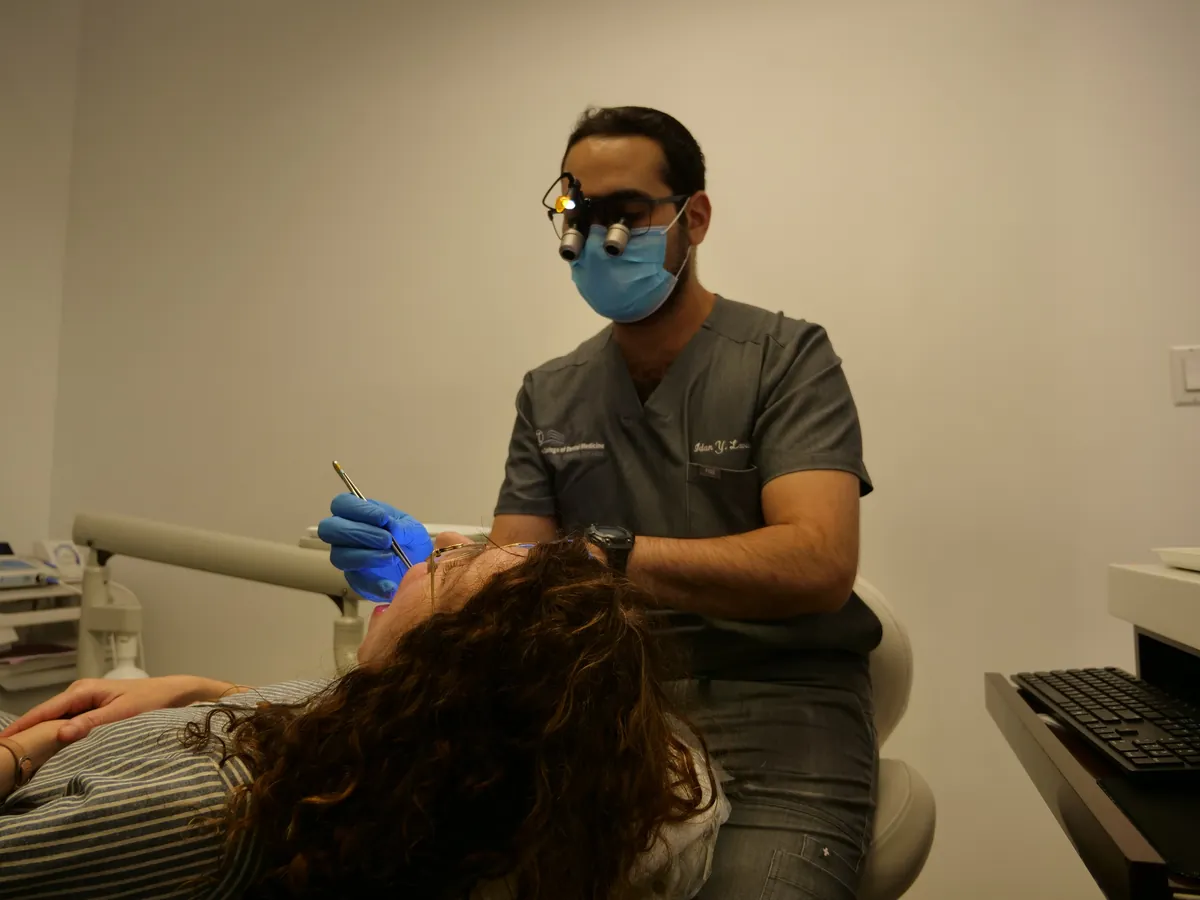
What drives scaling and root planing cost
The price is built from the disease map: how much of the mouth is involved, how deep the deposits sit below the gumline, and how much follow-up the result needs.
Quadrants are the unit of the work.
Deep cleaning is performed and priced by quadrant — a quarter of the mouth at a time. A patient with early disease in one quadrant and a patient with generalized disease in all four are buying different amounts of dentistry under the same name. Your charting, tooth by tooth, is what turns the phrase into a number of quadrants.
Pocket depth changes the difficulty, not just the diagnosis.
Deposits a few millimeters below the gumline are reached and removed differently from deposits at the bottom of deep pockets, around root grooves and furcations where molars split. Deeper disease means longer appointments, more meticulous instrumentation, and sometimes staged visits — the depth map is a labor map, and the quote follows it.
Anesthesia is part of honest pricing.
Working below the gumline on inflamed tissue without numbing is neither kind nor thorough — patients flinch, and clinicians under-instrument sore areas. Local anesthesia for the treated quadrant is a normal part of this treatment. If a quote looks unusually lean, ask whether anesthesia is included or whether comfort is where the difference went.
Re-evaluation and maintenance are in the real cost.
The treatment's value is decided weeks later, when healed pockets are re-measured and non-responding sites are identified. After that, treated gum disease is managed with maintenance cleanings on a shorter cycle than standard six-month recalls. A quote covering only the cleaning appointments is a partial quote; ask what the full first year of care looks like.
How deep cleaning is planned and priced
A periodontal charting comes first — pocket depths and bleeding around every tooth decide how many quadrants genuinely need treatment, and in what order.
Full periodontal charting and diagnosis.
Every tooth is probed at six sites, with bleeding, recession, and mobility recorded, and imaging reviewed for bone levels. That chart is the diagnosis and the quote's foundation at once — it shows which quadrants have disease needing deep cleaning and which need only standard care, so nothing is treated or charged by habit.
Itemized quote by quadrant, with the follow-up stated.
You see the cost separated into its parts: the quadrants to be treated, anesthesia, the re-evaluation visit, and the maintenance interval recommended afterward. Insurance and financing questions are answered at this stage, with your actual plan checked — gum therapy coverage has specific documentation habits worth handling correctly the first time.
The deep cleaning appointments.
Treatment is scheduled by quadrant — often one or two per visit — with the area numbed first. Ultrasonic and hand instrumentation remove plaque and calculus from below the gumline and smooth the root surface so tissue can reattach more closely. You leave with soreness expectations and home-care instruction specific to the treated areas.
Re-evaluation, then maintenance.
After healing, the pockets are re-charted and compared with the original map. Sites that responded move to maintenance; sites that did not get a further plan, which can range from localized re-treatment to a periodontal specialist referral.
The re-evaluation is part of the treatment, not an extra
Scaling and root planing is measured by what the gums do afterward. Weeks after treatment, the pockets are re-measured: some will have tightened and stopped bleeding, and some deep sites may need further therapy or a specialist conversation. Skipping that appointment to save its cost is false economy — it is the visit that tells everyone whether the money already spent worked. The maintenance cleanings that follow, on a shorter interval than standard recalls, are likewise part of keeping treated gum disease quiet, not optional polish.
Hablamos español
Recibimos con gusto a pacientes que hablan español. El tratamiento de encías implica varias visitas y un plan de mantenimiento, y cada factor de costo se explica en su idioma — llámenos al (212) 561-5303. Si no tiene seguro, pregunte por la membresía y el financiamiento al llamar.
Scaling and root planing cost questions, answered
01What does scaling and root planing cost?
There is no responsible single figure, because the treatment is sized by your disease map. The drivers are how many quadrants need treatment — one through four — the depth of the pockets and deposits within them, the anesthesia involved, and the follow-up built around it: the re-evaluation visit and the maintenance schedule for the first year. Two quotes for the same mouth can differ because they include different amounts of that follow-up.
02Why is it charged per quadrant?
Because that is how the work is genuinely organized. Each quadrant is its own appointment's worth of anesthesia, instrumentation, and time, and disease is rarely uniform across the mouth — one quadrant may be deeply involved while another needs nothing beyond standard cleaning. Per-quadrant pricing means you pay for the disease you have, in the places you have it. If a practice quotes a whole mouth without a tooth-by-tooth charting, the number is a guess wearing a uniform. The chart comes first; the quadrants follow from it.
03Does insurance cover scaling and root planing?
Many plans cover it in part when the documentation supports the diagnosis — which is why the charting and imaging records matter beyond clinical reasons. Plans commonly require specific pocket-depth evidence, pay a category percentage rather than the whole fee, and may limit how often quadrants can be re-treated. Those details decide your real out-of-pocket cost more than the headline fee does. We can check your actual plan before treatment and submit the records properly. If you are uninsured, ask about membership and financing when you call.
04Is a deep cleaning just a more expensive regular cleaning?
No — they treat different conditions. A regular cleaning works above the gumline on a mouth with healthy attachment; it is prevention. Scaling and root planing works below the gumline, removing the deposits driving an active infection that has already cost bone, with the goal of shrinking pockets and stopping progression; it is therapy. Being offered a deep cleaning deserves a charting you can see, and being offered only a regular cleaning when pockets are deep is the opposite error. The diagnosis — not the price — decides which one you need.
05Why do I need a re-evaluation visit afterward?
Because nobody knows whether the treatment worked until the tissue has healed and been re-measured. Gums need weeks to tighten after the deposits are removed. At re-evaluation, the new chart is compared site by site with the original: most sites should show shallower pockets and no bleeding. The ones that do not are exactly the sites that need a next step — and without that visit they would simply continue quietly. It is the quality control of the whole treatment, and it is where the maintenance interval is set.
06What happens if I skip the deep cleaning and just wait?
Gum disease of this stage does not wait with you. The deposits below the gumline are protected from brushing and flossing — that is precisely why professional removal is the treatment — so the infection driving them persists, pockets deepen, bone loss continues, and teeth loosen slowly over time. The eventual treatment for advanced disease is more involved than the treatment for the stage you are in now, in scope and in cost.
07Where are you located?
54 Warren Street, New York, NY 10007, in the heart of Tribeca — serving Tribeca, SoHo, Battery Park City, the Financial District, and Downtown Manhattan. A deep-cleaning consultation includes a full periodontal charting and an itemized, quadrant-by-quadrant discussion of exactly what needs treatment and what does not.
Deep cleaning in the heart of Tribeca
Find us at 54 Warren Street, New York, NY 10007 — in the heart of Tribeca, serving Tribeca, SoHo, Battery Park City, the Financial District, and Downtown Manhattan.
Told you need a deep cleaning? Start with a charting.
Call (212) 561-5303 or book online. We will chart every pocket, show you the map that drives the quote, and price only the quadrants that genuinely need treatment — with the re-evaluation and maintenance plan stated up front.
Your Visit from Tribeca
Getting here from Tribeca is a short walk, not a trip, and that is how most of our neighbors arrive. If you are coming by subway, the 1, 2, 3, A, C, and E trains stop at Chambers Street, about a five-minute walk up Warren to our door. The 4, 5, and 6 at Brooklyn Bridge–City Hall are ten minutes on foot through the civic center, and the J and Z also stop at Chambers Street for the east-side connection.
Citi Bike stations sit on Warren Street and Greenwich Street, and New Jersey commuters can take PATH to the World Trade Center Oculus.
When you arrive at 54 Warren Street, we keep the day simple and unhurried from the moment you check in. Our team works together under one roof, so your visit stays in one place instead of sending you across town for another appointment or another opinion. We talk through what brought you in, take any imaging we need here in the office, and explain what we are seeing in plain language before we discuss next steps together.
You will always know what we recommend, why we recommend it, and what can wait, so you leave with a clear plan rather than unanswered questions.
Life in Tribeca moves between the cast-iron lofts on Franklin Street, the towers along West Street, and afternoons with families at Washington Market Park, and we schedule with that rhythm in mind. We are open Monday through Friday from 8 AM to 6 PM, Saturday from 9 AM to 4 PM, and Sunday from 9 AM to 2 PM, and you can book online any time or call us at (212) 561-5303.
Street parking here is tight, with cobblestone blocks and film shoots, but attended garages on Warren Street and Greenwich Street sit within a block of our door. Follow-ups stay with our same team, so your care feels continuous.
Ongoing care is where being neighbors really pays off for our Tribeca patients. A six-month recall is just a short walk over, a quick check-in with the team who already knows your history, and a cleaning that fits between school drop-off and the rest of your day. When treatment takes more than one visit, we sequence it sensibly, review healing in person, and adjust the plan together rather than by phone tag.
Because we have cared for families here since 2007, we notice small changes early, keep your records continuous, and remind you when you are due — so staying on track never feels like starting over.
How Care Is Planned at Our Tribeca Studio
Every treatment plan at Tribeca Dental Studio begins with a diagnosis, not a recommendation made in the abstract. We examine the tooth or area in question, review imaging taken here in the office — including 3D CBCT scans when the case calls for them — and talk through what we see in plain language before any treatment is proposed. You will always know what we recommend, why we recommend it, and what could safely wait.
When several options would serve you well, we lay them side by side: what each involves, how many visits it takes, how long it is expected to last, and what it asks of the neighboring teeth and bone.
That conversation becomes a written plan. The sequence, the timing, and the reasoning are set down before treatment begins, so there are no surprises mid-course and no step is improvised. Staged treatment is grouped into planned steps when we can, and each stage is checked before the next one starts.
If a simpler option would serve you just as well, that is the option we will put in front of you — and if the honest answer is that a tooth or a treatment can be watched rather than treated today, we will say that instead.
Because every specialty sits under one roof at 54 Warren St, a plan that touches several disciplines is designed as a whole. Implant surgery, periodontics, endodontics, orthodontics, cosmetic work, airway care, and pediatric dentistry are handled by one team in one place, which means the implant plan accounts for the gum plan, the orthodontic plan accounts for the airway, and nothing is lost between offices across town.
Your records, your imaging, and your history stay with the same team from the first visit through every follow-up.
Technology We Use — and Why It Matters
Good planning depends on seeing clearly. Our studio works with 3D CBCT imaging, which shows bone volume, nerve positions, sinus anatomy, and root form in three dimensions rather than the flat shadow of a standard X-ray. Implant positions, grafting decisions, root canal anatomy, and expansion planning are all worked out on that imaging before treatment begins, so the day of the procedure holds as few unknowns as possible.
Digital planning carries the same approach into orthodontics and cosmetic work: tooth movement and smile design are mapped in advance, and you can see the intended direction before committing to it.
Laser technology is part of everyday care here, from gum therapy to the NightLase protocol we use for snoring. Lasers let us treat soft tissue with precision and, in many cases, with a quieter recovery than traditional surgery. For sleep concerns, we use at-home sleep testing rather than assumptions: your breathing is measured in your own bed, and the results — not a guess — decide whether an oral appliance, NightLase, or a referral is the right path.
Technology earns its place in the plan only when it changes a decision or improves an outcome; that is the standard each tool here is held to.
Costs, Insurance, and Written Estimates
Before treatment begins, you receive the plan in writing — including what each stage involves and what it costs — so you can decide with the full picture in front of you. There is no obligation attached to a consultation, and a second opinion is a reasonable thing to want; we would rather you choose with clear information than feel rushed into a chair.
If you have dental insurance, our team verifies your coverage and explains what it does and does not apply to before we start, and if you do not, the written plan still lets you stage treatment sensibly over time.
Dental treatment is often easier to approach in planned stages than all at once. A written plan lets you sequence what is urgent, what protects the teeth around it, and what is elective, so each visit moves the whole plan forward. If something changes along the way — a tooth responds better or worse than expected — the plan is revisited with you, in writing, before the next step. That discipline is what keeps a long course of treatment from becoming a series of surprises.
Comfort, Recovery, and Follow-Up
Most dental anxiety comes from the unknown, so we work to remove it: what will happen, how long it takes, what it will feel like, and what recovery looks like are all covered before we begin. During treatment we check in rather than push through, and after it we tell you plainly what is normal, what is not, and when to call.
Written aftercare instructions go home with you, and the precautions in them — protecting a healing site, eating soft foods for a few days, keeping the area clean — are the difference between an uneventful recovery and a complicated one.
Follow-up is part of the treatment, not an extra. We schedule reviews around your life, use return visits to check healing and the details we flagged together, and keep recall reminders running so maintenance does not drift. If something feels off between visits, we would rather see you quickly than have you wait and wonder.
Call us at (212) 561-5303 or book online at any time — the studio is open Monday to Friday from 8:00 AM to 6:00 PM, Saturday from 9:00 AM to 4:00 PM, and Sunday from 9:00 AM to 2:00 PM.
Before You Book
A final word on how to use pages like this one. Treatment pages describe what is possible; a consultation decides what is appropriate — for your anatomy, your history, your goals, and your budget, in that order of conversation. If anything here has raised a question we have not answered, bring it with you: patients who arrive with marked-up pages and specific questions get the most from their first visit, and the plan we write together is better for it.
Tribeca Dental Studio is at 54 Warren St in Tribeca, and new patients are welcome at any of the services described on this site. Book online at any time or call (212) 561-5303. The first step is an examination and an honest conversation; everything else in dentistry follows from those two things done properly.
The Next Step Is a Conversation
Wherever this page found you — a search at midnight, a partner's forwarded link, a dentist's suggestion — the next step is smaller than the worry usually makes it feel. A consultation at the studio is an examination and a conversation, not a commitment: findings first, options with their honest trade-offs, a written plan with costs, and time to decide at home.
Patients tell us the plan is what they actually came for, whether they proceed here, proceed elsewhere, or proceed nowhere for now. That is the offer, and it stands on every page of this site: 54 Warren St, bookable online at any hour, or at (212) 561-5303 — Monday to Friday 8:00 AM to 6:00 PM, Saturday 9:00 AM to 4:00 PM, Sunday 9:00 AM to 2:00 PM.
The Consultation Is Not a Funnel
A last word that applies to every page in this series, whichever treatment brought you here: the consultation is not a funnel. Patients arrive at these pages mid-worry — about a tooth, a jaw, a night's sleep, a smile in photographs — and the studio's answer has been the same since 2007. An examination. Imaging where imaging decides. A written plan with the options and their costs, including the option of doing less, or nothing yet.
Then time to think, at home, without a follow-up call designed to hurry you. If that is the experience you were hoping dentistry could be, the door is at 54 Warren St, and it opens online at any hour or at (212) 561-5303.
How We Plan Your Care at Tribeca Dental Studio
Every treatment at Tribeca Dental Studio starts with a diagnosis, not a sales pitch. Before we recommend anything, we examine the tooth or area in question, review imaging taken here in the office, and talk through what we see in plain language. You will always know what we recommend, why we recommend it, and what could safely wait.
That recommendation becomes a written plan, so the sequence, the timing, and the reasoning are clear before any treatment begins — and if a simpler option would serve you just as well, that is the option we will put in front of you.
Our studio brings every dental specialty under one roof at 54 Warren St in Tribeca, and it has since 2007. General dentistry, cosmetic care, implant surgery, periodontics, endodontics, orthodontics, airway care, and pediatric dentistry are handled by one team in one place, which means a treatment that touches several specialties is planned as a whole rather than handed off between offices across town.
Your records, your imaging, and your history stay with the same team from the first visit through every follow-up, so nothing is lost between providers and no step is planned in isolation.
We are open Monday to Friday from 8:00 AM to 6:00 PM, Saturday from 9:00 AM to 4:00 PM, and Sunday from 9:00 AM to 2:00 PM. You can book online at any time or call us at (212) 561-5303.
The studio sits between Greenwich Street and West Broadway, steps from the Chambers Street subway hub (1, 2, 3, A, C, E), with attended garages on Warren Street and Greenwich Street within a block of our door for patients who drive in.
Care does not end when the procedure does. We schedule reviews and follow-ups around your life, group staged treatment into planned steps when we can, and use each return visit to check healing and watch the details we flagged together. Between appointments we stay in touch with recall reminders and clear next steps, and if something feels off, we would rather see you quickly than have you wait and wonder.
The goal is a plan you understand, a team you recognize, and results that are checked over time rather than assumed.