Receding Gums Treatment in NYC: Slowing Recession and Protecting Exposed Roots
Receding gums treatment begins with finding out why the gumline is moving — brushing force, thin tissue, gum disease, grinding, or tooth position — because the right treatment follows the cause. This page explains how recession is staged, what non-surgical care can do for early cases, when grafting becomes the answer, and how sensitivity is handled along the way.
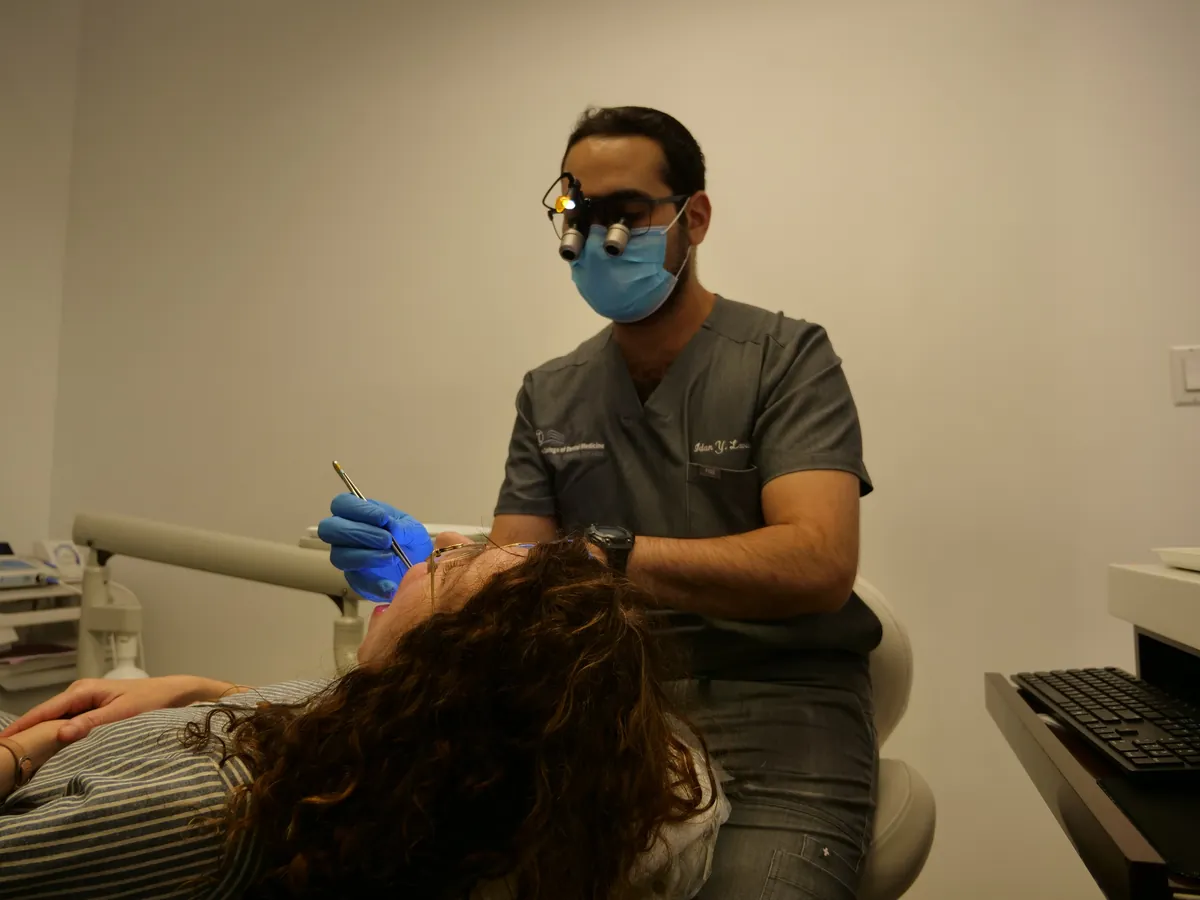
Why gums recede — and why the cause decides the treatment
Recession is a symptom with several different causes, and each cause has a different fix. Treating the gumline without treating the reason rarely holds.
Recession is measured, not guessed.
At the exam, each tooth is measured in millimeters — how much root is exposed, how thick the remaining tissue is, whether the area is still progressing. Those numbers stage the problem and create the baseline for future visits. Without them, nobody can honestly say whether your recession is stable, slow, or active — and the treatment decision is exactly that distinction.
The causes are usually specific and findable.
Hard brushing with a stiff brush is the classic cause, often concentrated on the side opposite your dominant hand. Thin natural tissue, teeth toward the lip, gum disease that thinned the support, nighttime grinding, and lip attachments that tug the margin each produce distinct patterns. The pattern usually points at the cause — and the cause points at the fix.
Early recession is often managed without surgery.
When recession is shallow, tissue reasonably thick, and the cause removable, treatment is to remove the cause and watch with measurements: softer brush, corrected technique, disease treated, grinding managed. Many such cases stabilize and stay on the record. Not every gumline problem is surgical, and a practice that grafts everything is not doing you a favor.
Advanced recession changes the tooth's future.
As more root is exposed, the risks compound: decay in a surface that caries easily, wear notches deepening at the gumline, sensitivity that changes how you eat and clean, and — where bone support is also reduced — a tooth whose long-term outlook narrows. At this stage, grafting to cover and thicken is usually the conversation, because monitoring no longer protects anything.
How receding gums treatment is staged
Measure first, remove the cause, then decide between monitoring, non-surgical care, and grafting — in that order, not the reverse.
Recession exam and staging.
We measure every affected area, photograph the gumline, assess tissue thickness and quality, check for gum disease, and review your brushing habits and any grinding. The staging that results — depth, tissue type, progression risk — is the foundation of the plan, and we show it to you rather than summarize it into a verdict.
Removing or reducing the cause.
Before any discussion of covering roots, the force that exposed them is addressed: brushing technique rebuilt, a night guard where grinding is involved, gum disease treated, a tugging frenum noted for correction. Skipping this step is how grafts fail and monitored cases keep progressing — it is the least glamorous and most important part of the treatment.
Non-surgical care and monitored stability.
For early cases, care means professional cleaning, desensitizing treatment for exposed roots where needed, protection of vulnerable surfaces, and scheduled re-measurement. If the numbers hold still across visits, that is a genuine treatment success — stability is the goal, and surgery stays in reserve for change rather than being spent on a stable gumline.
Grafting when the stage calls for it.
Where recession is deep, progressing, symptomatic, or the tissue too thin to trust, we plan grafting — your own tissue, donor tissue, or a substitute — to cover the root and thicken the area. The staging measurements tell us which teeth genuinely need it and which do not, so surgery is aimed, not blanket. Healing is then followed with the same measurements that justified it.
Sensitivity is a symptom worth treating too
Exposed roots are made of softer material than crowns, with tiny channels leading toward the nerve — which is why a sip of cold water can land like a jolt. Sensitivity is often the complaint that finally brings recession to attention, and it deserves its own plan: desensitizing care, protection of the surface, and coverage where the exposure is too great to settle. You should not have to organize your eating around your gumline.
Hablamos español
We warmly welcome Spanish-speaking patients. Gum recession is easier to manage when the causes, the staging, and every option are explained in your language — call us at (212) 561-5303. If you are uninsured, ask about membership and financing when you call.
Receding gums questions, answered
01Can receding gums grow back on their own?
No — and it is better to hear that plainly. Gum tissue that has migrated down the root does not regrow to its former level by itself, whatever a product promises. What treatment can do is stop the recession from progressing, protect the exposed root, ease sensitivity, and — with grafting — surgically cover the root with tissue again. The realistic goals are stability, protection, and, where indicated, coverage. Anyone who suggests a toothpaste will regrow your gumline is selling you the toothpaste.
02What causes gums to recede?
The common causes are mechanical and biological. Brushing too hard or with a hard brush wears the margin away over years. Naturally thin gum tissue tears and retreats under forces thicker tissue tolerates. Gum disease thins the supporting tissue and bone. Teeth positioned toward the lip sit behind thin bone and gum. Nighttime grinding flexes teeth at the gumline, and a lip attachment that inserts close to the margin can tug it down. Most mouths show a combination, which is why the exam looks for your specific pattern before naming a treatment.
03How is gum recession staged?
By measurement. We record how many millimeters of root are exposed on each tooth, the thickness and quality of the remaining gum, whether there is still a band of firm attached tissue, any bleeding or disease, and signs of progression such as wear notches or increasing sensitivity. Combined with the cause, those findings sort a tooth into watch-and-maintain, treat-the-cause, or graft. Staging matters because the same two millimeters of recession can be a stable footnote in one mouth and an active problem in another.
04Does receding gums treatment always mean surgery?
No. Shallow recession in thick, healthy tissue, with its cause removed, is frequently managed with monitoring, professional cleaning, and home-care correction alone — and many such cases never progress. Surgery enters the plan when recession is deep or advancing, the tissue is thin and fragile, sensitivity is disrupting eating or cleaning, root decay has begun, or planned dental work needs stronger tissue. The staging exam is what separates the two paths, and we would rather monitor a stable gumline than operate on one.
05Why have my teeth become sensitive at the gumline?
Because the surface now exposed was never meant to meet hot coffee. Enamel covers the crown; below the gumline, the root is covered by a much softer layer with microscopic channels running toward the nerve. Cold, sweet, acidic foods and even a toothbrush can travel those channels and register as a zing. Sensitivity often improves with desensitizing care and gentler technique; where exposure is extensive, covering the root with a graft addresses the cause rather than the symptom. New or worsening sensitivity is worth an exam, not just a different toothpaste.
06Can brushing technique really cause recession?
Yes — it is one of the most common causes we see, and the most fixable. A hard brush, heavy pressure, and a horizontal scrubbing motion concentrate wear exactly at the gumline, especially on prominent teeth. The pattern is often worst on one side, matching the mechanics of your dominant hand. Correcting it means a soft brush, light pressure, and small angled strokes at the gum edge — simple changes, but they remove a force your tissue has been absorbing for decades. If the cause is not removed, every other treatment is working uphill.
07Where are you located?
54 Warren Street, New York, NY 10007, in the heart of Tribeca — serving Tribeca, SoHo, Battery Park City, the Financial District, and Downtown Manhattan. A recession visit includes full measurements and staging of every affected tooth, a cause assessment, and a staged plan you can see the logic of.
Receding gums treatment in the heart of Tribeca
Find us at 54 Warren Street, New York, NY 10007 — in the heart of Tribeca, serving Tribeca, SoHo, Battery Park City, the Financial District, and Downtown Manhattan.
A gumline that is moving deserves measurement, not guessing.
Call (212) 561-5303 or book online. We will measure the recession, stage it, find its cause, and give you a plan that matches the stage — from monitoring to grafting — with honest reasoning at each step.
Your Visit from Tribeca
Getting here from Tribeca is a short walk, not a trip, and that is how most of our neighbors arrive. If you are coming by subway, the 1, 2, 3, A, C, and E trains stop at Chambers Street, about a five-minute walk up Warren to our door. The 4, 5, and 6 at Brooklyn Bridge–City Hall are ten minutes on foot through the civic center, and the J and Z also stop at Chambers Street for the east-side connection.
Citi Bike stations sit on Warren Street and Greenwich Street, and New Jersey commuters can take PATH to the World Trade Center Oculus.
When you arrive at 54 Warren Street, we keep the day simple and unhurried from the moment you check in. Our team works together under one roof, so your visit stays in one place instead of sending you across town for another appointment or another opinion. We talk through what brought you in, take any imaging we need here in the office, and explain what we are seeing in plain language before we discuss next steps together.
You will always know what we recommend, why we recommend it, and what can wait, so you leave with a clear plan rather than unanswered questions.
Life in Tribeca moves between the cast-iron lofts on Franklin Street, the towers along West Street, and afternoons with families at Washington Market Park, and we schedule with that rhythm in mind. We are open Monday through Friday from 8 AM to 6 PM, Saturday from 9 AM to 4 PM, and Sunday from 9 AM to 2 PM, and you can book online any time or call us at (212) 561-5303.
Street parking here is tight, with cobblestone blocks and film shoots, but attended garages on Warren Street and Greenwich Street sit within a block of our door. Follow-ups stay with our same team, so your care feels continuous.
Ongoing care is where being neighbors really pays off for our Tribeca patients. A six-month recall is just a short walk over, a quick check-in with the team who already knows your history, and a cleaning that fits between school drop-off and the rest of your day. When treatment takes more than one visit, we sequence it sensibly, review healing in person, and adjust the plan together rather than by phone tag.
Because we have cared for families here since 2007, we notice small changes early, keep your records continuous, and remind you when you are due — so staying on track never feels like starting over.
How Care Is Planned at Our Tribeca Studio
Every treatment plan at Tribeca Dental Studio begins with a diagnosis, not a recommendation made in the abstract. We examine the tooth or area in question, review imaging taken here in the office — including 3D CBCT scans when the case calls for them — and talk through what we see in plain language before any treatment is proposed. You will always know what we recommend, why we recommend it, and what could safely wait.
When several options would serve you well, we lay them side by side: what each involves, how many visits it takes, how long it is expected to last, and what it asks of the neighboring teeth and bone.
That conversation becomes a written plan. The sequence, the timing, and the reasoning are set down before treatment begins, so there are no surprises mid-course and no step is improvised. Staged treatment is grouped into planned steps when we can, and each stage is checked before the next one starts.
If a simpler option would serve you just as well, that is the option we will put in front of you — and if the honest answer is that a tooth or a treatment can be watched rather than treated today, we will say that instead.
Because every specialty sits under one roof at 54 Warren St, a plan that touches several disciplines is designed as a whole. Implant surgery, periodontics, endodontics, orthodontics, cosmetic work, airway care, and pediatric dentistry are handled by one team in one place, which means the implant plan accounts for the gum plan, the orthodontic plan accounts for the airway, and nothing is lost between offices across town.
Your records, your imaging, and your history stay with the same team from the first visit through every follow-up.
Technology We Use — and Why It Matters
Good planning depends on seeing clearly. Our studio works with 3D CBCT imaging, which shows bone volume, nerve positions, sinus anatomy, and root form in three dimensions rather than the flat shadow of a standard X-ray. Implant positions, grafting decisions, root canal anatomy, and expansion planning are all worked out on that imaging before treatment begins, so the day of the procedure holds as few unknowns as possible.
Digital planning carries the same approach into orthodontics and cosmetic work: tooth movement and smile design are mapped in advance, and you can see the intended direction before committing to it.
Laser technology is part of everyday care here, from gum therapy to the NightLase protocol we use for snoring. Lasers let us treat soft tissue with precision and, in many cases, with a quieter recovery than traditional surgery. For sleep concerns, we use at-home sleep testing rather than assumptions: your breathing is measured in your own bed, and the results — not a guess — decide whether an oral appliance, NightLase, or a referral is the right path.
Technology earns its place in the plan only when it changes a decision or improves an outcome; that is the standard each tool here is held to.
Costs, Insurance, and Written Estimates
Before treatment begins, you receive the plan in writing — including what each stage involves and what it costs — so you can decide with the full picture in front of you. There is no obligation attached to a consultation, and a second opinion is a reasonable thing to want; we would rather you choose with clear information than feel rushed into a chair.
If you have dental insurance, our team verifies your coverage and explains what it does and does not apply to before we start, and if you do not, the written plan still lets you stage treatment sensibly over time.
Dental treatment is often easier to approach in planned stages than all at once. A written plan lets you sequence what is urgent, what protects the teeth around it, and what is elective, so each visit moves the whole plan forward. If something changes along the way — a tooth responds better or worse than expected — the plan is revisited with you, in writing, before the next step. That discipline is what keeps a long course of treatment from becoming a series of surprises.
Comfort, Recovery, and Follow-Up
Most dental anxiety comes from the unknown, so we work to remove it: what will happen, how long it takes, what it will feel like, and what recovery looks like are all covered before we begin. During treatment we check in rather than push through, and after it we tell you plainly what is normal, what is not, and when to call.
Written aftercare instructions go home with you, and the precautions in them — protecting a healing site, eating soft foods for a few days, keeping the area clean — are the difference between an uneventful recovery and a complicated one.
Follow-up is part of the treatment, not an extra. We schedule reviews around your life, use return visits to check healing and the details we flagged together, and keep recall reminders running so maintenance does not drift. If something feels off between visits, we would rather see you quickly than have you wait and wonder.
Call us at (212) 561-5303 or book online at any time — the studio is open Monday to Friday from 8:00 AM to 6:00 PM, Saturday from 9:00 AM to 4:00 PM, and Sunday from 9:00 AM to 2:00 PM.
Before You Book
A final word on how to use pages like this one. Treatment pages describe what is possible; a consultation decides what is appropriate — for your anatomy, your history, your goals, and your budget, in that order of conversation. If anything here has raised a question we have not answered, bring it with you: patients who arrive with marked-up pages and specific questions get the most from their first visit, and the plan we write together is better for it.
Tribeca Dental Studio is at 54 Warren St in Tribeca, and new patients are welcome at any of the services described on this site. Book online at any time or call (212) 561-5303. The first step is an examination and an honest conversation; everything else in dentistry follows from those two things done properly.
The Next Step Is a Conversation
Wherever this page found you — a search at midnight, a partner's forwarded link, a dentist's suggestion — the next step is smaller than the worry usually makes it feel. A consultation at the studio is an examination and a conversation, not a commitment: findings first, options with their honest trade-offs, a written plan with costs, and time to decide at home.
Patients tell us the plan is what they actually came for, whether they proceed here, proceed elsewhere, or proceed nowhere for now. That is the offer, and it stands on every page of this site: 54 Warren St, bookable online at any hour, or at (212) 561-5303 — Monday to Friday 8:00 AM to 6:00 PM, Saturday 9:00 AM to 4:00 PM, Sunday 9:00 AM to 2:00 PM.
The Consultation Is Not a Funnel
A last word that applies to every page in this series, whichever treatment brought you here: the consultation is not a funnel. Patients arrive at these pages mid-worry — about a tooth, a jaw, a night's sleep, a smile in photographs — and the studio's answer has been the same since 2007. An examination. Imaging where imaging decides. A written plan with the options and their costs, including the option of doing less, or nothing yet.
Then time to think, at home, without a follow-up call designed to hurry you. If that is the experience you were hoping dentistry could be, the door is at 54 Warren St, and it opens online at any hour or at (212) 561-5303.
How We Plan Your Care at Tribeca Dental Studio
Every treatment at Tribeca Dental Studio starts with a diagnosis, not a sales pitch. Before we recommend anything, we examine the tooth or area in question, review imaging taken here in the office, and talk through what we see in plain language. You will always know what we recommend, why we recommend it, and what could safely wait.
That recommendation becomes a written plan, so the sequence, the timing, and the reasoning are clear before any treatment begins — and if a simpler option would serve you just as well, that is the option we will put in front of you.
Our studio brings every dental specialty under one roof at 54 Warren St in Tribeca, and it has since 2007. General dentistry, cosmetic care, implant surgery, periodontics, endodontics, orthodontics, airway care, and pediatric dentistry are handled by one team in one place, which means a treatment that touches several specialties is planned as a whole rather than handed off between offices across town.
Your records, your imaging, and your history stay with the same team from the first visit through every follow-up, so nothing is lost between providers and no step is planned in isolation.
We are open Monday to Friday from 8:00 AM to 6:00 PM, Saturday from 9:00 AM to 4:00 PM, and Sunday from 9:00 AM to 2:00 PM. You can book online at any time or call us at (212) 561-5303.
The studio sits between Greenwich Street and West Broadway, steps from the Chambers Street subway hub (1, 2, 3, A, C, E), with attended garages on Warren Street and Greenwich Street within a block of our door for patients who drive in.
Care does not end when the procedure does. We schedule reviews and follow-ups around your life, group staged treatment into planned steps when we can, and use each return visit to check healing and watch the details we flagged together. Between appointments we stay in touch with recall reminders and clear next steps, and if something feels off, we would rather see you quickly than have you wait and wonder.
The goal is a plan you understand, a team you recognize, and results that are checked over time rather than assumed.