How Long Does a Dental Implant Take?
How long does a dental implant take? From consultation to the final crown, typically 3 to 6 months — but only a few hours of that is spent in the chair. Most of the timeline is your bone quietly fusing to the implant between short visits. Here are the stages, and what stretches or shortens them.
The stages, with their clocks
An implant is a sequence, and each stage has its own timing.
Consultation and 3D planning (1 visit)
Examination, a 3D scan of the jaw, and the plan: implant position, whether grafting is needed, and your personal timeline. This visit decides everything downstream — including whether your case is a 3-month case or a 6-month one.
Placement (1 visit, usually under an hour per implant)
The titanium implant is placed in the jawbone in a single appointment. Many patients are surprised how manageable this visit is — for a straightforward single implant, it is often shorter than a crown appointment.
Osseointegration (about 3 to 6 months)
The bone grows onto the implant surface and locks it in — this fusion is what makes an implant an implant. It cannot be rushed; loading a crown before the bone has fused is how implants fail. You are not in pain or in our office during this stage — you are simply living your life while it happens.
The final crown (2 short visits)
Once fused, a small connector (abutment) is placed and the custom crown is made and fitted — impressions or a scan, then delivery about two weeks later. This is the day the gap becomes a tooth again.
What stretches the timeline
Three common reasons a case runs longer — all knowable at your consultation.
Bone grafting
If the jaw has thinned where the tooth was lost, graft material rebuilds it. A graft placed before the implant typically needs 3 to 4 months to mature; sometimes graft and implant go in together. This is the most common reason a case runs 6 months or more.
A tooth still needs to come out
If the failing tooth is still present, extraction comes first. Sometimes the implant can be placed the same day; sometimes the socket heals for a few months first. Either way, it is sequenced at your consultation, not improvised.
Upper-jaw and sinus cases
Upper back teeth sit under the sinus. If bone is short there, a sinus lift adds bone height — and healing time. These cases are routine for an implant surgeon, but they are not the fast cases, and you deserve to hear that up front.
Your healing factors
Smoking, uncontrolled diabetes, and some medications slow bone healing and can extend the fusion stage — or rule implants out until addressed. An honest timeline includes your health picture, which is why the consultation is a medical conversation, not a sales one.
Can it be done faster — same-day implants?
In the right case, yes: for patients with strong bone and the right bite conditions, an implant can be placed — and a temporary tooth fitted — on the same day, including full-arch treatment where you leave with a complete set of temporary teeth. 'Same-day' describes the surgery day, not the whole treatment: the final, strongest teeth still come after the bone has fused, months later. Whether you qualify is a scan-and-examination question. Anyone promising same-day final teeth to every patient is skipping the biology.
Hablamos español
We warmly welcome Spanish-speaking patients. Our team will explain in your language how long your implant treatment will take, stage by stage, and what could shorten or lengthen it in your case — before anything begins.
How long a dental implant takes — questions
01How long does the whole implant process take from start to finish?
Typically 3 to 6 months: consultation and planning, one placement visit, 3 to 6 months of bone fusion (no appointments needed during most of it), then two short visits for the final crown. Cases needing bone grafting first can run 6 to 9 months.
02How long does the implant surgery itself take?
For a single straightforward implant, usually under an hour. Multiple implants or grafting in the same visit take longer. Most patients manage the appointment comfortably with local anesthesia, and sedation is available — ask at your consultation.
03How much time off work will I need?
Most patients take the day of placement, and many are back at a desk the next day with mild soreness managed by standard pain relief taken as directed. Physically demanding jobs may want two days. The months of healing that follow require no time off at all.
04Why can't the crown go on right away?
Because the implant's strength comes from bone fused to its surface, and that fusion takes months. A crown loaded too early can move the implant microscopically and break the fusion — the most preventable cause of implant failure. Temporary options exist so you are never left with a visible gap while you heal.
05How long do I go without a tooth?
In most cases, you don't. A temporary tooth or a discreet removable replacement can cover the space during healing, especially for front teeth. Your consultation will map exactly what you will be wearing at every stage — nobody should be surprised by a gap.
06Does the timeline differ for All-on-4 or full-arch implants?
The shape is similar but compressed at the front: surgery day includes a full set of temporary teeth, so you leave with a complete smile. The final set comes after 3 to 6 months of healing and fusion. Total time to finals is comparable to a single implant — the difference is you have teeth throughout.
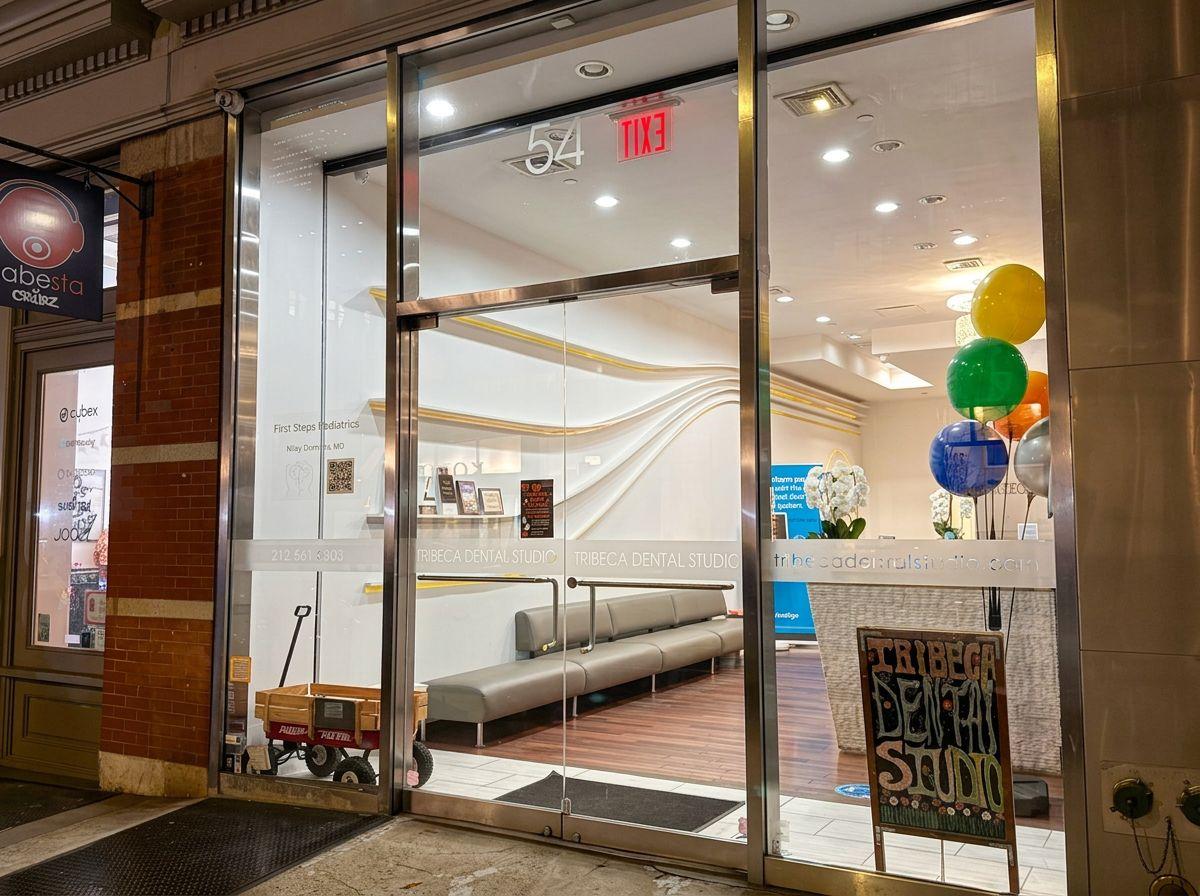
In Tribeca, at 54 Warren Street
Tribeca Dental Studio is at 54 Warren Street, New York, NY 10007 — a short walk from the Chambers Street and City Hall stations, and easy to reach from SoHo, Battery Park City, the Financial District and the rest of Lower Manhattan. Implant consultations, surgery, and final restorations all happen under one roof.
Your timeline starts with a scan, not a guess
Whether yours is a 3-month case or a 9-month one is written in your jawbone — and a 3D scan reads it in one visit. Call (212) 561-5303 or book a consultation, and leave with your stages, your dates, and your costs in writing.
Your Visit from Tribeca
Getting here from Tribeca is a short walk, not a trip, and that is how most of our neighbors arrive. If you are coming by subway, the 1, 2, 3, A, C, and E trains stop at Chambers Street, about a five-minute walk up Warren to our door. The 4, 5, and 6 at Brooklyn Bridge–City Hall are ten minutes on foot through the civic center, and the J and Z also stop at Chambers Street for the east-side connection.
Citi Bike stations sit on Warren Street and Greenwich Street, and New Jersey commuters can take PATH to the World Trade Center Oculus.
When you arrive at 54 Warren Street, we keep the day simple and unhurried from the moment you check in. Our team works together under one roof, so your visit stays in one place instead of sending you across town for another appointment or another opinion. We talk through what brought you in, take any imaging we need here in the office, and explain what we are seeing in plain language before we discuss next steps together.
You will always know what we recommend, why we recommend it, and what can wait, so you leave with a clear plan rather than unanswered questions.
Life in Tribeca moves between the cast-iron lofts on Franklin Street, the towers along West Street, and afternoons with families at Washington Market Park, and we schedule with that rhythm in mind. We are open Monday through Friday from 8 AM to 6 PM, Saturday from 9 AM to 4 PM, and Sunday from 9 AM to 2 PM, and you can book online any time or call us at (212) 561-5303.
Street parking here is tight, with cobblestone blocks and film shoots, but attended garages on Warren Street and Greenwich Street sit within a block of our door. Follow-ups stay with our same team, so your care feels continuous.
Ongoing care is where being neighbors really pays off for our Tribeca patients. A six-month recall is just a short walk over, a quick check-in with the team who already knows your history, and a cleaning that fits between school drop-off and the rest of your day. When treatment takes more than one visit, we sequence it sensibly, review healing in person, and adjust the plan together rather than by phone tag.
Because we have cared for families here since 2007, we notice small changes early, keep your records continuous, and remind you when you are due — so staying on track never feels like starting over.
How Care Is Planned at Our Tribeca Studio
Every treatment plan at Tribeca Dental Studio begins with a diagnosis, not a recommendation made in the abstract. We examine the tooth or area in question, review imaging taken here in the office — including 3D CBCT scans when the case calls for them — and talk through what we see in plain language before any treatment is proposed. You will always know what we recommend, why we recommend it, and what could safely wait.
When several options would serve you well, we lay them side by side: what each involves, how many visits it takes, how long it is expected to last, and what it asks of the neighboring teeth and bone.
That conversation becomes a written plan. The sequence, the timing, and the reasoning are set down before treatment begins, so there are no surprises mid-course and no step is improvised. Staged treatment is grouped into planned steps when we can, and each stage is checked before the next one starts.
If a simpler option would serve you just as well, that is the option we will put in front of you — and if the honest answer is that a tooth or a treatment can be watched rather than treated today, we will say that instead.
Because every specialty sits under one roof at 54 Warren St, a plan that touches several disciplines is designed as a whole. Implant surgery, periodontics, endodontics, orthodontics, cosmetic work, airway care, and pediatric dentistry are handled by one team in one place, which means the implant plan accounts for the gum plan, the orthodontic plan accounts for the airway, and nothing is lost between offices across town.
Your records, your imaging, and your history stay with the same team from the first visit through every follow-up.
Technology We Use — and Why It Matters
Good planning depends on seeing clearly. Our studio works with 3D CBCT imaging, which shows bone volume, nerve positions, sinus anatomy, and root form in three dimensions rather than the flat shadow of a standard X-ray. Implant positions, grafting decisions, root canal anatomy, and expansion planning are all worked out on that imaging before treatment begins, so the day of the procedure holds as few unknowns as possible.
Digital planning carries the same approach into orthodontics and cosmetic work: tooth movement and smile design are mapped in advance, and you can see the intended direction before committing to it.
Laser technology is part of everyday care here, from gum therapy to the NightLase protocol we use for snoring. Lasers let us treat soft tissue with precision and, in many cases, with a quieter recovery than traditional surgery. For sleep concerns, we use at-home sleep testing rather than assumptions: your breathing is measured in your own bed, and the results — not a guess — decide whether an oral appliance, NightLase, or a referral is the right path.
Technology earns its place in the plan only when it changes a decision or improves an outcome; that is the standard each tool here is held to.
Costs, Insurance, and Written Estimates
Before treatment begins, you receive the plan in writing — including what each stage involves and what it costs — so you can decide with the full picture in front of you. There is no obligation attached to a consultation, and a second opinion is a reasonable thing to want; we would rather you choose with clear information than feel rushed into a chair.
If you have dental insurance, our team verifies your coverage and explains what it does and does not apply to before we start, and if you do not, the written plan still lets you stage treatment sensibly over time.
Dental treatment is often easier to approach in planned stages than all at once. A written plan lets you sequence what is urgent, what protects the teeth around it, and what is elective, so each visit moves the whole plan forward. If something changes along the way — a tooth responds better or worse than expected — the plan is revisited with you, in writing, before the next step. That discipline is what keeps a long course of treatment from becoming a series of surprises.
Comfort, Recovery, and Follow-Up
Most dental anxiety comes from the unknown, so we work to remove it: what will happen, how long it takes, what it will feel like, and what recovery looks like are all covered before we begin. During treatment we check in rather than push through, and after it we tell you plainly what is normal, what is not, and when to call.
Written aftercare instructions go home with you, and the precautions in them — protecting a healing site, eating soft foods for a few days, keeping the area clean — are the difference between an uneventful recovery and a complicated one.
Follow-up is part of the treatment, not an extra. We schedule reviews around your life, use return visits to check healing and the details we flagged together, and keep recall reminders running so maintenance does not drift. If something feels off between visits, we would rather see you quickly than have you wait and wonder.
Call us at (212) 561-5303 or book online at any time — the studio is open Monday to Friday from 8:00 AM to 6:00 PM, Saturday from 9:00 AM to 4:00 PM, and Sunday from 9:00 AM to 2:00 PM.
Before You Book
A final word on how to use pages like this one. Treatment pages describe what is possible; a consultation decides what is appropriate — for your anatomy, your history, your goals, and your budget, in that order of conversation. If anything here has raised a question we have not answered, bring it with you: patients who arrive with marked-up pages and specific questions get the most from their first visit, and the plan we write together is better for it.
Tribeca Dental Studio is at 54 Warren St in Tribeca, and new patients are welcome at any of the services described on this site. Book online at any time or call (212) 561-5303. The first step is an examination and an honest conversation; everything else in dentistry follows from those two things done properly.
The Next Step Is a Conversation
Wherever this page found you — a search at midnight, a partner's forwarded link, a dentist's suggestion — the next step is smaller than the worry usually makes it feel. A consultation at the studio is an examination and a conversation, not a commitment: findings first, options with their honest trade-offs, a written plan with costs, and time to decide at home.
Patients tell us the plan is what they actually came for, whether they proceed here, proceed elsewhere, or proceed nowhere for now. That is the offer, and it stands on every page of this site: 54 Warren St, bookable online at any hour, or at (212) 561-5303 — Monday to Friday 8:00 AM to 6:00 PM, Saturday 9:00 AM to 4:00 PM, Sunday 9:00 AM to 2:00 PM.
The Consultation Is Not a Funnel
A last word that applies to every page in this series, whichever treatment brought you here: the consultation is not a funnel. Patients arrive at these pages mid-worry — about a tooth, a jaw, a night's sleep, a smile in photographs — and the studio's answer has been the same since 2007. An examination. Imaging where imaging decides. A written plan with the options and their costs, including the option of doing less, or nothing yet.
Then time to think, at home, without a follow-up call designed to hurry you. If that is the experience you were hoping dentistry could be, the door is at 54 Warren St, and it opens online at any hour or at (212) 561-5303.
How We Plan Your Care at Tribeca Dental Studio
Every treatment at Tribeca Dental Studio starts with a diagnosis, not a sales pitch. Before we recommend anything, we examine the tooth or area in question, review imaging taken here in the office, and talk through what we see in plain language. You will always know what we recommend, why we recommend it, and what could safely wait.
That recommendation becomes a written plan, so the sequence, the timing, and the reasoning are clear before any treatment begins — and if a simpler option would serve you just as well, that is the option we will put in front of you.
Our studio brings every dental specialty under one roof at 54 Warren St in Tribeca, and it has since 2007. General dentistry, cosmetic care, implant surgery, periodontics, endodontics, orthodontics, airway care, and pediatric dentistry are handled by one team in one place, which means a treatment that touches several specialties is planned as a whole rather than handed off between offices across town.
Your records, your imaging, and your history stay with the same team from the first visit through every follow-up, so nothing is lost between providers and no step is planned in isolation.
We are open Monday to Friday from 8:00 AM to 6:00 PM, Saturday from 9:00 AM to 4:00 PM, and Sunday from 9:00 AM to 2:00 PM. You can book online at any time or call us at (212) 561-5303.
The studio sits between Greenwich Street and West Broadway, steps from the Chambers Street subway hub (1, 2, 3, A, C, E), with attended garages on Warren Street and Greenwich Street within a block of our door for patients who drive in.
Care does not end when the procedure does. We schedule reviews and follow-ups around your life, group staged treatment into planned steps when we can, and use each return visit to check healing and watch the details we flagged together. Between appointments we stay in touch with recall reminders and clear next steps, and if something feels off, we would rather see you quickly than have you wait and wonder.
The goal is a plan you understand, a team you recognize, and results that are checked over time rather than assumed.