Invisalign Cost in NYC: What to Expect at Tribeca Dental Studio
December 2, 2025
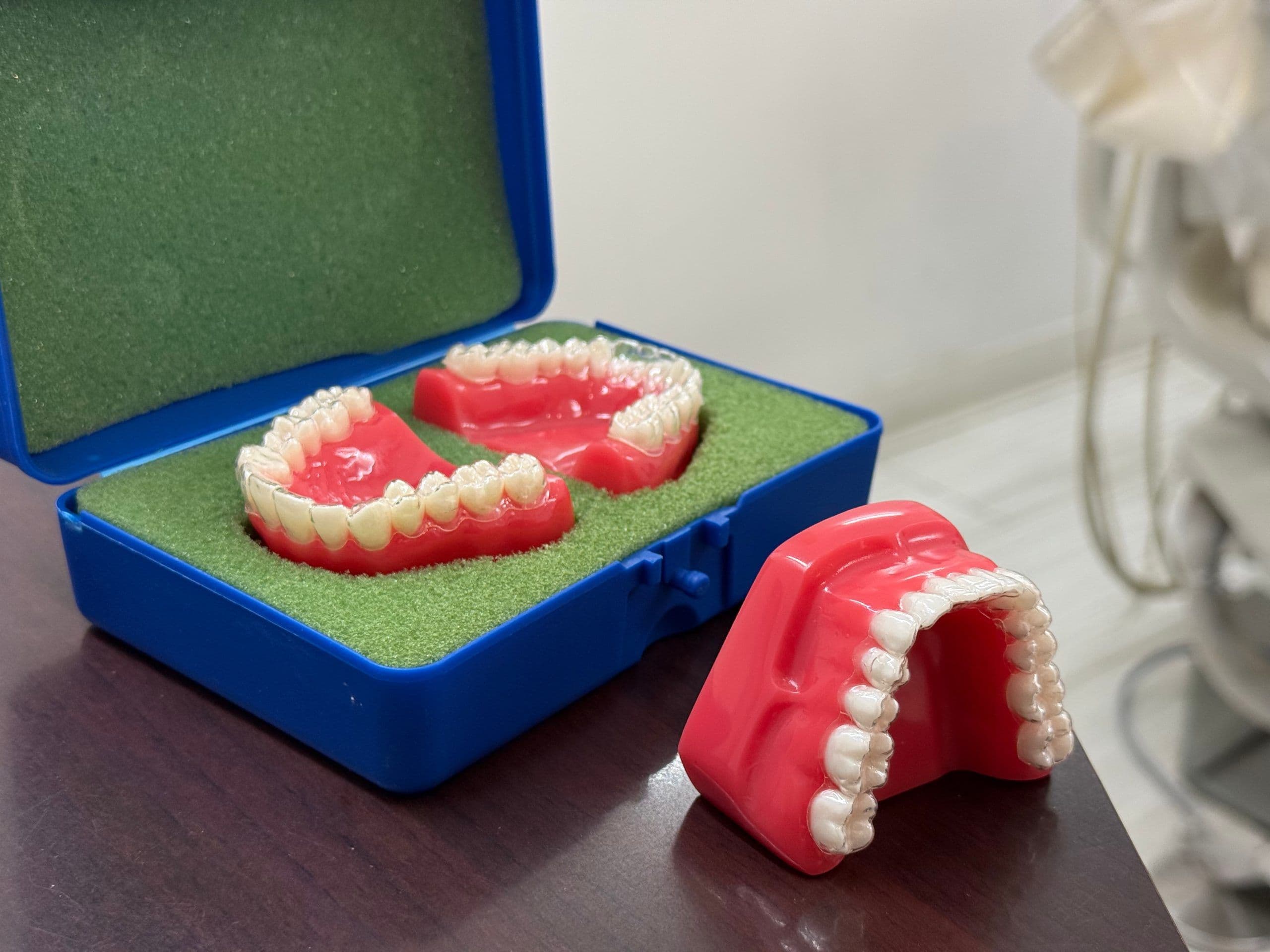
At Tribeca Dental Studio (54 Warren St, Tribeca, NYC), Invisalign cost is based on the complexity of your case. In New York City, Invisalign typically costs between $4,000 and $9,000. At Tribeca Dental Studio, average pricing is $2,800 – $4,000 for mild or express cases, $4,000 – $6,500 for moderate cases, and $6,500 – $14,000 for comprehensive treatment.
Your fee covers the full orthodontic process — consultation, 3D scan, digital smile design, all aligners, attachments, progress checks, refinements, and final retainers — and your exact, personalized price is set after a detailed smile evaluation and 3D digital scan, before treatment begins. Below, we explain what drives that price, what is included, what can cost extra, and how insurance and financing change what you actually pay.
If you’re considering straightening your smile with clear aligners, one of the first questions you probably have is:
“How much does Invisalign cost in NYC?”
The truth is, pricing can vary widely across Manhattan — but at Tribeca Dental Studio, we provide transparent, personalized pricing so patients always know exactly what they’re investing in.
Below is the most up-to-date, NYC-specific breakdown of Invisalign costs, what affects your total price, and why choosing an experienced provider makes all the difference.
What Is Invisalign?
Invisalign is a modern orthodontic system that uses a series of clear, removable aligners to gradually straighten teeth without brackets or wires.
Benefits include:
-
Nearly invisible appearance
-
Quick, comfortable treatment
-
Easy removal for eating and brushing
-
Custom 3D digital treatment planning
-
Predictable smile results
Tribeca Dental Studio uses advanced digital scanning and precision planning to create a fully customized Invisalign journey.
Here is how the treatment itself works day to day: you wear each set of aligners for a short stage, then move on to the next set in the series. Aligners should be worn 20 to 22 hours a day, removed only for eating, drinking anything other than water, and brushing and flossing.
That wear time is what keeps treatment on schedule — the more consistently your aligners are worn, the more predictable your timeline, and the less likely you are to need extra refinement rounds that extend your treatment.
How Much Does Invisalign Cost in NYC?
In New York City, Invisalign typically costs between $4,000 and $9,000 depending on case complexity.
For national context, clear aligner treatment averages about $5,108 without insurance, according to a 2023 Synchrony cost-of-care study cited by CareCredit, with typical prices ranging from about $1,800 to $8,100 depending on location. New York City sits at the top of that range — and the next sections explain exactly why.
At Tribeca Dental Studio, average pricing is:
| Invisalign Treatment Type | Price Range |
|---|---|
| Mild / Express cases | $2,800 – $4,000 |
| Moderate cases | $4,000 – $6,500 |
| Comprehensive cases | $6,500 – $14,000 |
| Teen Invisalign | $4,500 – $7,000 |
We also offer:
-
Flexible payment plans
-
0% interest financing options
-
HSA & FSA acceptance
-
Insurance coverage assistance
Your exact Invisalign cost is calculated after a detailed smile evaluation and 3D digital scan.
What Happens at Your Invisalign Consultation at Tribeca Dental Studio
Your Invisalign cost starts with an in-person consultation, because no two cases move teeth the same way. The visit begins with a comprehensive oral exam to confirm that your teeth and gums are healthy enough for orthodontic movement, along with any imaging needed to see your roots and bone. Moving teeth on an unhealthy foundation is how problems start, so this step comes first.
Next comes a 3D digital scan of your teeth — no messy impressions. From that scan, your doctor builds a digital treatment plan that maps each stage of tooth movement from start to finish, so you can preview how your smile is expected to progress, stage by stage, and see an estimated timeline before you decide anything.
Only after that plan exists can your quote be exact. Your consultation includes:
A comprehensive exam and any imaging your case requires
A 3D digital scan of your teeth
A digital preview of your planned tooth movement and estimated timeline
A written, itemized quote based on your case — the number of aligners, the movements required, and everything your fee includes
Verification of any orthodontic insurance benefits you can apply
A walk-through of payment and financing options
You receive that written quote before you commit to treatment, so the number you plan around is the number you actually pay.
Why Invisalign Costs More in NYC Compared to Other Cities
Manhattan has one of the highest concentrations of cosmetic dentistry specialists in the U.S. Invisalign prices are influenced by:
-
Doctor expertise
-
Technology used
-
Complexity of tooth movement
-
Number of aligners required
-
Need for attachments or refinements
-
Premium materials and lab fees
-
Geographic pricing standards
Tribeca Dental Studio stays competitively priced while offering top-tier orthodontic technology and highly skilled smile design.
At Tribeca Dental Studio, those citywide cost drivers break down in specific ways. Every set of aligners is custom-fabricated by Align Technology, the maker of Invisalign, from your digital plan, and that laboratory fee is built into your treatment price.
The 3D scanning and planning technology used to design your case, the time your doctor spends planning and reviewing each stage of movement, and the cost of operating a full-service practice in Manhattan — space, staff, and equipment — all shape the final fee.
What that buys you is supervision. Your treatment is planned and monitored by a doctor who has examined your teeth in person, who can adjust the plan mid-treatment with refinements, and who can handle related care — from cleanings to restorative work — under one roof, instead of sending you between offices if something else needs attention along the way.
What’s Included in Your Invisalign Cost at Tribeca Dental Studio
When you begin Invisalign treatment with us, your fee includes the entire orthodontic process, not just the aligners:
- Comprehensive consultation
- 3D digital scan (no messy impressions)
- Digital smile design
- All aligners needed
- Attachments & IPR if required
- Progress check appointments
- Refinements
- Final retainers
- Follow-up for long-term stability
Our goal is not just straight teeth — it’s delivering a beautifully functional bite that lasts.
What Can Cost Extra
Because your treatment fee already includes your aligners, attachments, progress check appointments, refinements, and final retainers, the surprise costs that catch many orthodontic patients are already covered. A few things can still sit outside an aligner fee, at any practice, and they are worth asking about before you start:
Dental work needed before treatment begins. A cleaning, fillings, or gum care must be completed before teeth can move safely, and that work is billed separately from your Invisalign fee.
Replacement retainers in the years after treatment. Your final retainers are included, but retainers wear out, crack, or get lost over time, and replacement sets are an additional cost.
Replacement aligners. If you lose a tray mid-treatment, a replacement can carry a fee — one more reason to keep your previous set as a backup until your doctor tells you to discard it.
Elective add-ons, such as professional whitening once treatment is complete.
Your written quote spells out exactly what your fee includes, so run through this list with your doctor before you begin.
Factors That Affect Invisalign Cost
Several elements determine your personalized Invisalign pricing:
1. Severity of Misalignment
Mild crowding costs less; complex bite corrections cost more.
2. Treatment Duration
Shorter treatments require fewer aligners and fewer appointments.
3. Number of Refinements
Refinements (extra aligners) may be needed to perfect your smile.
4. Additional Procedures
Some cases require:
-
Polishing
-
Attachments
-
Elastics
-
Bite correction
Your provider will explain all expected steps during your consultation.
5. Case Complexity and Treatment Length
The pricing tiers above — mild or express, moderate, and comprehensive — are really a measure of how far your teeth need to travel. Mild cases involve minor crowding, small gaps, or teeth that have shifted slightly after earlier braces; they use a short series of aligners and sit at the lower end of the 6–18 month treatment range. Moderate cases correct more visible crowding or spacing across several teeth and usually land in the middle.
Comprehensive treatment corrects bite problems as well as alignment, uses as many aligners as the case requires plus the most refinement rounds, and takes the longest. That is why two patients can receive very different Invisalign prices at the same office: the quote follows the case, not a flat rate.
Teen cases follow the same logic. Invisalign for teens is priced by the same complexity tiers — the table above puts average teen pricing at $4,500 – $7,000 — and a teen quote reflects the same factors: how much movement is needed, how long treatment runs, and how many refinements the case is likely to need. Because teen treatment happens while teeth and jaws are still developing, the in-person monitoring built into supervised treatment matters even more.
Invisalign vs. Braces: Comparing Costs
| Treatment | Cost Range | Aesthetic | Comfort | Treatment Time |
|---|---|---|---|---|
| Invisalign | $2,800–$14,000 | Nearly invisible | Very comfortable | 6–18 months |
| Traditional Braces | $3,000–$7,500 | Visible metal/ceramic | Moderate discomfort | 12–24 months |
Most Tribeca patients prefer Invisalign because of its aesthetics, comfort, and predictability.
The honest trade-off is about lifestyle and compliance as much as price. Braces are fixed to your teeth, so they work around the clock without depending on your discipline — but they come with food restrictions, trickier brushing and flossing, and more frequent adjustment visits. Invisalign removes all of that friction, which is why so many working adults in NYC choose it, but it only works if you actually wear the aligners 20 to 22 hours a day.
A patient who will not wear removable aligners consistently may honestly get a better result from braces, at a similar overall cost.
What About Mail-Order Aligners?
Mail-order aligner kits advertise a lower upfront price, and it is worth understanding what that price leaves out. Treatment begins from a home impression kit rather than an in-person exam, X-rays, and a 3D scan, so no one directly checks your gums, roots, or bite before your teeth start moving. During treatment, no doctor monitors how your bite is changing or whether your roots and gums are tolerating the movement.
That matters because orthodontics is not just cosmetic straightening. Moving teeth without supervision can create new bite problems, and issues such as gum recession or a tooth that stops tracking its aligner can go unnoticed until they are harder — and more expensive — to correct. Mail-order treatment also cannot use attachments or IPR, two of the tools that make more complex movements possible.
For very minor cosmetic changes it may look cheaper; for anything involving your bite, or if a problem develops mid-treatment, supervised care at a practice like Tribeca Dental Studio is the safer comparison — and fixing a failed mail-order case in person usually costs more than supervised treatment would have in the first place.
Does Insurance Cover Invisalign?
Yes — many dental insurance plans offer orthodontic benefits that apply to Invisalign.
Our team verifies coverage before treatment and handles all claim submissions to help maximize reimbursement.
One detail many patients miss: orthodontic coverage usually comes with a lifetime maximum — a total amount your plan will pay toward orthodontic treatment per person across your whole life, not per year. Once that maximum is used, it does not renew. If you used part of it on earlier orthodontics, such as braces as a teenager, only the remainder is available now.
Plans also differ on who qualifies: some limit orthodontic benefits to children and teens, others cover adults too, and some require a waiting period before benefits begin. Because plans vary so much, Tribeca Dental Studio verifies your specific benefits before treatment starts and explains exactly what your plan will and will not pay toward your case.
Also know that orthodontic benefits are rarely paid in one lump sum: in many plans, the benefit is released in stages as treatment progresses. That means changing insurance plans mid-treatment can affect how much of your benefit you actually receive — one more reason to verify the details before your first aligner is made, not after.
Is Invisalign Worth the Investment?
Absolutely — especially in a professional city like NYC.
Benefits include:
-
Improved confidence
-
Better bite alignment
-
Lower risk of future dental issues
-
Straighter teeth without braces
-
A healthier foundation for long-term oral health
Patients consistently report that Invisalign is one of the most life-improving dental decisions they’ve made.
Invisalign Cost Financing & Payment Options
Tribeca Dental Studio offers:
-
0% Interest Plans (CareCredit, Sunbit)
-
Monthly Payments starting as low as $99
-
Pay-as-you-go options
-
HSA/FSA support
We make high-end orthodontics accessible for every patient.
In practice, most patients spread their Invisalign cost across the same months they are in treatment. A monthly plan turns one large fee into a predictable payment that runs alongside your aligner schedule, and the 0% interest options above mean that spreading the cost does not have to mean paying more overall.
Tax-advantaged accounts can help further. Orthodontic treatment is an eligible expense for both HSA and FSA funds, so paying from one of those accounts means paying with pre-tax dollars. If you use an FSA, timing matters: FSA funds are generally use-it-or-lose-it within the plan year, so many patients coordinate the start of treatment with open enrollment or a new plan year. Our team can help you time payments around your account rules.
These tools also combine. A typical arrangement applies your insurance benefit first, uses HSA or FSA dollars toward the remaining balance, and spreads what is left over a monthly plan — so your out-of-pocket cost each month can be far lower than the headline fee suggests. Bring your insurance card and your account details to your consultation, and we will map out the combination that fits your case and your budget.
Ready to Start Invisalign in NYC?
Book your orthodontic consultation at Tribeca Dental Studio and discover your personalized Invisalign cost, treatment timeline, and digital smile preview.
A straighter, healthier smile is closer — and more affordable — than you think.
You can book your Invisalign consultation with Tribeca Dental Studio at 54 Warren St, Tribeca, New York, NY 10007, by calling (212) 561-5303, or online: book your consultation. Your visit includes your exam, 3D scan, digital smile preview, and a written, itemized Invisalign quote — so you leave knowing your exact cost, estimated timeline, and payment options.
FAQ
In NYC, Invisalign costs range from $4,000 to $9,000, depending on case complexity. Mild cosmetic cases are lower, while bite corrections cost more.
NYC pricing reflects specialist expertise, advanced imaging technology, and the higher cost of operating a dental practice in Manhattan.
Yes — many dental insurance plans offer orthodontic benefits that partially cover Invisalign treatment.
In some cases, yes. Mild Invisalign cases may cost less than ceramic or lingual braces.
Absolutely. We offer 0% interest plans, flexible monthly payments, and accept HSA/FSA funds.
Everything: consultations, digital 3D scans, aligners, attachments, refinements, retainers, and follow-up care.
How much does Invisalign cost in NYC without insurance?
Without insurance, you pay the same case-based fees described on this page: Invisalign in NYC typically costs between $4,000 and $9,000, and at Tribeca Dental Studio average pricing runs from $2,800 – $4,000 for mild cases to $6,500 – $14,000 for comprehensive treatment. Insurance lowers your out-of-pocket cost, but it does not change the underlying fee — and financing can spread the full amount into monthly payments.
Are retainers included in the Invisalign cost?
At Tribeca Dental Studio, yes — your final retainers are part of your treatment fee, along with follow-up care to protect your result. Retainers are not a once-in-a-lifetime purchase, though: they wear down and can be lost, so plan on replacement sets over the years as a normal, separate cost of keeping your teeth straight.
What happens if I lose an aligner?
Call the office as soon as you notice. Depending on how long you wore that set, your doctor may have you go back to your previous aligners, move ahead to the next set, or order a replacement tray. Do not simply skip ahead or stop wearing aligners altogether — teeth begin shifting back quickly, and going without can add time and refinement rounds to your treatment. Keeping your previous set until your doctor says otherwise is the simplest insurance against a lost tray.
Can I use HSA or FSA funds for Invisalign?
Yes. Orthodontic treatment is an eligible expense for health savings accounts and flexible spending accounts, and Tribeca Dental Studio accepts HSA and FSA funds. If you are paying from an FSA, check your plan's deadline first — most FSA funds must be spent within the plan year.
How long does Invisalign treatment take?
Most treatment falls within the 6–18 month range shown in the comparison table above. Mild cases finish at the shorter end; comprehensive bite corrections take the longest. Your own timeline depends heavily on wearing your aligners 20 to 22 hours a day — consistent wear is the single biggest factor under your control.
About Tribeca Dental Studio
Tribeca Dental Studio, located at 54 Warren St, New York, NY 10007, has provided comprehensive dental care to Lower Manhattan since 2007. Led by Dr. Nina Izhaky, our practice combines general, pediatric, orthodontic, oral surgery, and periodontal care under one roof.
Our focus on airway health, dental implants, veneers, and pediatric dentistry sets us apart. We use 3D CBCT imaging, digital planning, and laser technology — including NightLase for snoring — to deliver precise, comfortable care.
To schedule a consultation, call (212) 561-5303 or book online. We welcome patients from Tribeca, SoHo, Battery Park City, the Financial District, and throughout downtown Manhattan.
How We Write — and How We Practice
The articles on this blog are written from the same standard we apply in the treatment rooms: diagnosis before recommendation. When we explain a treatment here — an implant, an aligner plan, a sleep appliance — we explain how the decision is actually made in practice: the examination, the imaging, the alternatives considered, and the reasons one path is chosen over another.
If a topic has a genuine controversy or a matter of professional judgment, we say so rather than smoothing it over, because a reader who understands the trade-offs makes better decisions than one who has only seen the brochure version.
Nothing here replaces an examination of your own mouth, and we are careful about the difference. General information can tell you what questions to ask and what a thorough answer sounds like; it cannot tell you whether your bone will hold an implant, whether your snoring is apnea, or whether a tooth can be saved. When an article touches your situation, treat it as preparation for a conversation — then have the conversation.
We hold same-day slots for emergencies, and consultations carry no obligation: book online or call (212) 561-5303.
About the Practice
Tribeca Dental Studio has served Lower Manhattan from 54 Warren St since 2007, with general, cosmetic, implant, periodontal, endodontic, orthodontic, airway, and pediatric care under one roof and one team's direction. The questions our patients ask in the chair are the ones this blog answers: what a treatment involves, how long it takes, what recovery feels like, what it costs to do it properly, and how to tell a careful plan from a rushed one.
If your question is not covered, ask us at your visit — the honest answer is the house style.
To schedule, book online at any time or call (212) 561-5303. The studio is open Monday to Friday from 8:00 AM to 6:00 PM, Saturday from 9:00 AM to 4:00 PM, and Sunday from 9:00 AM to 2:00 PM, steps from the Chambers Street subway hub, and welcomes patients from Tribeca, the Financial District, Battery Park City, SoHo, and across downtown Manhattan.
A Note on Symptoms and Self-Diagnosis
Readers often arrive here after a search that began with a symptom — a tooth that throbs at night, gums that bleed, a snore a partner can no longer sleep through. A word of honest framing: an article can help you understand what a symptom commonly means and how urgently it usually needs attention, but it cannot rank your case.
Bleeding gums are sometimes a hygiene problem and sometimes the first sign of periodontal disease; a twinge is sometimes a high filling and sometimes a dying nerve. The difference is found in an examination and imaging, not in a paragraph — which is why these articles end where they do: with an invitation to be seen, not a verdict.
If what you are feeling cannot wait, do not let reading substitute for calling. The studio holds same-day emergency slots daily, and a call to (212) 561-5303 with a plain description of the problem is the fastest route to a real answer. For everything else, bring the article to your appointment. Mark the passage that matched your situation.
It gives the conversation a head start, and it gives you a way to check that the plan you are offered actually addresses the thing that brought you in.
What Things Cost, and Why We Answer That Way
Cost questions deserve a straight answer, and the straightest one available before an examination is structural: dental fees follow diagnosis, materials, laboratory work, and time, in that order. That is why this blog explains what drives the cost of the treatments it covers — the imaging, the grafting, the stages, the restoration — instead of printing numbers that would be fiction for most readers.
After an examination, the answer becomes exact: a written plan with each stage and its fee, which you can consider without obligation and compare against any other opinion you choose to get.
We would rather earn a patient with a clear plan than close one with a fast number. If you are comparing practices, compare plans: what was examined, what was imaged, what is included, what happens if healing changes the sequence. The articles here are written to give you those questions. The studio's answers, for your mouth specifically, are one appointment away.
No Miracles, No Scares
One more commitment, because it decides whether health writing helps or harms: we do not publish scares or miracles. A treatment described here does what it does within limits we will name — an appliance manages apnea for the patients whose anatomy suits it, a laser protocol helps the snoring cases it is indicated for, an implant succeeds at the rate careful planning produces, not at a hundred percent.
If a claim anywhere in dentistry sounds too clean, it is missing its conditions, and our articles try to restore them. You will make better decisions with the conditions attached, and so will we.
Questions Worth Bringing to Your Appointment
The most useful thing you can bring to a dental appointment is a good question, so here is the short list our doctors wish every new patient asked — of us, and of any practice being considered. What did the examination and imaging actually show? Which parts of the plan are urgent, which protect the teeth around them, and which are elective? What happens if each part waits six months? What are the alternatives, and why is this one recommended over them?
And what will the follow-up look like — how will we know the treatment worked? A practice that answers those questions completely, in writing, has shown you its standard before it has touched a tooth.
Notice what is not on the list: the brand names of equipment, the décor of the office, the speed of the sales process. Dentistry is a long relationship disguised as a series of procedures. The practices worth keeping are the ones whose plans you understand, whose reasoning you can repeat to a spouse at the kitchen table, and whose follow-ups happen whether or not you remember to ask.
That is the relationship this studio has tried to build since 2007, one written plan at a time.
If an article here has started a question we have not answered, the consultation is where it gets answered for your mouth specifically. Book online at any time or call (212) 561-5303. Bring the page, bring the question, and expect the answer to involve an examination, imaging where it matters, and a plan you can take home and think over. That is not a sales technique. It is the whole technique.
How This Journal Treats Uncertainty
A closing note on how this journal treats uncertainty, because dental information online rarely does. Where a question has a settled answer, the articles here give it plainly. Where the honest answer is that it depends — on imaging, on anatomy, on the findings of an examination nobody can perform through a screen — the articles say that too, and explain what it depends on and how the dependence gets resolved in a real appointment. That restraint is deliberate.
A journal that pretends every question has a universal answer trains its readers to expect certainty from their treatment as well, and dentistry, practiced honestly, offers something better than certainty: a diagnosis, a plan with its reasoning shown, and follow-up that checks whether the reasoning was right.
If you have read this far down any page of this site, you are the reader these pieces are written for — the one who checks. Bring the checking with you. The consultation at 54 Warren St rewards it: findings first, options with trade-offs, costs in writing, and time to decide. Book online at any hour or call (212) 561-5303.